

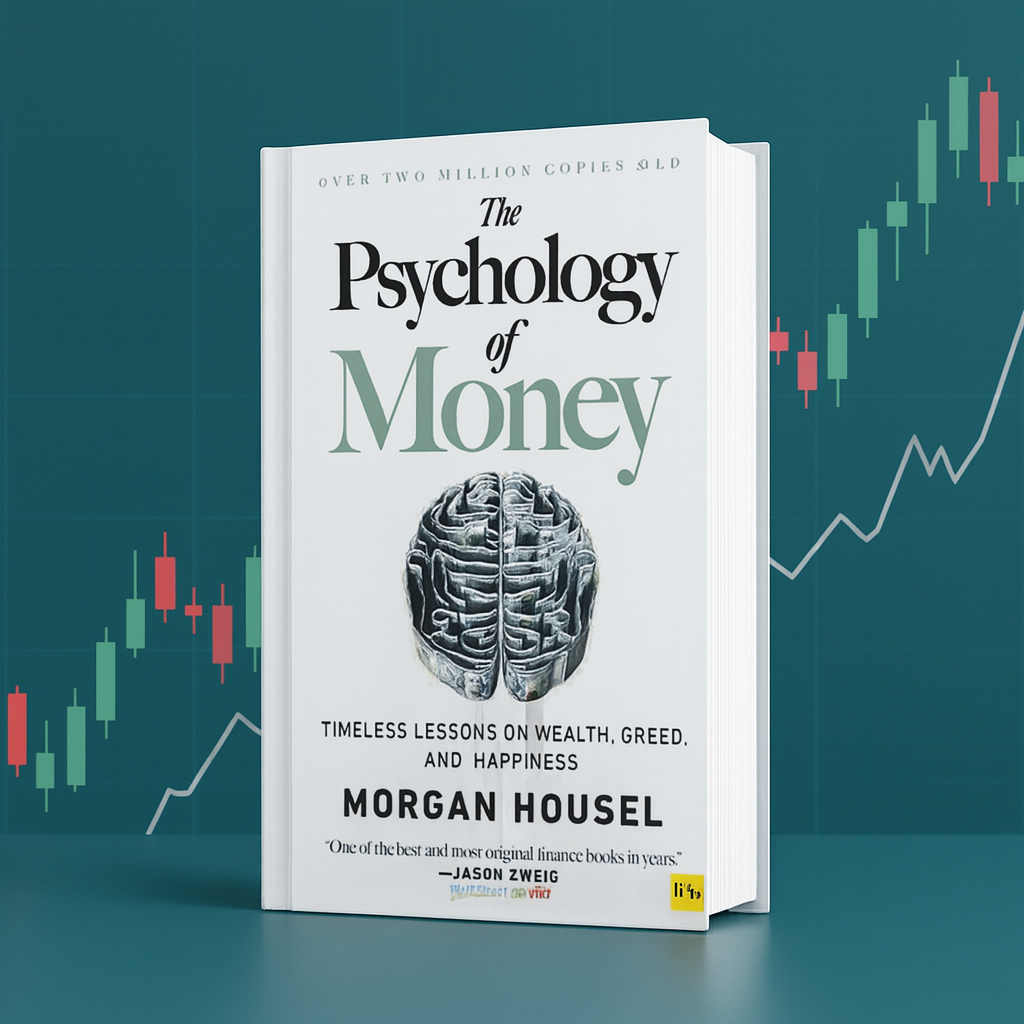
Morgan Housel explains why even smart people make bad money choices and shows how focusing on behavior, risk limits, and knowing what is enough can protect your capital, support steady compounding, and keep trading sustainable over the long term—learn how to apply its rules today.
The Psychology of Money: Timeless Lessons on Wealth, Greed, and Happiness by Morgan Housel is a book about why smart people still make bad decisions with money. Its central claim is simple: success with money has less to do with intelligence and more to do with behavior—habits, emotions, ego, and fear.
For investors and traders today—especially beginners scrolling through social media, tempted by meme stocks, crypto pumps, and “quick 10x” stories—this point is crucial. Your biggest risk is not missing the next hot trade. Your biggest risk is how you react to gains, losses, and uncertainty.
Think of this book less as a guide to picking assets and more as a manual for how to think and feel about money. Before you optimize your strategy or your indicators, Housel is basically asking: can you manage your expectations, your greed, and your fear?
Core Ideas – The Main Lessons in Plain Language
At its heart, the book repeats one idea in many ways: how you behave with money matters more than what you know about money. From that, several key lessons follow.
“No one is crazy” about money
People make financial decisions based on their own experiences. Someone who grew up during a market crash sees risk differently from someone who only lived through bull markets. What looks foolish to you may actually be logical from their point of view.
For traders, this means: don’t assume other market participants are stupid. They just have different histories, goals, and fears. That mindset makes it easier not to take market moves personally.
Luck and risk work together
Good outcomes are never pure skill. Bad outcomes are not always pure stupidity. Luck and risk are the unseen forces behind many financial stories.
For trading, this is a reminder to treat big wins with humility and big losses with calm. After a winning streak, do not assume you are a genius. After a losing streak, do not assume you are hopeless. Ask, “What part of this was skill, and what part was just luck?”
Getting rich vs. staying rich
Housel draws a sharp line between building wealth and keeping it. Getting rich often requires taking some risk and being aggressive at times. Staying rich requires the opposite: caution, redundancy, and the ability to walk away from danger.
For traders, this touches risk management. High leverage and oversized positions might speed up gains, but they also speed up ruin. The long game belongs to the trader who survives.
Compounding is powerful—but fragile
Small gains over long periods beat big gains that end in blow-ups. The magic of compounding only works if you stay in the game.
For a trader or investor, this suggests that steady, controlled growth can be more meaningful than chasing explosive returns. A modest, consistent return that you can repeat for years often beats a wild winning month followed by a crash.
Knowing what is “enough”
One of the most memorable themes is “enough.” If you never decide what “enough” means, you may always chase more—more risk, more leverage, more action—until something breaks.
For traders, “enough” might be a daily profit goal, a monthly growth target, or simply financial security. If you never define it, greed will quietly push you into trades you should not take.
Wealth is what you don’t see
Housel distinguishes between being rich and being wealthy. Rich is visible: fancy cars, luxury brands, impressive vacations. Wealth is invisible: savings, investments, and the freedom not to worry about your next paycheck.
In trading terms, the goal is not to show big profit screenshots. The goal is to build a quiet, growing equity curve that lets you sleep at night.
Reasonable beats perfectly rational
Classical finance expects people to be perfectly rational. Housel argues that “reasonable” is more realistic and more useful. A strategy you can tolerate emotionally is better than a theoretically perfect plan you abandon during a crisis.
For traders, this means: choose systems and risk levels you can stick with through drawdowns, not just when the market is kind.
Strengths – What the Book Does Well
This book stands out in several ways that matter for beginner and casual investors.
Clear, short chapters
The 20 chapters are short and focused. Each one can be read on its own and delivers one key idea. You don’t need a finance degree to follow along. The language is plain, and the stories carry the concepts.
Story-driven, not textbook-style
Instead of equations, Housel uses stories: investors who became rich by accident, people who lost everything late in life, and ordinary savers who did surprisingly well. These stories make the lessons stick. A beginner can say, “I see myself in this,” which is far more powerful than a formula on a whiteboard.
Focus on behavior, not products
The book does not push specific funds, brokers, or asset classes. It focuses on mindset and behavior—topics that apply whether you are buying broad index funds, trading forex, or dabbling in crypto. That makes it feel more timeless and less like a trend-chasing guide.
Warm, human tone
The writing feels calm and humane. Housel doesn’t shame readers for past mistakes. He explains how people naturally fall into traps and then offers gentler, healthier ways to think about money. For new investors, that tone can be the difference between staying engaged and shutting down.
Limitations – What the Book Leaves Out
Even a very good book has blind spots. This one is no exception.
Light on practical “how-to” details
You will not find step-by-step instructions for choosing ETFs, building a portfolio, or designing a trading system. There are no checklists for asset allocation or risk formulas you can plug into a spreadsheet. If you want a technical manual, you will need other books beside this one.
Mostly U.S.-oriented examples
Many of the stories and references assume a U.S. setting, including retirement plans, tax discussions, and historical examples. The core lessons still apply elsewhere, but readers in other countries may need to translate some details to their own systems.
Tends toward conservatism
The repeated praise for “room for error,” caution, and survival is wise, but some readers might interpret it as a warning against taking any meaningful risk. Young investors or traders with a long time horizon still need to take rational, measured risks to grow. The book does not always spell that out.
Limited focus on structural issues
Housel focuses on personal behavior, not on systemic factors like wage inequality, regulatory differences, or the role of institutions. If you are looking for a deep dive into how the financial system itself is structured, this book keeps its scope narrower.
Some repetition of themes
Because each chapter stands alone, ideas like luck, compounding, and “enough” show up more than once. This can be helpful for beginners but may feel repetitive for more advanced readers.
Trader’s Takeaway – Turning Ideas into Action
For a retail trader or beginner investor, the book’s value lies in the rules of thumb it suggests for your real-life behavior. You can translate its lessons into a few practical habits:
- Make survival your first goal.
Set clear risk limits per trade. Avoid using maximum leverage. Design your approach so that a bad week hurts your ego, not your long-term future. - Treat big wins as dangerous moments.
After a strong run, do not increase your risk just because you feel invincible. Consider withdrawing some profits or locking in gains instead. Confidence is good; overconfidence is deadly. - Decide what “enough” means for you.
Choose concrete targets. Maybe it is a certain monthly amount you want your investing to produce, or a long-term capital goal. Use those targets to know when to stop trading for the day instead of chasing more and more. - Think long-term even in short-term markets.
You might trade intraday, but your wealth story is measured in years. Before changing your system after a small drawdown, ask: is this a real flaw or just normal variance? - Pick strategies you can actually live with.
A simple strategy with modest risk that you can follow for years is more valuable than a complex strategy you abandon in fear or boredom. - Protect your attention.
Markets already create enough emotional noise. Social media adds more. Limit your exposure to hype, envy, and “I turned $100 into $10,000” stories. Keep your focus on your process, not other people’s highlights.
If you read the book with a pen in hand, you can turn each chapter into one or two behavioral rules for your trading or investing—little guardrails that keep your emotions from pushing you off the road.
Who Should Read It
This book is especially suited for:
- New traders who feel overwhelmed by charts and terms but want to start from the right mental foundation.
- Casual investors who use index funds, mutual funds, or long-term portfolios and want to understand why staying invested matters.
- Finance students who have studied the math of markets but not the messy human side.
- Experienced traders who know the tools but keep repeating emotional mistakes—overtrading, chasing losses, or abandoning plans during stress.
- Financial coaches or advisors looking for stories and metaphors to explain behavior to clients in simple language.
It is less suitable if you are seeking a detailed playbook for asset selection, derivatives strategies, or advanced portfolio construction. It complements those resources; it doesn’t replace them.
Verdict – A Modern Classic on Money Mindset (Rating: 9/10)
The Psychology of Money earns its place as a modern classic because it focuses on the hardest part of finance: the human mind. It will not tell you what to buy next week. Instead, it will help you build the temperament to handle whatever you end up buying—or selling.
For investors and traders, this is not a complete roadmap, but it is a very strong foundation. As a mindset guide, it is excellent. As a technical manual, it is intentionally limited. As a long-term companion to your financial life, it is deeply valuable.
Rating: 9 out of 10.
If you are at the beginning of your investing or trading journey, read it soon. If you have already lived through a major bull market and a painful drawdown, read it again. The lessons will land differently each time, because your own financial story will have changed—and that is exactly the point of the book.