


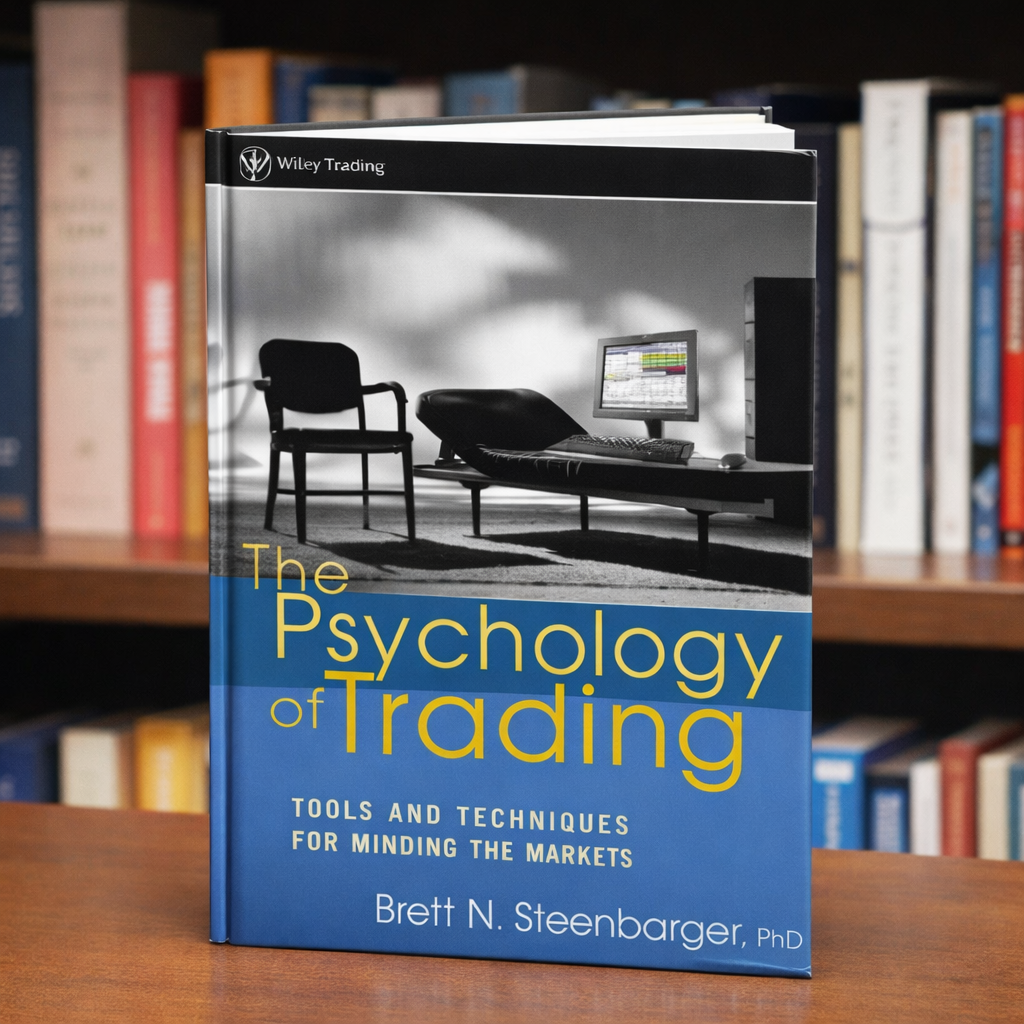
Brett Steenbarger shows how fear, overconfidence, and poor self-control—not bad analysis—cause most trading losses. Drawing on real trader experience, it explains how emotional awareness, structure, and patience improve long-term results. Learn why psychology belongs in every trading system.
The Psychology of Trading by Brett N. Steenbarger is not a book about charts, indicators, or secret strategies. Instead, it focuses on the person behind the screen. Its central idea is simple but often ignored: most trading mistakes are not caused by poor market knowledge, but by human behavior under pressure.
That insight matters more today than ever. Modern markets move fast. Social media amplifies fear and greed. Trading platforms make it easy to overtrade with a single click. In this environment, emotional control is no longer a “nice to have.” It is a core skill.
Steenbarger, a clinical psychologist who has worked closely with professional traders, argues that trading is a performance discipline—closer to elite sports or surgery than to casual investing. Success depends on self-awareness, emotional regulation, and deliberate practice. This book explains why so many traders fail and what separates those who survive from those who burn out.
For beginners and casual investors, the book offers a clear warning: if you do not understand how your mind reacts to risk, the market will teach you—often at a high cost.
Core Ideas: How Psychology Shapes Trading Outcomes
The book builds its argument step by step, almost like a proof.
First, Steenbarger explains that markets trigger strong emotions because money is tied to survival instincts. Wins create excitement and overconfidence. Losses create fear, denial, or revenge trading. These reactions are natural, not signs of weakness. The problem is acting on them without awareness.
Second, he shows how emotions distort decision-making. Under stress, traders narrow their focus. They ignore information that contradicts their position. They exit winners too early and hold losers too long. In other words, they stop following their own rules.
A useful metaphor here is driving in heavy rain. You may know how to drive well, but panic makes you grip the wheel too tightly and overcorrect. Trading under emotional stress works the same way.
Third, the book reframes discipline. Discipline is not willpower alone. It is structure. Traders who succeed design environments that reduce emotional strain: clear rules, position sizing limits, routines, and post-trade reviews. They do not rely on “being strong” in the moment.
Fourth, Steenbarger introduces the idea of trading as self-development. Every trade provides feedback—not just about the market, but about the trader. Patterns of mistakes reveal emotional blind spots. Improvement comes from studying those patterns honestly.
Finally, the book emphasizes that psychological growth is ongoing. There is no final state of emotional mastery. Even professionals struggle. What separates them is how quickly they recognize problems and correct course.
Strengths: What the Book Does Especially Well
One of the book’s greatest strengths is its clarity. Steenbarger avoids heavy academic language, even when discussing psychology. Concepts like anxiety, impulsivity, and reinforcement are explained in plain terms. You do not need a background in psychology to follow the argument.
Another strength is credibility. The book is grounded in real-world experience. Steenbarger draws on case studies from professional traders, hedge funds, and proprietary trading desks. These examples make the lessons feel concrete rather than theoretical.
The book also excels at reframing failure. Losses are not treated as moral failures or signs of low intelligence. They are treated as data. This mindset is especially helpful for beginners, who often quit trading not because they lack skill, but because they internalize losses as personal flaws.
Finally, the book respects the reader. It does not promise easy fixes or “mindset hacks.” Instead, it offers a realistic picture of how hard trading is—and why that difficulty is precisely what makes psychological preparation essential.
Limitations: Where Readers Should Be Careful
Despite its strengths, the book has limits.
First, readers looking for step-by-step trading strategies will not find them here. There are no entry signals or portfolio models. Beginners who expect direct “how to trade” instructions may feel lost if they do not already have a basic market framework.
Second, some examples come from professional trading environments that retail traders cannot fully replicate. Access to mentors, teams, or institutional tools may feel out of reach for solo traders. While the principles still apply, the context can feel distant at times.
Third, the book leans heavily toward active trading. Long-term investors may find fewer direct references to their style, even though the psychological lessons—patience, loss tolerance, overconfidence—are equally relevant.
Lastly, some readers may find the emphasis on self-analysis uncomfortable. The book asks readers to confront their habits honestly. That can be challenging, especially for those who prefer external explanations for losses.
Trader’s Takeaway: What This Means in Practice
For a retail trader or beginner investor, the practical lesson is clear: psychology is not an add-on. It is part of the trading system.
A simple takeaway is to treat emotions as signals, not enemies. Feeling anxious before a trade may indicate oversizing. Feeling euphoric after a win may signal increased risk-taking. The goal is not to eliminate emotions, but to read them correctly.
Another key implication is the value of journaling. Steenbarger strongly supports keeping a trading journal—not just of trades, but of thoughts and emotions. Over time, patterns emerge. Many traders discover they make the same mistake under the same emotional conditions.
Position sizing also becomes a psychological tool, not just a risk metric. Smaller positions reduce emotional noise. Clear stop rules reduce hesitation. Structure protects the trader from themselves.
Perhaps the most important takeaway is patience with oneself. Trading competence develops slowly. Expecting fast mastery creates frustration and reckless behavior. Progress comes from small, consistent improvements.
Who Should Read This Book
This book is well suited for:
- New traders who want to understand why trading feels harder than expected
- Casual investors curious about the emotional side of decision-making
- Finance students looking for a human perspective often missing from textbooks
- Experienced traders struggling with consistency or burnout
It is less suitable for readers seeking purely technical or quantitative instruction without reflection.
Verdict: A Grounded, Honest Guide to the Trader’s Mind
The Psychology of Trading does not promise profits. It promises something more realistic and more valuable: insight into why intelligent, well-prepared people still make costly mistakes in markets.
Brett Steenbarger makes a convincing case that trading success is not just about predicting prices, but about managing oneself under uncertainty. The book’s calm, professional tone and practical wisdom make it accessible without oversimplifying the challenge.
For readers willing to look inward and treat trading as a craft rather than a gamble, this book remains one of the most credible guides available.
Rating: 8.5 out of 10
A thoughtful, enduring work that belongs on the shelf of anyone serious about understanding the human side of investing and trading.