

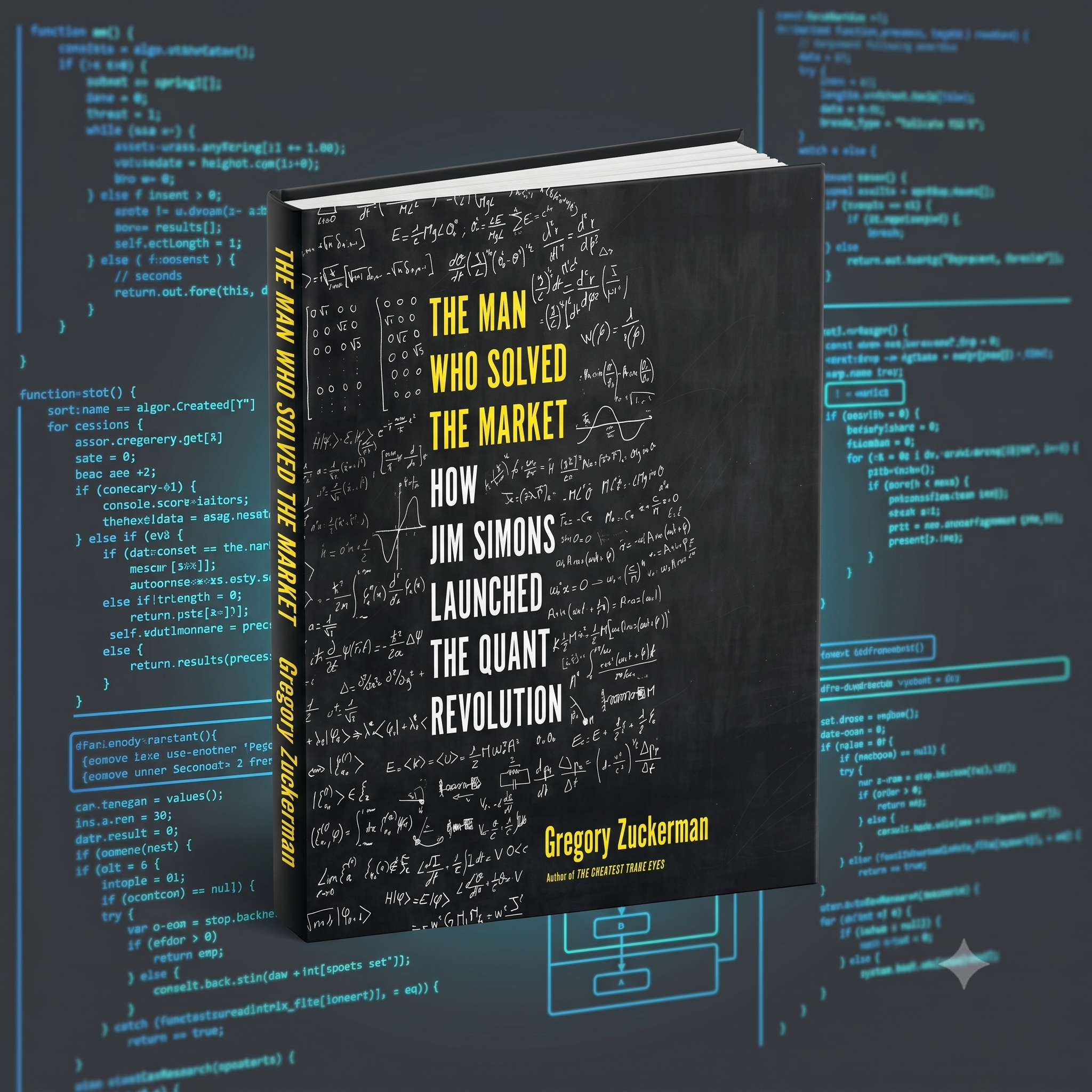
Our review of The Man Who Solved the Market pulls back the curtain on Jim Simons and his legendary Medallion Fund. Discover how algorithmic systems outsmart human emotion and learn why competing against machines on a short-term horizon is a losing battle. Read the full review to see how you can adapt your strategy to survive the modern quantitative revolution.
Imagine a private hedge fund that functions like a literal money machine. Over a thirty-year span, this fund generates average annual returns of roughly 66 percent. Even after charging massive management fees, its net returns beat Warren Buffett, George Soros, and every other investing legend on the planet.
This is not a financial fantasy. It is the real-world track record of the Medallion Fund, managed by Renaissance Technologies.
In The Man Who Solved the Market, veteran Wall Street Journal scribe Gregory Zuckerman pulls back the curtain on the man behind this machine: Jim Simons. Simons was not a financier. He was an award-winning mathematician and former Cold War codebreaker who looked at the stock market and saw a giant, chaotic puzzle waiting to be decoded.
For ordinary investors, Zuckerman’s book is more than a fascinating biography. It is a vital reality check. It explains how the rise of algorithms—computer programs that trade automatically based on mathematical formulas—changed the rules of investing forever. If you want to understand why individual stock picking feels harder than ever today, this book holds the blueprint.
Core Ideas: The Math Behind the Money
To appreciate how Simons “solved” the market, we have to look at the core principles that drove his success. Zuckerman breaks these down into three main ideas that flipped traditional investing on its head.
1. Humans are Flawed; Math is Objective
Traditional investing relies on human judgment. An analyst studies a company’s earnings, visits their factories, and makes a guess about the future. Simons believed this approach was deeply broken. Humans are plagued by fear, greed, and cognitive biases. We see patterns where they do not exist and let emotion dictate our buying and selling.
Simons decided to banish human emotion entirely. He hired physicists, cryptographers, and astronomers—deliberately avoiding Wall Street MBAs. Together, they built computer models to make every single trading decision. The rule was absolute: if the math said buy, they bought, no matter what the human traders felt.
2. Focus on Patterns, Not “Why”
If a stock goes up, standard investors want to know the reason. Did the company launch a new product? Did interest rates drop?
Simons and his team did not care about the “why.” They treated the market as a sequence of numbers. By analyzing decades of historical data, their computers discovered hidden, repetitive patterns. For example, they found that certain stocks consistently dip at 10:15 AM on Tuesdays and recover by noon. These anomalies are often invisible to the human eye, but to a powerful computer, they are predictable goldmines.
3. The Power of Many Small Wins
Many retail traders chase “home runs”—the single tech stock that will jump 500 percent. Renaissance Technologies took the exact opposite route. They played a game of volume and probabilities, much like a casino.
The Medallion Fund did not need to be right all the time. In fact, their models were only right about 51 percent of the time. But by placing millions of tiny trades a day across thousands of global markets, that tiny statistical edge added up to billions of dollars. They won by hitting countless singles, never by swinging for the fences.
Strengths: A Narrative That Unlocks Secrets
Zuckerman’s biggest achievement is his ability to turn a highly technical subject into a gripping, human story.
- Unprecedented Access: Renaissance Technologies is notoriously secretive. Employees sign strict non-disclosure agreements, and the fund’s inner workings are guarded like state secrets. Zuckerman spent years tracking down former staffers, and he even managed to interview Simons himself. The result is an incredibly detailed insider account that reads like a corporate thriller.
- No Jargon Required: You do not need a degree in advanced calculus to enjoy this book. Zuckerman excels at using simple metaphors to explain complex trading strategies. When discussing data collection, he compares it to tracking weather patterns over decades to predict a brief afternoon shower. This approach keeps the book highly engaging for casual readers.
- The Human Cost of Wealth: The book does not just praise the triumphs; it examines the personal toll of this extreme success. Zuckerman explores the fierce internal political battles, the paranoia regarding stolen code, and the tragic personal losses Simons endured. It reminds us that behind the cold, calculating algorithms are real, fragile human beings.
Limitations: What the Book Leaves Out
While The Man Who Solved the Market is a masterpiece of financial journalism, critical readers should keep a few limitations in mind.
- The Specific Recipes Remain Secret: If you are buying this book hoping to find a specific formula to trade your own account, you will be disappointed. Zuckerman explains what the machines did, but he cannot show you the exact code. The secret sauce of the Medallion Fund remains locked inside their server rooms in Long Island.
- Oversimplification of Risk: The narrative occasionally skates over the immense dangers of algorithmic trading. Computers operate on past data. When unprecedented global events happen—such as a sudden pandemic or a political crisis—these models can fail spectacularly. While Zuckerman mentions a few moments where the systems went haywire, he focuses heavily on the victories.
- The “Moneymaking” Bias: Because the book focuses on the most successful fund in history, it can create a bit of a survivor bias. It makes quantitative trading look unbeatable, whereas many firms attempting this same approach have gone completely bankrupt over the years.
Trader’s Takeaway: Lessons for the Little Guy
Can an everyday retail trader replicate Jim Simons? Absolutely not. You do not have a supercomputer network or a team of elite scientists. However, this book provides critical survival lessons for anyone navigating modern markets.
Don’t Fight the Machines on Their Turf: If you are day-trading based on quick chart patterns or short-term news, you are competing directly against algorithms that can execute trades in microseconds. You will lose that battle every single time.
Instead of trying to beat the computers at speed, everyday investors should play the long game. Machines are designed for short-term inefficiencies. They excel at holding assets for minutes or hours. A retail investor’s true edge lies in a long-term horizon—buying quality assets and holding them for years. Time is the one variable that can neutralize a computer’s speed advantage.
Furthermore, Zuckerman’s book reminds us to control our emotional impulses. When the market drops, our instinct is to panic and sell. Setting up simple, automated rules for your own portfolio—like investing a fixed amount every month regardless of market conditions—is a great way to mimic the discipline of Simons’ machines on a modest scale.
Who Should Read This Book?
This book is a versatile read that fits several different audiences:
- Curious Beginners: If you have zero finance background but want to understand how modern Wall Street works, this is an ideal starting point.
- Retail Traders: Anyone actively managing their own stock portfolio needs to read this to understand the invisible forces moving prices behind the scenes.
- Tech and Math Enthusiasts: If you love data science, codebreaking, or history, you will be fascinated by how pure mathematics conquered the world of big money.
The Verdict
The Man Who Solved the Market is an essential addition to any financial library. It bridges the gap between the old world of stock picking and the new world of big data. Gregory Zuckerman delivers a fast-paced, deeply researched story that is as educational as it is entertaining. It strips away the mystique of Wall Street and reveals the market for what it truly is: a complex system governed by probability, discipline, and data.