

A worth-reading methodology text built on genuine empirical research into growth stock leadership, CAN SLIM’s seven-factor framework remains one of the more intellectually honest attempts to systematize momentum investing in plain English. The book’s iron rule — cut every loss at 7–8%, no exceptions, no rationalizations — is the single most valuable sentence in a trading text aimed at retail participants, because it is the one lesson most of them will violate within the first month of live trading. Active retail traders with a basic chart vocabulary should read this before touching a growth name; casual investors who can’t define relative strength should read something easier first, or risk treating a tactical momentum system as a passive wealth-building blueprint it was never designed to be.
Introduction
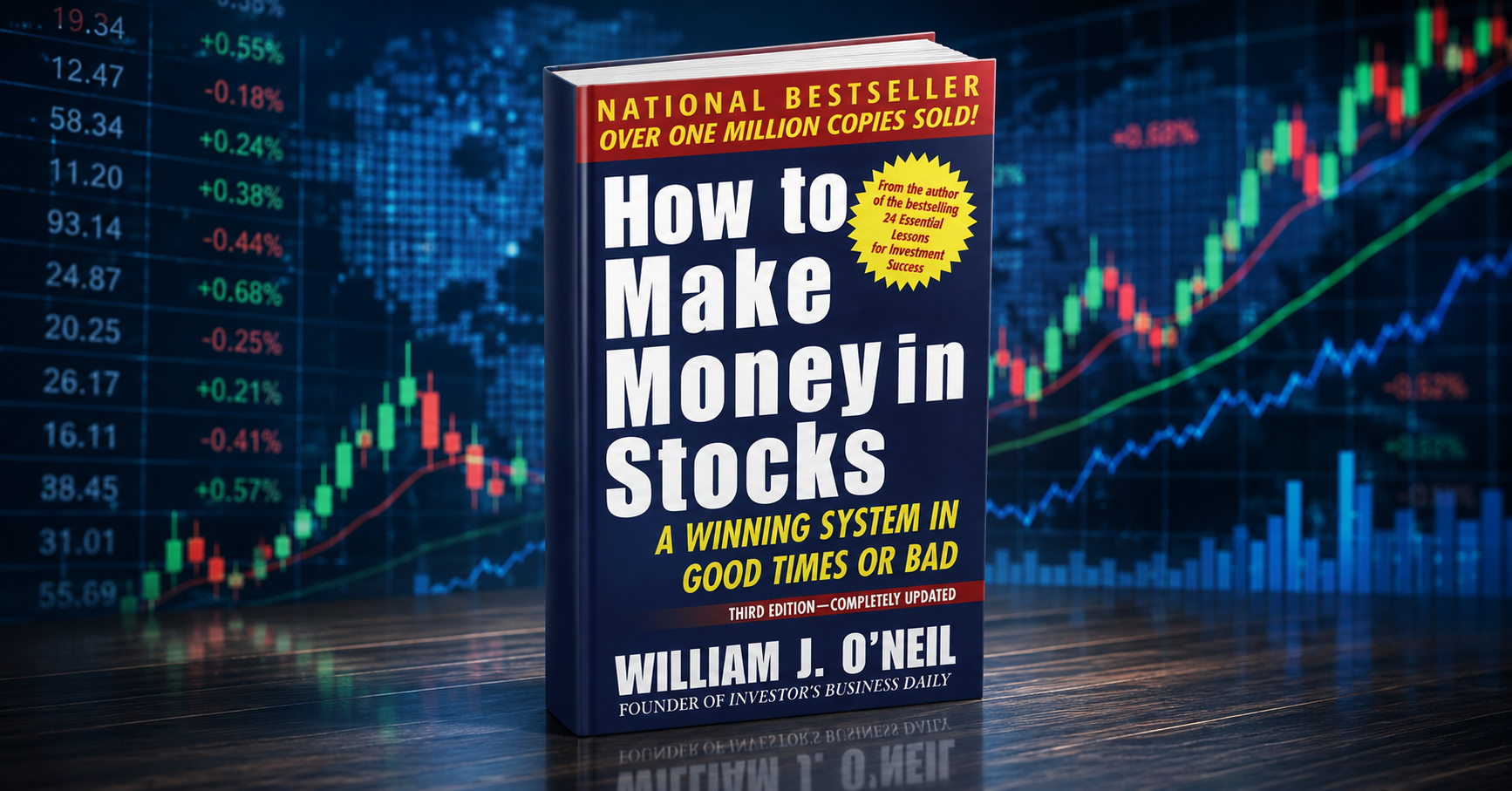
Seven criteria. That is William O’Neil’s entire thesis: find stocks scoring on seven specific fundamental and technical criteria — Current quarterly earnings, Annual earnings growth, New product or service, Supply and demand in shares, Leader in its industry, Institutional sponsorship, and Market direction — and buy them when they break out of a recognizable price base on volume. The system, CAN SLIM, is not complicated. What is complicated is executing it with the discipline O’Neil demands, in a market environment that has grown orders of magnitude more competitive since the book first appeared in 1988.
O’Neil built his fortune the hard way — a genuine 1958 purchase of Dreyfus Fund shares using a system of his own devising, followed by the founding of William O’Neil + Co., the institutional equity research firm that still serves major fund managers. He is not an armchair theorist. He back-tested thousands of historical market leaders to derive the CAN SLIM criteria, a process that predates the academic momentum literature by years. That research pedigree gives the book something most retail trading texts lack entirely: an empirical foundation that is at least partially falsifiable.
But the conflict sitting quietly in the background — O’Neil also founded Investor’s Business Daily, the financial newspaper whose proprietary data, including its Composite Rating, Earnings Per Share Rating, and Relative Strength Rating, are the instruments CAN SLIM traders literally cannot operate without — goes unmentioned throughout. That silence is worth naming before we go any further.
Key Takeaways
- The 7–8% hard stop is the book’s most durable contribution — O’Neil’s insistence on cutting every loss before it compounds is not a preference, it is the arithmetic of long-term survival in trend-following systems.
- Earnings acceleration matters more than earnings level — the distinction between a company earning well and a company whose earnings are growing at an accelerating quarterly rate is the difference between a value stock and a growth leader, and O’Neil makes it clearly.
- Price and volume confirm what fundamentals can only suggest — CAN SLIM explicitly refuses to buy a fundamentally strong stock in a broken chart, a discipline that would have saved retail traders from every great fundamental trap of the last thirty years.
- Market direction is not optional context, it is a primary filter — O’Neil’s insistence on identifying the broader market as in either a confirmed uptrend, correction, or distribution phase before placing any individual trade remains one of the framework’s most underappreciated elements.
- Survivorship bias is embedded in the case study architecture — every historical winner O’Neil profiles cleared the CAN SLIM criteria, but the book provides no base rate data on how many stocks cleared the same criteria and subsequently failed.
Overview
The book’s central argument is that the greatest stock market winners of any era share a set of identifiable characteristics before their major advance — and that a disciplined investor can learn to recognize those characteristics in real time. O’Neil’s back-tested universe covers market leaders from the 1880s through the 2000s, including names like Xerox, Syntex, Price Company, and Home Depot in their formative breakout phases. The data point he returns to repeatedly: the median price-earnings multiple of the greatest market leaders at the time of their initial breakout was approximately 20–25x — far above the market average, and far above where a value-oriented investor would have touched them.
The cup-with-handle base pattern is the book’s signature technical formation: a stock declines, forms a rounded bottom over seven weeks minimum, rallies toward its prior high, then undergoes a brief pullback (the “handle”) before breaking out on high volume. O’Neil argues this pattern reflects the final shakeout of weak holders before institutional accumulation drives a sustained advance. In a live trading environment, this passage rings true because I have watched the false breakout version — no handle, immediate overhead supply — destroy accounts that ignored the distinction.
The Relative Strength Rating, which measures a stock’s price performance against all other stocks in the IBD universe over the prior 52 weeks, is the framework’s most honest innovation. O’Neil specifies that leaders typically carry an RS Rating of 87 or above at breakout, and that buying stocks with RS Ratings below 70 is one of the most common and most expensive errors retail momentum traders make. The irony, of course, is that the RS Rating is a proprietary IBD metric, computed and sold by the company its author founded.
The book’s fourth edition, updated in 2009, adds post-dot-com and post-2008 case studies, which partially address the criticism that CAN SLIM was a creature of the 1990s bull market. O’Neil’s chart examples from the 2003–2007 cycle — including Baidu, Google, and Apple — demonstrate that the base-breakout framework maintained predictive validity well into the era of electronic markets and institutional algorithmic execution.
Writing & Structure
Prose Style
O’Neil writes the way a trader talks: direct, declarative, and faintly impatient with anyone who hasn’t done their homework. There is no literary ambition here, no attempt at narrative arc, and no sympathy for hedging. This is a feature, not a bug. The prose would be unreadable in a novel; as a trading manual, it is exactly what the format demands.
Research Depth
The chart-heavy appendices — hundreds of annotated stock charts illustrating successful and failed base formations — are the book’s single most valuable section and the one most likely to be skipped by anyone reading a Kindle edition. The annotations are dense, occasionally redundant, but represent a genuine attempt to make the pattern-recognition process teachable rather than merely asserted. In a field where most technical analysis books claim their formations are self-evident, O’Neil’s obsessive annotation is actually a methodological virtue.
Narrative Structure
The organizational logic is cumulative rather than sequential — each chapter adds a layer to the CAN SLIM filter rather than building toward a climactic argument. This makes the book easy to re-read selectively and difficult to read narratively. It is a reference text wearing the clothes of a business book, and it works better when treated as the former.
Pacing
Repetition is the book’s principal structural flaw. The 7–8% stop-loss rule is restated with near-identical emphasis in at least six separate chapters, the cup-with-handle description reappears in three, and the warnings against averaging down on losing positions recur so frequently that a reader counting instances could build a solid drinking game around it. Some of this repetition is pedagogically intentional — O’Neil knows that the rules he is articulating are the ones traders will violate, and he is trying to hammer them into long-term memory. The effect, regardless of intent, is a book that could lose 30% of its word count without losing 5% of its intellectual content.
The Trader’s Lens
Central Financial Concepts
- Earnings Per Share acceleration — O’Neil requires minimum 25% quarterly EPS growth in recent quarters, with the most recent quarter showing the strongest growth rate of the sequence.
- Relative Strength Rating — proprietary IBD metric scoring a stock’s 52-week price performance against its peers on a 1–99 scale; O’Neil requires 87+ at the point of breakout entry.
- Institutional sponsorship — the book tracks the number and quality of mutual fund owners, treating fund accumulation as a demand-side confirmation of fundamental quality; the specific threshold is increasing institutional ownership over recent quarters.
- Base patterns and pivot points — cup-with-handle, flat base, double-bottom, and saucer formations with specific depth, duration, and volume profile requirements that define valid breakout entry levels.
- Distribution days — O’Neil’s market-direction filter counts sessions where a major index declines on higher volume than the prior session; four to six distribution days within a rolling five-week window signal institutional selling and trigger a defensive posture across the entire portfolio.
Lessons for Traders
- The loss-cut arithmetic is not optional — a 7% loss requires a 7.5% gain to recover; a 50% loss requires a 100% gain. O’Neil runs this math explicitly, and it is the clearest statement in any retail trading text of why asymmetric downside risk destroys compounding accounts.
- Never average down on a losing position — the 2000–2002 Nasdaq collapse, in which institutional holders of names like Cisco Systems, JDS Uniphase, and WorldCom added to losing positions on the mistaken belief in mean reversion, is the real-world analog O’Neil’s framework would have navigated correctly: the distribution-day count signaled a market top months before the catastrophic drawdown.
- Volume confirms price; price alone is noise — a breakout from a cup-with-handle on below-average volume is a trap; the same price move on 40–50% above-average volume is a signal. This distinction between price action and confirmed price action is underappreciated in the broader retail commentary ecosystem.
- The market always tops before the economy does — O’Neil’s discussion of how market leaders begin to fail and distribution days accumulate six to nine months before a recession becomes visible in economic data remains one of the more practically useful observations in the text for anyone managing equity exposure across a cycle.
Accuracy vs. Narrative Spin
The CAN SLIM back-test is real. O’Neil’s research team did examine thousands of historical market leaders, and the seven criteria do appear with striking frequency in the pre-advance profiles of major winners. What the book conspicuously omits is the false-positive rate — the number of stocks that satisfied CAN SLIM criteria and subsequently failed to advance materially, or declined outright. Without that number, the system’s statistical validity cannot be assessed by the reader. O’Neil presents confirmatory evidence with the confidence of a completed experiment; he is delivering the highlights reel.
In a live trading environment, this omission matters enormously. I have run CAN SLIM screens during mid-cycle markets and found 40 to 60 qualifying setups simultaneously — far more than any single trader can manage, and a signal that the system’s specificity degrades during speculative environments. O’Neil acknowledges that market environment is the primary filter, but the framework’s performance in low-breadth, sector-rotational markets where momentum clusters break down rapidly is not addressed with the same empirical rigor as the bull-market case studies.
The IBD conflict deserves direct treatment. William O’Neil founded Investor’s Business Daily, the publication whose proprietary ratings — EPS Rating, RS Rating, Composite Rating, Accumulation/Distribution Rating — are the precise instruments the CAN SLIM system requires to operate. The book recommends IBD by name as the indispensable data source for the strategy. A reader who follows the methodology as written will become a paying IBD subscriber. O’Neil never acknowledges this commercial alignment. That is not a conspiracy; it is a standard finance-industry structure. But calling it out is basic editorial hygiene, and the absence of any disclosure in four editions of the book is a meaningful omission in a text that otherwise presents itself as objective research.
Psychology & Culture
O’Neil’s deepest psychological contribution is also his least celebrated: the insistence that the market is always right and the trader’s opinion is always irrelevant. This sounds obvious. It is not. The entire architecture of retail trading psychology — the need to be right, the reluctance to realize a loss, the conviction that a beaten-down stock must recover — runs directly counter to what CAN SLIM demands. O’Neil is not selling a system for generating returns. He is selling a system for dismantling the ego structures that make consistent trading impossible.
The book’s implicit cultural critique is sharper than it appears. CAN SLIM was developed in the era of open-outcry markets, telephone order entry, and hand-drawn charts — a world in which information asymmetry between institutional and retail investors was so vast that most individual traders were essentially operating blind. O’Neil’s system was, in that context, a genuine attempt to give retail participants a structured, rules-based process that could compete with institutional research. The irony of the current moment is that the information gap has narrowed dramatically while the execution gap has widened catastrophically — algorithmic market makers and high-frequency traders now front-run breakouts in milliseconds, and the cup-with-handle setup that O’Neil documented in 1988 is now one of the most heavily scanned patterns in quantitative equity strategies.
Trader Insight
O’Neil’s most unsettling observation is buried in his chapter on selling: most retail traders do not fail because they cannot identify winning stocks — they fail because they cannot bring themselves to sell losing ones. The asymmetry is not intellectual but psychological. CAN SLIM’s loss-cutting rule is not a risk management technique; it is a behavioral intervention targeting the specific cognitive bias — loss aversion, reframed as “patience” — that the market punishes most severely and most consistently across every cycle, every decade, and every era of trading technology.
Reader Fit
- Retail traders — the primary audience, and the one that will extract the most directly applicable material; anyone actively trading individual equities without a defined entry and exit framework should read this before placing another order, if only to understand what a complete system looks like versus a collection of half-formed intuitions.
- Finance and economics students — CAN SLIM is a useful pre-academic articulation of momentum factor investing that predates the Jegadeesh and Titman momentum literature by years; students studying factor premia and systematic equity strategies will find O’Neil’s practitioner approach a useful complement to academic papers, even where his empirical methodology falls short of peer-review standards.
- Wall Street insiders — limited incremental value for institutional equity researchers who already operate with proprietary screening tools and dedicated quant teams; the framework is historically interesting and the loss-discipline sections are perennially relevant, but the operational infrastructure CAN SLIM assumes is already embedded in any serious growth equity process.
- General readers — largely unsuitable; CAN SLIM requires active monitoring, chart literacy, and a willingness to sell at a loss that is psychologically incompatible with passive investing habits, and a general reader who takes O’Neil at face value without understanding the system’s execution demands will almost certainly misapply it.
Verdict
Final Score: 7/10
Composite Score
| Category | Score (/10) | Weight | Weighted | Bar |
|---|---|---|---|---|
| Financial Accuracy | 7/10 | 30% | 2.10 | |
| Writing & Clarity | 6/10 | 20% | 1.20 | |
| Trader Psychology | 8/10 | 20% | 1.60 | |
| Educational Value | 8/10 | 20% | 1.60 | |
| Lasting Relevance | 7/10 | 10% | 0.70 | |
| Composite Total | 7.20 | |||