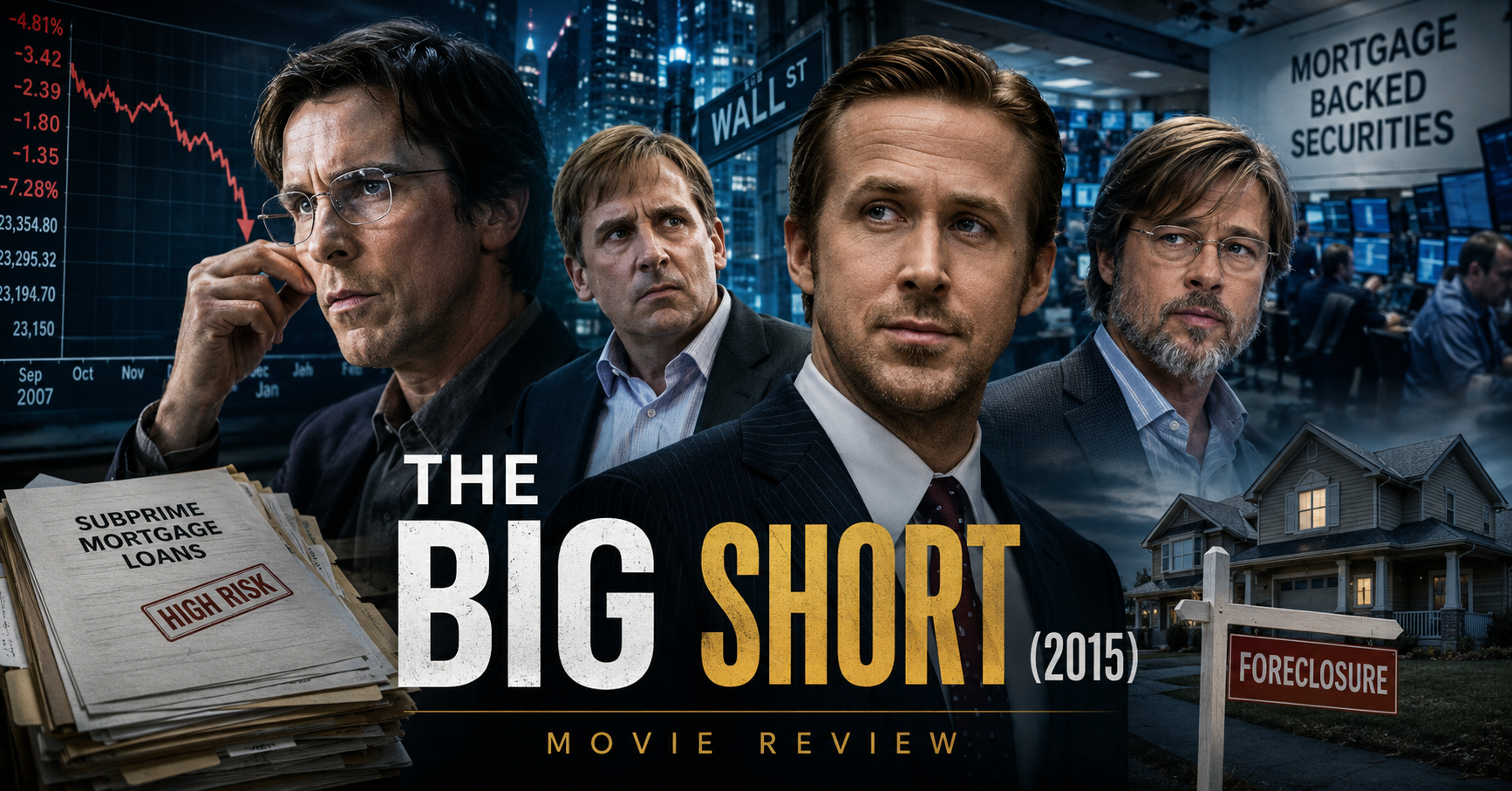
The Big Short earns a 9/10 Trader Score by doing something almost no financial film manages: it models the credit default swap and synthetic CDO trade correctly, down to the counterparty risk that nearly killed the winning bet. The lesson isn’t that these four saw the crash coming — it’s that being right early nearly bankrupted every one of them anyway. Watch it as a case study in position sizing under institutional pressure, not just a morality tale.
Introduction
The Big Short is the rare Wall Street film that survives a line-by-line audit. Most trading movies get the adrenaline right and the arithmetic wrong; this one inverts the formula, and it’s better for it.
Adam McKay took Michael Lewis’s dense nonfiction account of the 2008 mortgage collapse and did the unthinkable — he made credit default swaps and synthetic CDOs comprehensible to an audience that had never opened a Bloomberg terminal. In a live trading environment, this rings true because the hardest part of any derivatives desk isn’t the trade, it’s explaining the trade to the risk committee before they cut your line.
The film follows four separate parties — Michael Burry, Mark Baum, Jared Vennett, and the Cornwall Capital duo — who each independently arrive at the same short thesis against subprime mortgage bonds, years before the rest of the market catches on.
Key Takeaways
- Being early is a cost center. Burry’s fund bled negative carry on his swap premiums for nearly two years before the thesis paid off — correct positioning without correct timing is just an expensive opinion.
- Ratings agencies were paid by the entities they rated. That single conflict of interest, more than any individual trader’s greed, is the structural root of the crisis.
- Liquidity evaporates exactly when you need it. The synthetic CDO market had no real secondary market, meaning even a correct short could get marked against you by a counterparty with every incentive to stall.
- Complexity is a business model. Tranching mortgage risk into AAA-rated slices wasn’t really about risk management — it was about generating fee income at every layer of repackaging.
- Nobody at the top wanted to hear it. The film’s real villain isn’t fraud in the legal sense — it’s willful institutional blindness dressed up as due diligence.
Synopsis
In 2005, hedge fund manager Michael Burry runs the numbers on subprime mortgage bonds and concludes the housing market is built on defaulting loans dressed up as investment-grade paper. Since no instrument exists to bet against these bonds directly, he pushes Wall Street banks to invent one — the credit default swap on mortgage bonds — essentially paying an insurance premium that pays out enormous multiples if the underlying mortgages fail.
Trader Jared Vennett stumbles onto the same thesis and pitches it to hedge fund manager Mark Baum, whose team does field research — literally driving to Florida subdivisions — and discovers the loans behind these bonds are being issued to borrowers with no verifiable income. Meanwhile two junior investors, working out of a garage-fund called Cornwall Capital, find the same trade and use retired banker Ben Rickert to get access to the same swap market the big institutions control.
All four parties place their bets and then spend the film’s back half in the worst part of any trade: waiting, while the market keeps rising against them and their counterparties mark the swaps to a price that keeps the losing side happy. When the bonds finally default in 2008, the payout arrives — but not before genuine funding risk nearly forces several of them to liquidate the position before it turns profitable.
Cinematic Qualities
Performances
Christian Bale’s Michael Burry is the standout — a socially awkward, glass-eyed fund manager who trusts a spreadsheet over a room full of skeptics, played with just enough tic to be memorable without becoming caricature. Steve Carell’s Mark Baum channels genuine moral disgust at an industry he still profits from, which is a more honest performance than most finance films attempt.
Direction
McKay’s fourth-wall breaks — Margot Robbie in a bubble bath, Anthony Bourdain explaining CDOs via a seafood stew analogy, Selena Gomez at a blackjack table — could have been gimmicks. Instead they function as legitimate pedagogy, translating instruments most retail viewers have never encountered into digestible metaphor without materially distorting the mechanics.
Production Design
The trading floors, glowing monochrome Bloomberg terminals, and 2005-era flip phones read as almost quaint now, but the film wisely doesn’t lean on nostalgia — the technology dates, the greed doesn’t.
The Trader’s Lens
Central Financial Concepts
- Credit Default Swaps (CDS): insurance-like contracts that pay out if an underlying bond defaults, used here to bet against mortgage bonds without owning them.
- Collateralized Debt Obligations (CDOs): pools of mortgage debt sliced into tranches and rated by perceived seniority of repayment.
- Synthetic CDOs: CDOs built not from actual mortgages but from CDS contracts referencing other CDOs — leverage on top of leverage.
- Tranche risk: the false assumption that slicing a bad asset into rated layers changes its underlying default probability.
- Counterparty and mark-to-market risk: the danger that your position can be correct and still get margin-called into oblivion before the payoff materializes.
Lessons for Traders
- Conviction without liquidity is a liability. Burry’s investors tried to pull capital while he was still right, echoing every fund manager who’s ever had to defend a drawdown before vindication.
- Position sizing has to survive being early, not just being right — a lesson every trader who’s ever shorted a bubble on the correct thesis but the wrong week has learned the hard way.
- Rating agency reliance is outsourced due diligence, and outsourced due diligence is how AAA-rated paper backed by no-income, no-job, no-asset loans made it onto pension fund balance sheets.
- This is a direct historical analog to the 1998 LTCM collapse: correct models, wrong assumptions about correlation and liquidity under stress, same result.
Accuracy vs. Dramatization
In a live trading environment, the film’s depiction of margin pressure on a winning-but-unrealized short position is dead accurate — I’ve watched correct theses get killed by exactly this kind of mark-to-market squeeze. The instruments, the tranching mechanics, and the ratings-agency conflicts are represented with real fidelity, which is more than can be said for most Hollywood finance.
Where the film takes license is in compressing years of due diligence into montage and giving Cornwall Capital’s Ben Rickert a moralizing monologue about celebrating a bet that pays out via national economic collapse. It’s worth noting: the film never lets its protagonists off the hook as heroes — profiting from the crash is treated as its own uncomfortable ethical compromise, not a redemption arc, which is more honest than most finance cinema manages.
Psychology & Culture
What the film captures better than almost any of its peers is the specific psychological toll of conviction that the entire market disagrees with. Burry’s investors don’t doubt his math so much as they can’t tolerate the discomfort of being contrarian while losing money on paper, month after month.
That’s not a character flaw unique to 2005 — it’s the standard operating pressure on anyone holding a position the consensus hates. The firms selling these mortgage bonds weren’t run by cartoonish villains; they were staffed by people whose entire compensation structure rewarded not asking the one question that mattered.
Trader Insight
The most unsettling psychological truth in the film is that nobody in the ratings agencies or the banks needed to be malicious — they just needed a bonus structure that made ignorance more profitable than diligence. That’s a more durable failure mode than fraud, because it doesn’t require anyone to believe they’re doing anything wrong.
Audience Fit
- Retail traders: essential viewing for understanding how illiquid, opaque instruments can turn a correct thesis into a forced liquidation before the payoff.
- Finance and economics students: one of the few mainstream films that teaches derivative structuring without dumbing it down into nonsense — pair with the Lewis book for the footnotes.
- Wall Street insiders: will recognize the culture beats immediately, though some may find the film’s moral disgust at the industry a little rich given who profits at the end.
- General audiences: the celebrity-cameo explainers do real work here, but even they can’t fully flatten the density of tranche mechanics in the middle act — expect to rewind once or twice.
Verdict
Final Score: 9/10
Composite Score Table
| Category | Score (/10) | Weight | Weighted | Bar |
|---|---|---|---|---|
| Financial Accuracy | 9/10 | 35% | 3.15 | |
| Cinematic Quality | 9/10 | 20% | 1.80 | |
| Trader Psychology | 10/10 | 25% | 2.50 | |
| Educational Value | 9/10 | 15% | 1.35 | |
| Rewatchability | 8/10 | 5% | 0.40 | |
| Composite Weighted Total | 9.20 / 10 | |||
Frequently Asked Questions
Yes, unusually so. The mechanics of credit default swaps, mortgage tranches, and synthetic CDOs are represented with real precision, and the film’s biggest liberties are in character composites and timeline compression rather than the underlying financial instruments.
Absolutely — it’s one of the few mainstream films that teaches derivative structuring correctly. Pair it with the original Michael Lewis book for the footnotes Hollywood couldn’t fit into two hours.
The film is based on Michael Lewis’s 2010 nonfiction book “The Big Short: Inside the Doomsday Machine,” which follows the handful of traders and investors who bet against the U.S. housing market before the 2008 collapse.
Being right early is functionally indistinguishable from being wrong. Michael Burry’s thesis was correct for nearly two years before the market agreed with him, and the margin calls almost broke him before the payoff arrived.