

Our Against the Gods book review details Peter Bernstein’s exploration of risk management history. Discover how the shift from fate to probability built modern financial markets and why understanding uncertainty is essential for long-term survival. See how this classic helps investors build a stronger psychological foundation for better trading decisions.
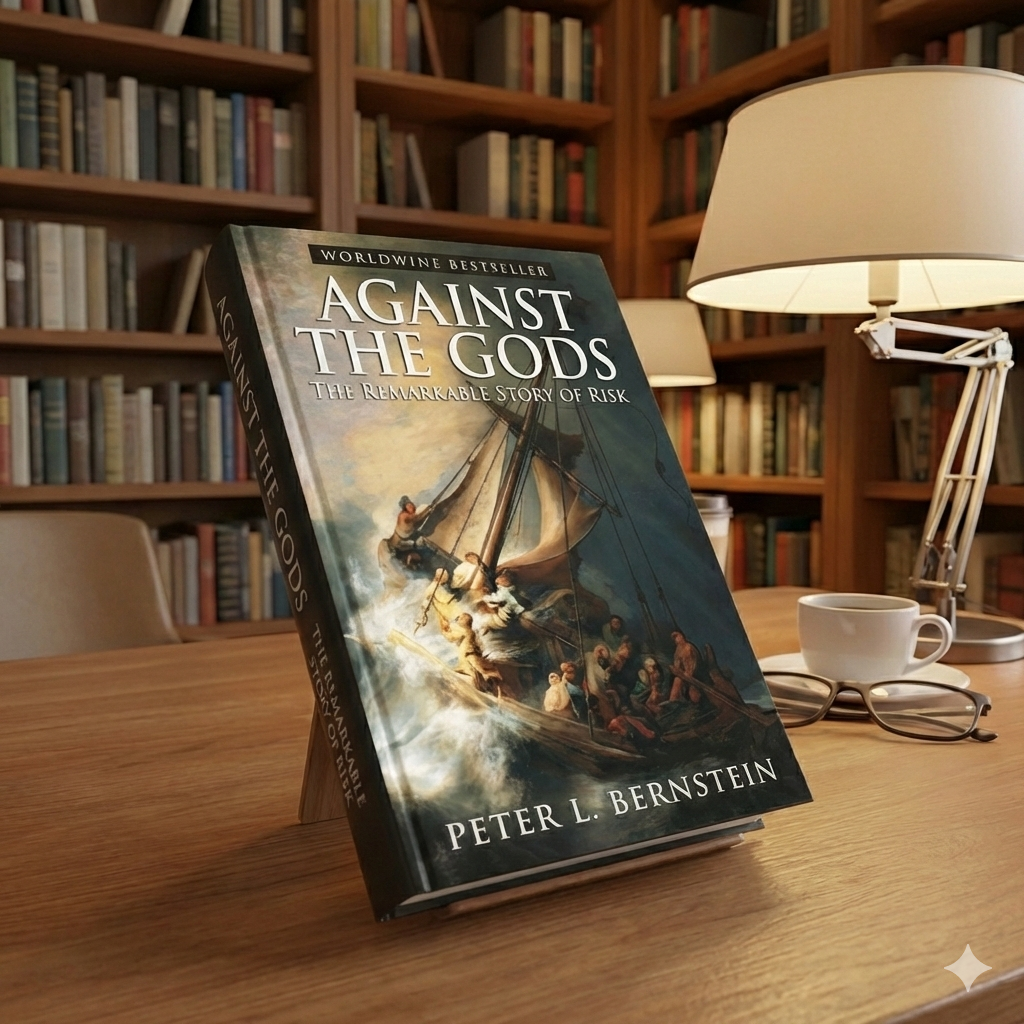
Against the Gods: The Remarkable Story of Risk by Peter L. Bernstein is not a book about stock picking, trading systems, or market forecasts. It is something more fundamental. It asks a deeper question: How did humans learn to think about uncertainty—and why does that matter for money today?
Bernstein’s central theme is simple but powerful. Modern finance exists because people learned to measure risk instead of fearing it blindly. Once risk became something that could be studied, priced, and managed, investing became possible on a large scale. Without this shift, markets as we know them would not exist.
For today’s investors and traders—especially beginners—this book offers a rare gift. It explains why markets behave the way they do, rather than telling you what to buy. In an age filled with charts, indicators, and confident predictions, Against the Gods teaches humility. It reminds readers that uncertainty is not a flaw in markets. It is the market.
Core Ideas: How Humans Learned to Live With Uncertainty
Bernstein organizes the book like a long historical journey. Each step builds on the last, much like a mathematical proof.
Risk Was Once Seen as Fate
For most of history, people believed that the future was controlled by gods, luck, or destiny. Storms, plagues, and financial ruin were seen as acts of fate. There was little reason to plan, calculate, or hedge. If something bad happened, it was simply meant to be.
This mindset made long-term investing impossible. You cannot price risk if you believe outcomes are random acts of divine will.
The Birth of Probability Changed Everything
The turning point came in the 17th century, when mathematicians began studying games of chance. Dice, cards, and gambling problems led to the first probability theories.
This was revolutionary. For the first time, people realized that uncertainty followed patterns. Even if you could not predict a single outcome, you could estimate ranges and likelihoods.
Bernstein shows how this idea quietly reshaped the world. Insurance, pensions, loans, and eventually financial markets all depend on probability. Without it, modern investing would collapse.
Risk Became Something to Manage, Not Avoid
As probability theory matured, risk stopped being something to run from. It became something to manage.
Bernstein connects this shift to the rise of capitalism, entrepreneurship, and financial innovation. Investors began demanding compensation for taking risk. Higher risk required higher reward. This simple idea underlies everything from bond yields to equity returns.
The key insight here is subtle but important: risk is not danger—it is variability. Loss is one possible outcome, but not the only one.
Confidence Can Be Dangerous
One of the book’s most important lessons is that knowledge can breed overconfidence. As models became more complex, many investors began to believe risk could be controlled completely.
Bernstein repeatedly returns to financial crises to show the limits of human understanding. From speculative bubbles to market crashes, the same pattern appears: people mistake estimates for certainties.
Risk can be measured, but it cannot be eliminated.
Strengths: Why the Book Endures
Clear Thinking Without Jargon
Bernstein writes with clarity and restraint. He avoids heavy formulas and technical language. Instead, he explains ideas through stories, historical figures, and real-world examples.
This makes the book accessible to readers without a finance background, while still offering depth for experienced investors.
A Long-Term Perspective
Most investing books focus on short-term tactics. Against the Gods takes the opposite approach. It stretches across centuries, showing how ideas evolved slowly and often painfully.
This long view helps readers avoid common traps, such as believing that today’s market environment is unique or permanent.
Intellectual Honesty
Bernstein does not pretend that risk models are perfect. He openly discusses their failures. This honesty builds trust and reinforces one of the book’s core messages: humility matters in finance.
Limitations: What Readers Should Keep in Mind
Not a Practical How-To Guide
Readers looking for step-by-step trading strategies or portfolio rules will not find them here. The book is conceptual, not tactical.
This is not a flaw, but it is a limitation. Readers should see it as a foundation, not a manual.
Historical Distance From Modern Markets
The book was published before high-frequency trading, crypto markets, and algorithmic strategies became mainstream. While the principles still apply, readers must translate them into today’s context.
For example, risk models are now faster and more complex, but they still rely on assumptions that can break during stress.
Trader’s Takeaway: Lessons for Investors and Beginners
For traders and retail investors, Against the Gods offers several practical lessons—even without giving trading rules.
Uncertainty Is Normal
Markets are not broken when outcomes surprise you. Surprise is built into the system. Expecting certainty leads to poor decisions.
Think of risk like weather forecasts. A 70% chance of rain does not guarantee rain, but ignoring the forecast is still unwise.
Models Are Tools, Not Truth
Indicators, backtests, and risk metrics are helpful—but they are not reality. They are simplified maps.
As the saying goes, “The map is not the territory.” Traders who forget this often size positions too aggressively or trust historical data too much.
Survival Comes Before Returns
Bernstein’s history shows that markets reward those who stay in the game. Many brilliant investors failed not because they were wrong once, but because they could not survive volatility.
For beginners, this means managing position size, leverage, and expectations. A smaller gain that keeps you trading is better than a large risk that wipes you out.
Risk Is the Price of Opportunity
Every return comes with uncertainty. There is no free lunch. Once you accept this, investing becomes calmer and more rational.
Who Should Read This Book
This book is especially suited for:
- Beginner investors who want to understand markets without technical overload
- Retail traders seeking better risk awareness rather than new indicators
- Finance students looking for context beyond textbooks
- Experienced investors who value history and first principles
Those seeking quick profits or mechanical strategies may find it slow. Curious thinkers will find it rewarding.
Verdict: A Classic Worth Your Time
Against the Gods is not exciting in the way market news is exciting. It does not promise fast gains or secret formulas. Instead, it offers something rarer: clarity about how uncertainty works—and why respecting it matters.
In a financial world obsessed with prediction, Bernstein reminds us that risk is not a problem to solve, but a reality to understand.
For anyone serious about investing or trading, this book belongs on the short list of essential reading.
Rating: 9 out of 10
It is not a trading guide—but it may quietly improve every trading decision you make afterward.