
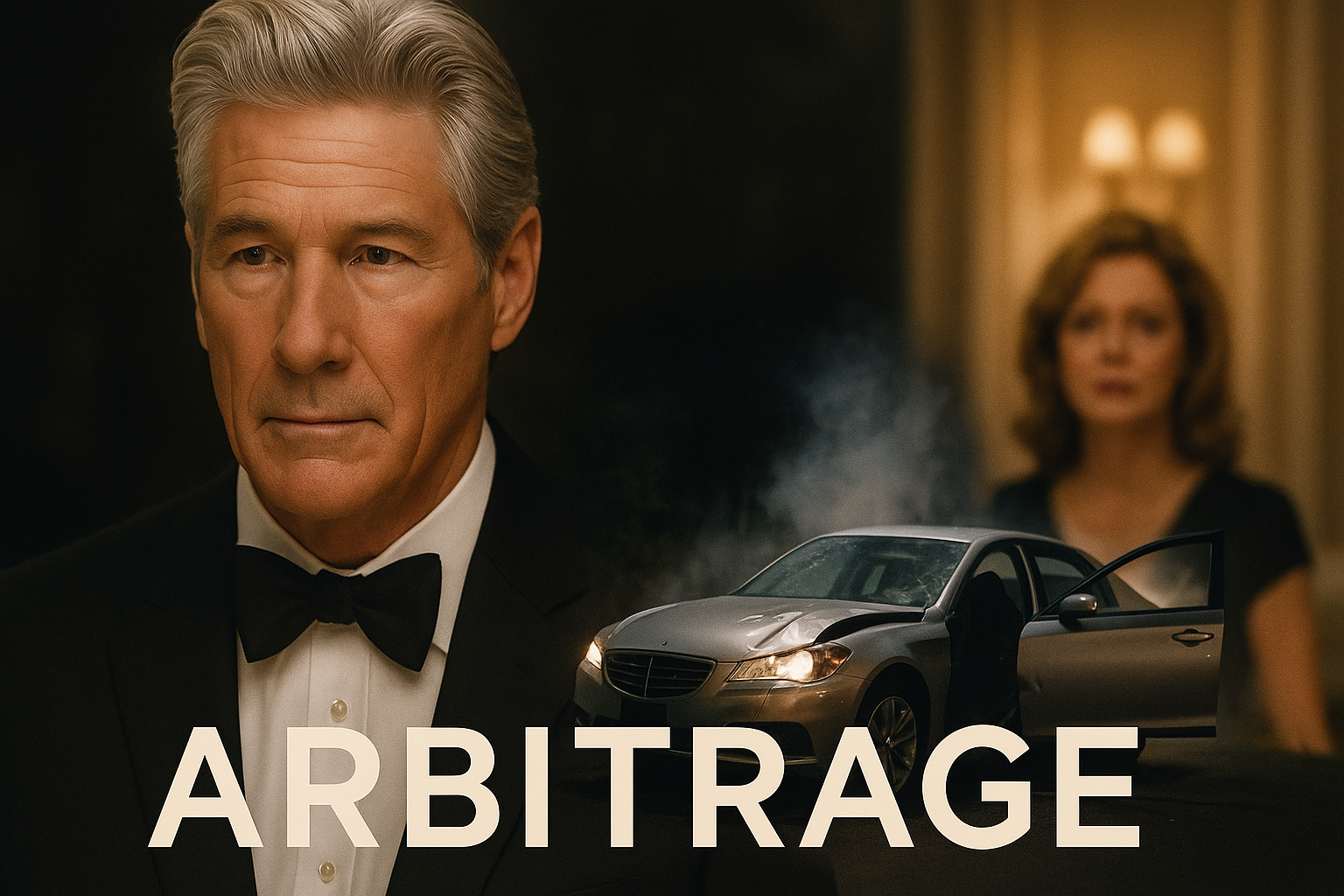
Arbitrage movie review examines Robert Miller’s hidden losses, off-books leverage, and moral compromises, showing how governance, incentives, and character risk shape real-world finance; use this breakdown to sharpen your due diligence and see how calm markets can hide structural danger.
Nicholas Jarecki’s Arbitrage follows Robert Miller (Richard Gere), a sixty-year-old New York hedge fund titan on the brink of a lucrative exit. Publicly, he is the polished patriarch of a successful family firm; privately, he’s sitting on a time bomb of his own making.
Miller has papered over a catastrophic investment loss by borrowing $412 million off-books from a business associate, effectively committing financial-statement fraud to keep his fund’s reported performance intact while he races to sell the firm to a major bank. The sale must close before auditors, regulators, or his own daughter and COO, Brooke (Brit Marling), discover the gap between the numbers and reality.
The plot pivots when Miller, driving late at night with his French art-dealer mistress Julie (Laetitia Casta), dozes off and crashes the car. Julie is killed; Miller, injured but mobile, flees the scene to avoid scandal and criminal charges. He calls Jimmy Grant (Nate Parker), the son of a former employee from a rough neighborhood, to pick him up and help him disappear from the accident site.
From there, Arbitrage runs on two parallel tracks of risk:
- Financial risk: holding together a fraudulent balance sheet long enough to close a nine-figure sale.
- Legal and reputational risk: evading a hit-and-run investigation led by dogged Detective Bryer (Tim Roth), who’s convinced Miller is guilty even when the evidence is thin.
Brooke gradually uncovers the accounting irregularities and realizes her father has falsified the books. His wife Ellen (Susan Sarandon) eventually discovers the accident coverup and uses this leverage to negotiate a brutal separation agreement that shifts control of the family wealth to her charitable foundation and their daughter.
By the final scene, the sale is complete, Miller has escaped prosecution, Jimmy has narrowly avoided prison, and the buyer quietly chooses to ignore a late-discovered problem in Miller’s books to protect his own institution. Miller walks to the podium at a black-tie banquet honoring him as a paragon of success. The screen cuts to black before he speaks, leaving the audience alone with the dissonance between what we know and what the world chooses to celebrate.
Cinematic Qualities
Arbitrage is tightly constructed, almost novelistic in its focus. At 107 minutes, it wastes little screen time. Jarecki directs with restraint; there are no flashy trading floor montages or market-crash CGI sequences. Most of the drama unfolds in offices, town cars, and quiet rooms where deals are made and lives are traded away.
Richard Gere anchors the film with one of his most nuanced performances. His Miller is not a caricatured Wall Street villain but a highly functional sociopath: warm, articulate, generous when it suits him, and relentlessly pragmatic when cornered. The charm feels lived-in, not cosmetic, which makes his rationalizations more unsettling. Critics widely praised Gere’s work here, and he received a Golden Globe nomination for Best Actor in a Drama.
The supporting cast is similarly precise. Marling’s Brooke is the conscience of the firm, an operator who understands both the numbers and the reputational stakes. Sarandon plays Ellen not as a passive spouse but as a hard realist who understands exactly how power and money function in their world. Tim Roth’s Bryer, with his Queens accent and cynical edge, introduces a procedural counterweight — law enforcement as another political actor, not an untainted force.
Visually, the film contrasts warm, golden interiors of wealth with cooler, harsher palettes in police stations and working-class neighborhoods. The cinematography and score are understated but effective; this is a drama built on faces, conversations, and small shifts in power rather than spectacle.
If there is a flaw, it lies in pacing around the middle act, where the legal maneuvering and repeated interrogations slightly overstay their welcome. But overall, the film maintains tension by tightening the net around Miller — not through chase scenes, but through audit deadlines, subpoenas, and the ticking clock of a pending deal.
Trader’s Lens
Core Financial Concepts
At its heart, Arbitrage is about financial statement fraud, liquidity risk, and the misuse of leverage and relationships rather than about trading strategy. Miller’s fraud is essentially a temporary, undisclosed capital injection meant to conceal realized losses and keep his fund’s track record intact long enough to close a sale.
The key concepts on screen include:
- Window dressing & financial-statement fraud: Miller’s off-books $412 million loan is a textbook example of manipulating reported capital and returns to mislead investors and counterparties.
- Audit and deal risk: The tension around the external audit and the buyer’s due diligence mirrors real-world pressures in M&A — where timing, information asymmetry, and accounting judgment calls can shift billions in value.
- Counterparty incentives: The buyer’s eventual decision to “look away” from irregularities to avoid damaging his own institution is depressingly realistic in a world where reputational contagion can be more dangerous than the underlying loss.
Despite its title, the film is not about textbook arbitrage — riskless profit from price discrepancies — but about arbitraging information and accountability: using private knowledge, personal networks, and time to shift risk onto others before the truth is priced in.
Lessons for Traders
- Risk doesn’t disappear — it moves.
Miller doesn’t eliminate the investment loss; he hides it. The risk is transferred from his personal P&L to his investors, the acquiring bank, and ultimately the broader system of trust that underpins capital markets. For traders, the message is clear: unresolved losses and hidden exposures tend to resurface at the worst possible moment. - Leverage plus secrecy is lethal.
The off-books loan is an extreme form of leverage: borrowed cash with no transparency and a hard deadline attached. When combined with opaque reporting, this resembles the dynamics seen in real-world frauds and Ponzi-like arrangements, where new money props up old promises until the flow stops. - Process is part of risk management.
Brooke’s discovery of discrepancies in old ledgers — and her insistence on understanding them — shows how robust internal controls and skeptical inquiry can surface issues early. Her father’s response, to block and obfuscate, is the classic cultural failure that often precedes crisis. - Moral hazard thrives when downside is socialized.
Miller’s calculation is simple: if he gets away with it, he exits rich and revered; if he fails, investors and employees bear most of the damage. That asymmetry is a recurring pathology in financial crises — from mispriced structured products to aggressive risk-taking on other people’s capital. - Character risk is real risk.
The same personality traits that make Miller a successful dealmaker — charm, confidence, comfort with ambiguity — also enable deceit. For allocators and counterparties, the film is a reminder that governance, culture, and integrity are as important as Sharpe ratios.
Accuracy vs. Dramatization
For a mainstream thriller, Arbitrage is unusually grounded in plausible financial mechanics. The notion of a fund manager fabricating returns, leaning on a friendly lender, and shopping a sale before the gap is exposed tracks with patterns documented in real cases of hedge-fund fraud and Ponzi-style schemes.
Where the film leans into dramatization is in the convergence of corporate fraud, a fatal car accident, and a homicide investigation — a narrative stack that compresses multiple forms of risk into a single character’s arc. The speed at which the buyer overlooks a secondary audit report, and the neatness with which Miller’s legal exposure is neutralized via technicalities and leverage, are somewhat streamlined for storytelling. In real life, litigation, regulatory processes, and civil claims would likely drag on for years.
Still, the emotional truth feels right: sophisticated actors often negotiate outcomes in opaque backrooms, and legal “victory” can coexist with profound ethical failure.
Psychology & Culture
Arbitrage excels at portraying the mentality of high-finance elites without turning them into cartoon villains. Miller doesn’t see himself as a crook; he sees himself as a steward of capital who had a bad bet and is doing what’s “necessary” to protect employees and investors.
His justifications are familiar to anyone who has watched post-crisis testimony or read accounts of major frauds:
- “If I can just get through this transaction, everything will be fine.”
- “My investors depend on me; the ends justify the means.”
- “Everyone bends the rules at this level.”
The film carefully shows how systems enable individuals:
- Lawyers focus on procedural wins rather than justice.
- Bankers prioritize deal closure and reputational management over full accountability.
- Family members negotiate financial terms rather than moral reckoning.
Jimmy’s storyline adds a class and race dimension. He is pulled into elite fraud as a disposable asset — a working-class Black man asked to risk his freedom to protect a billionaire. Detective Bryer’s interest in Miller is partly prosecutorial zeal and partly resentment toward a system that rarely punishes men like Miller at all, let alone proportionally.
Psychologically, the film is a study in compartmentalization. Miller moves from funeral to boardroom, from crisis meeting to birthday party, with professional calm. That emotional bifurcation — the ability to separate personal guilt from professional focus — is both a survival skill in markets and, taken to extremes, a moral hazard.
Audience Fit
- Retail traders & active investors:
Will find Arbitrage valuable as a case study in how headline success can mask deep structural risk. The film underscores why due diligence must go beyond glossy performance numbers and charismatic leadership. - Finance students & young professionals:
This is a strong companion piece to academic material on financial fraud, corporate governance, and ethics. It dramatizes abstract concepts — agency problems, moral hazard, misaligned incentives — in a way textbooks rarely can. - Industry insiders:
Market veterans may quibble with minor procedural shortcuts, but many will recognize the culture: the pressure to “make the quarter,” the quiet deals to bury bad news, and the way institutions prioritize reputation over full transparency. - General audiences:
Even without deep knowledge of markets, viewers can follow the story as a human drama about lies, power, and consequences. The financial jargon is limited and contextual; the emotional stakes are clear. That said, those with some familiarity with finance will get more out of the subtler details around audits, deal mechanics, and incentives.
Verdict / Rating
Score: 8.5 / 10
Arbitrage is not an action-driven Wall Street fantasy; it’s a controlled, unsettling portrait of a man who treats ethics as another variable to be hedged. As cinema, it delivers strong performances, disciplined direction, and sustained tension without resorting to sensationalism. As a finance film, it offers one of the more credible depictions of how fraud can evolve from “temporary fix” to existential threat.
For traders and finance professionals, the core takeaway is this:
“Arbitrage” is less about clever trades than about the illusion of control — a reminder that hidden losses, moral shortcuts, and asymmetric incentives will eventually be marked to market, even if the law never catches up.
It is a film worth revisiting whenever markets seem too calm, returns too smooth, or a leader too confident that the rules are there to be bent, not followed.