

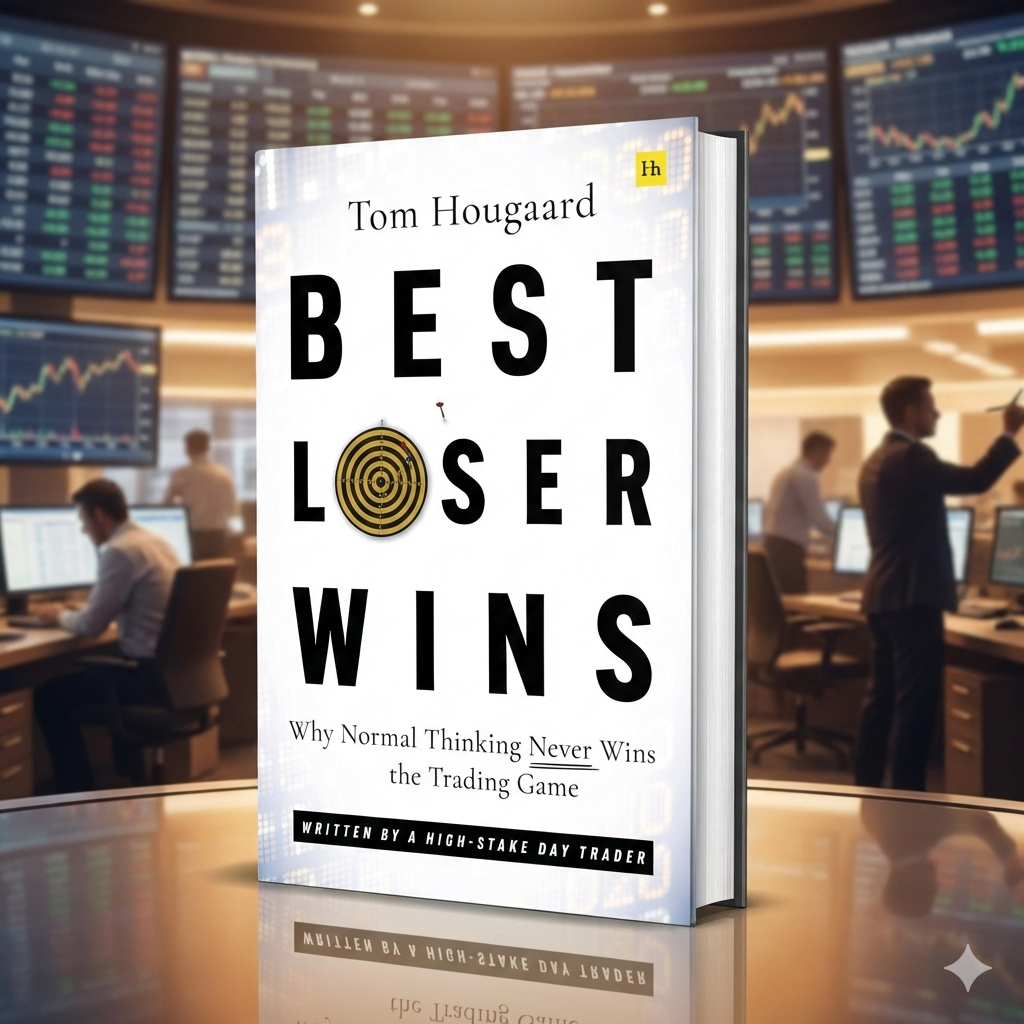
Tom Hougaard’s Best Loser Wins review highlights the critical role of psychology in trading. By prioritizing loss management over winning strategies, investors can overcome biological instincts that lead to poor decisions. Discover why learning to lose is the fastest path to consistent market profitability and see how you can apply these lessons to your own portfolio today.
In the high-stakes world of the stock market, we are often told that the smartest person in the room wins. We are taught to hunt for the “perfect” setup, the “sure-fire” stock tip, or the complex algorithm that guarantees success. But Tom Hougaard, in his provocative book Best Loser Wins, argues that our biggest obstacle isn’t a lack of data or a faulty strategy. It is our own biology.
Hougaard, a high-stakes trader who has spent decades in the trenches of the London markets, flips the traditional script of financial success on its head. His central theme is simple yet jarring: to win at trading, you must learn how to lose. This isn’t a book about charts or earnings reports; it is a masterclass in the psychological warfare required to survive the market.
Why This Book Matters Today
For the modern retail investor, the barriers to entry have never been lower. With a smartphone and a few hundred dollars, anyone can trade global markets. However, while the technology has evolved, the human brain has remained essentially the same for thousands of years.
Our instincts—the ones that kept our ancestors alive by avoiding pain and seeking safety—are the exact same instincts that cause us to lose money today. We hold onto losing stocks because we hate the “pain” of admitting we were wrong, and we sell our winners too early because we are “hungry” for a quick bit of safety. Hougaard’s book matters because it addresses this “software glitch” in the human mind, offering a bridge between knowing what to do and actually having the courage to do it.
Core Ideas: Thinking Against Your Instincts
The book operates on a logic that feels counterintuitive at first, but becomes undeniable as you turn the pages. Hougaard breaks down his philosophy into a few core pillars:
1. The Market is a Mirror
Hougaard argues that the market doesn’t care about your mortgage, your ego, or your “feeling” that a stock is “too cheap.” The market is simply a reflection of human behavior. Most people fail because they apply “normal” logic to an “abnormal” environment. In the real world, if you buy a shirt and it’s on sale, that’s a win. In trading, if you buy a stock and the price drops, your “discount” might actually be a warning sign that the company is failing.
2. High Stakes, Low Control
Most people think trading is about being right. Hougaard argues it is actually about how you behave when you are wrong. He introduces the concept that “Best Losers” are the ones who make the most money. By accepting a small loss quickly, you preserve your capital (and your sanity) for the next big opportunity.
3. The “Pain of Loss” vs. The “Fear of Missing Out”
The book dives deep into why we struggle. We feel the pain of a $100 loss twice as much as the joy of a $100 gain. This “Loss Aversion” traps beginners into a cycle of hoping a losing stock will “come back to break even,” while they cut their profits short the moment they see a tiny green number.
Strengths: Raw, Real, and Relatable
The most refreshing aspect of Best Loser Wins is Hougaard’s brutal honesty. Unlike many financial authors who hide behind back-tested spreadsheets, Hougaard shares his actual trading logs, including the days he lost hundreds of thousands of dollars.
- Clarity over Complexity: He avoids “Wall Street Speak.” You won’t find yourself reaching for a dictionary to understand “stochastic oscillators” or “macro-economic derivatives.” Instead, he uses metaphors that stick.
- The “Normal vs. Exceptional” Framework: He creates a clear distinction between how a “normal” person thinks and how an “exceptional” trader must think. This binary approach makes his advice easy to categorize and remember.
- Actionable Psychology: Most mindset books are “fluffy.” They tell you to “be disciplined.” Hougaard tells you why you aren’t disciplined (your amygdala is trying to save your life) and gives you the mental drills to override that impulse.
Limitations: A Word of Caution
While the book is a powerhouse of insight, it isn’t without its thorns.
- Intensity: Hougaard is a “scalper”—someone who trades in and out of the market very quickly. His style is high-octane. A casual investor who only checks their 401(k) once a month might find his intensity a bit overwhelming or even unnecessary for their long-term goals.
- The “One Way” Trap: Hougaard is very firm in his beliefs. While his logic is sound, some readers might find his “my way or the highway” tone a bit dismissive of other successful investing styles, such as long-term value investing.
- The Missing Technicals: If you are looking for a guide on how to read a balance sheet or how to pick a dividend stock, you won’t find it here. This is strictly a book about the person behind the computer, not the computer itself.
Trader’s Takeaway: Putting Lessons into Practice
How does a beginner actually use this? Think of your trading account like a garden.
- Pull the Weeds (The Losers): In a garden, you don’t keep the weeds just because you spent money on the seeds. You pull them early so they don’t choke the flowers. In your portfolio, you must set a “stop-loss”—a pre-determined price where you will sell if the stock goes down—and stick to it without emotion.
- Water the Flowers (The Winners): Most people “cut the flowers and water the weeds.” They sell their best-performing stocks to lock in a small profit but hold onto their worst ones, hoping they’ll recover. Hougaard teaches you to do the opposite: hold your winners and let them grow.
- Expect the “Ouch”: You will lose money on some trades. It’s a cost of doing business, like a restaurant paying for electricity. Once you stop viewing a loss as a personal failure and start viewing it as a business expense, you win the mental game.
Who Should Read This?
- The Newbie: If you’ve just opened your first brokerage account, read this before you place your first trade. It will save you thousands of dollars in “tuition” paid to the market.
- The “Stuck” Trader: If you have been trading for a year or two and find yourself breaking even or slowly losing, this book will likely identify exactly which psychological trap you are falling into.
- The Skeptic: If you think the stock market is just “gambling,” Hougaard’s disciplined, almost clinical approach to risk might change your mind about what professional trading actually looks like.
Verdict: The Final Word
Best Loser Wins is not just a finance book; it’s a manual on human nature. It strips away the glamour of the “Wolf of Wall Street” and replaces it with the disciplined reality of a professional athlete. It is uncomfortable to read at times because it forces you to confront your own irrationality and ego.
However, that discomfort is exactly why it is valuable. If you want to be part of the small percentage of people who actually make money in the markets, you cannot think like the majority. You must learn to lose well to win big.