

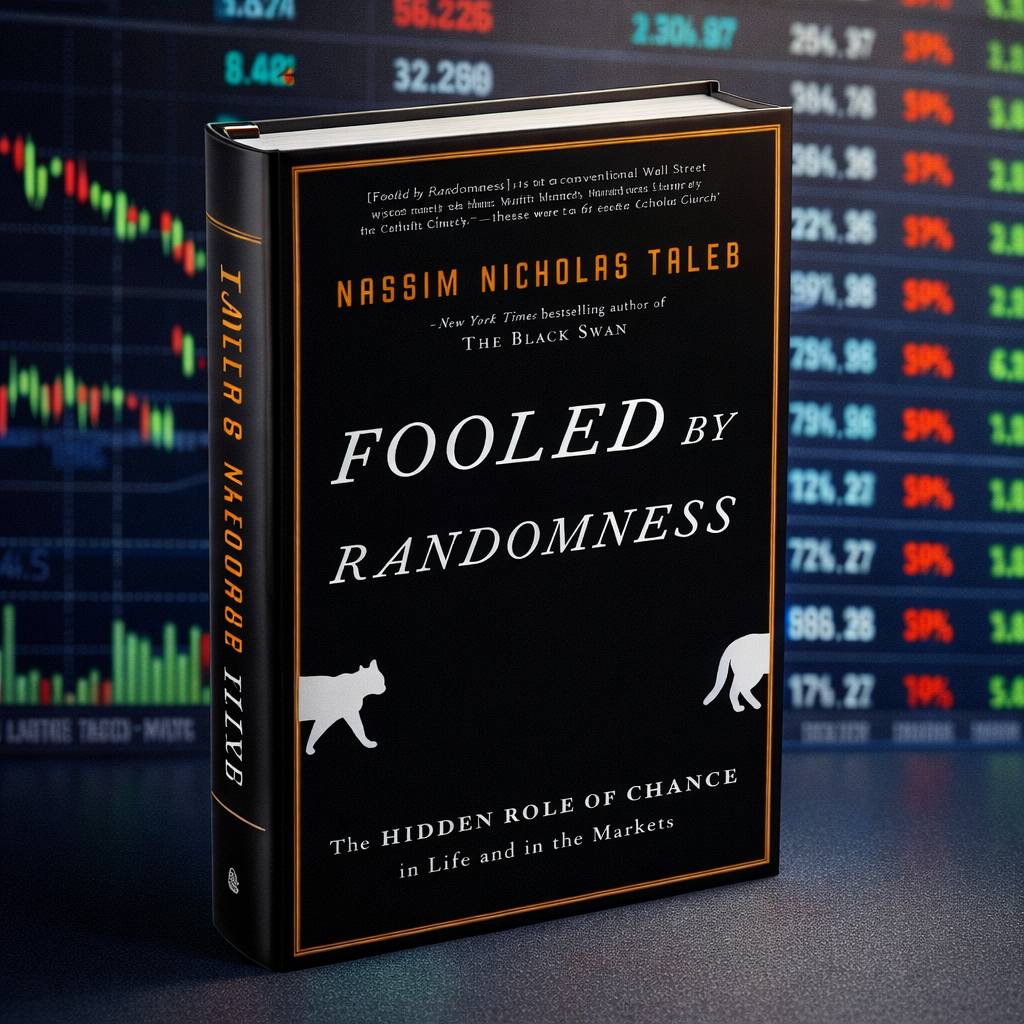
Fooled by Randomness shows how chance, not talent, often drives trading success. Nassim Taleb helps investors spot hidden risks, question performance stories, and think in probabilities—learn why respecting uncertainty leads to better long-term decisions.
First published in 2001 Fooled by Randomness message has only grown more relevant. Written by Nassim Nicholas Taleb, a former trader turned philosopher of risk, the book explores a simple but uncomfortable idea: many successes in markets — and in life — are driven more by luck than skill, even when they appear otherwise.
Taleb does not write a traditional investing guide. There are no stock tips, chart patterns, or portfolio formulas. Instead, he challenges how investors interpret outcomes. Why do we admire certain traders? Why do we trust confident experts? Why do people mistake short-term success for ability?
For today’s investors and traders — especially retail participants navigating social media, trading influencers, and performance screenshots — this book serves as a necessary counterweight. It teaches readers how easily the human mind creates stories to explain results that were largely random.
In short, Fooled by Randomness matters because it explains why smart people make bad financial judgments, and why markets reward humility more than confidence.
Core Ideas: The Logic Behind the Argument
Taleb builds his case step by step, almost like a mathematical proof. Each idea supports the next.
1. Randomness Is Stronger Than We Think
The central claim of the book is straightforward: chance plays a much larger role in outcomes than people are willing to admit. Markets are noisy systems. Prices move for many reasons, most of which no single trader fully understands.
Yet humans are wired to find patterns. When we see a trader make money several years in a row, we assume skill. When a fund performs well, we credit intelligence or strategy. Taleb argues that this instinct is dangerous. In a world with enough participants, some people will succeed purely by chance — and look brilliant doing it.
A useful metaphor Taleb returns to is coin tossing. If thousands of people flip coins repeatedly, a few will get long winning streaks. We do not call them skilled coin flippers. Yet in markets, we often do exactly that.
2. The Narrative Fallacy
Humans love stories. When something happens, we instinctively explain it with a clean narrative: “This trader succeeded because he was disciplined.” “That fund failed because management lacked vision.”
Taleb calls this the narrative fallacy — the tendency to create simple stories after the fact to explain complex outcomes. These stories feel convincing, but they often ignore randomness.
For investors, this matters because markets reward outcomes, not processes. A risky strategy that happens to work can look superior to a conservative one that faces bad luck. Over time, this leads people to copy fragile strategies that blow up later.
3. Survivorship Bias
Another core idea is survivorship bias. We only hear from winners. Failed traders disappear quietly. Funds that collapsed are removed from databases. Books are written by survivors, not by those wiped out by volatility.
This creates a distorted view of reality. If you study only successful traders, you may conclude that success is common and repeatable. Taleb reminds readers that absence of evidence is not evidence of absence. The invisible failures matter just as much as visible winners.
4. The Difference Between Luck and Skill
Taleb draws a sharp distinction between professions where skill dominates and those where luck dominates. A surgeon’s success depends largely on skill. A trader’s success depends heavily on randomness, especially in short time frames.
The problem arises when people judge traders as if they were surgeons. They assign moral value to profits and losses. Taleb argues this is a mistake. In probabilistic fields, outcomes alone are poor measures of ability.
This insight reshapes how readers should think about performance, risk, and reputation in markets.
Strengths: What the Book Does Exceptionally Well
1. It Changes How You See Markets Permanently
Few books alter perception as deeply as Fooled by Randomness. After reading it, it becomes difficult to look at trading results the same way. You start asking better questions: Was this outcome repeatable? What risks were hidden? How many failed before this winner appeared?
This mental shift is one of the book’s greatest strengths.
2. Real-World Trading Perspective
Taleb writes from experience. He understands trading desks, risk limits, drawdowns, and psychological pressure. This is not abstract theory. His examples — from traders, fund managers, and Wall Street culture — feel grounded and authentic.
For readers tired of motivational trading books, this realism is refreshing.
3. Clear Use of Metaphors
Although Taleb touches on probability and statistics, he relies heavily on metaphors. Coin flips, Russian roulette, and gambling analogies make abstract ideas easier to grasp. Beginners may not understand standard deviation, but they understand risk of ruin.
4. Emphasis on Risk Over Returns
Most investing books focus on how to make money. Taleb focuses on how not to lose everything. He argues that survival matters more than brilliance. This mindset aligns well with long-term investing and risk management principles.
Limitations: Where Readers Should Be Careful
1. Tone Can Feel Confrontational
Taleb’s writing style is confident and sometimes dismissive. He openly criticizes economists, traders, and academics. Some readers may find this abrasive. Others may mistake his certainty for arrogance.
For beginners, this tone can feel intimidating, even though the core lessons are valuable.
2. Not a “How-To” Guide
Readers looking for step-by-step trading strategies will not find them here. The book is conceptual, not instructional. It explains why many strategies fail, but not which strategy to adopt instead.
This is intentional, but it may frustrate readers seeking immediate practical rules.
3. Can Feel Repetitive
Taleb revisits the same ideas — randomness, luck, survivorship — from multiple angles. While this reinforces the message, some sections may feel repetitive, especially for readers who grasp the point early.
Trader’s Takeaway: Practical Lessons for Beginners
For retail traders and beginner investors, Fooled by Randomness offers several concrete lessons:
First, do not judge yourself too quickly. A few winning months do not prove skill. A losing streak does not mean failure. Focus on whether your decisions make sense under many possible outcomes.
Second, prioritize risk management. Avoid strategies that work most of the time but carry rare, catastrophic losses. In markets, staying alive matters more than being right.
Third, be skeptical of performance stories. Social media trading results, fund rankings, and guru narratives often ignore luck and hidden risks. Ask what could go wrong.
Fourth, think in probabilities, not certainties. Markets do not reward confidence. They punish fragility.
A simple metaphor helps: imagine crossing a river that is, on average, three feet deep. You can still drown. Averages hide danger. Markets behave the same way.
Who Should Read This Book
Fooled by Randomness is best suited for:
- Beginner traders who want a realistic view of markets
- Casual investors curious about how luck affects performance
- Finance students learning about risk and probability
- Experienced investors seeking a philosophical reset
- Anyone skeptical of “get rich quick” narratives
It is less suitable for readers looking for tactical trading setups or portfolio allocation formulas.
Verdict: A Necessary Reality Check
Fooled by Randomness is not a comforting book. It does not flatter the reader. Instead, it strips away illusions about control, skill, and certainty in markets.
That is precisely why it remains essential reading. In an era of algorithmic trading, influencer culture, and constant performance comparison, Taleb’s message feels urgent. Markets reward those who respect uncertainty and punish those who confuse luck for genius.
The book’s style may divide readers, and its lack of tactical guidance may disappoint some. But as a framework for thinking clearly about risk, it stands apart.
Rating: 9 out of 10
Not because it provides answers — but because it teaches you how to ask better questions.