

Known as the Pit Bull, Martin S. Schwartz remains one of the most successful traders in history, famously winning the U.S. Investing Championship with triple-digit returns. By shifting from fundamental research to technical price action and strict emotional discipline, he created a repeatable blueprint for market success. Learn why his transition from being right to being profitable is the ultimate lesson for every modern investor.
On a humid morning in 1979, Martin S. Schwartz sat at a desk that felt more like a cage. For nearly a decade, the man the world would later call “Buzzy” had worked as a securities analyst. He was brilliant, educated, and hardworking. He spent his days digging through financial reports and visiting factories. He knew the numbers better than anyone. Yet, despite his expertise, he was broke. He had spent ten years being “right” about companies while consistently losing money in the markets.
That morning, something clicked. He realized that the market did not care about his beautiful spreadsheets or his deep research. He was a fundamental analyst who was failing at the fundamentals of wealth. He decided to change his entire approach. He didn’t just want to be smart; he wanted to be rich. He saved up $100,000$, quit his job at E.F. Hutton, and bought a seat on the American Stock Exchange. It was a move that many of his peers thought was crazy. But for Buzzy, it was the first step in a calculated march toward becoming one of the most successful traders in history.
The Marine and the Analyst: A Foundation of Discipline
Martin Schwartz’s journey began far from the frenetic energy of the trading floor. Born in 1945, he followed a traditional path for a bright young man of his era. He graduated from Amherst College in 1967 and later earned an MBA from Columbia Business School. However, his academic career was interrupted by a stint in the U.S. Marine Corps Reserves.
His time in the Marines proved to be more than just a duty; it was a formative experience that shaped his professional DNA. The military taught him the importance of discipline, preparation, and, most importantly, the ability to act under pressure. He often compared trading to combat. In his view, a trader who “freezes” when the market moves against them is no different from a soldier who freezes under fire.
After his service, Schwartz returned to the corporate world. He spent nine years as a financial analyst at firms like Kuhn Loeb and E.F. Hutton. He focused on the healthcare sector, producing detailed reports on hospital management companies. While he earned a respectable salary, his personal trading was a disaster. He later admitted that he lost money for almost ten years straight. He was trapped in a cycle of “ego-driven” trading, where he refused to admit he was wrong because he had done so much research.
The turning point came during a professional scandal. Schwartz had written a bearish report on the hospital industry that was leaked to the press, causing stock prices to tumble. He had to testify before the New York Stock Exchange to prove he hadn’t acted unethically. Although he was cleared of any wrongdoing, the experience left him feeling “tainted” in the world of traditional finance. This setback, combined with the encouragement of his wife, Audrey, pushed him to finally take the leap into independent trading.
Step 1: Winning the Championship
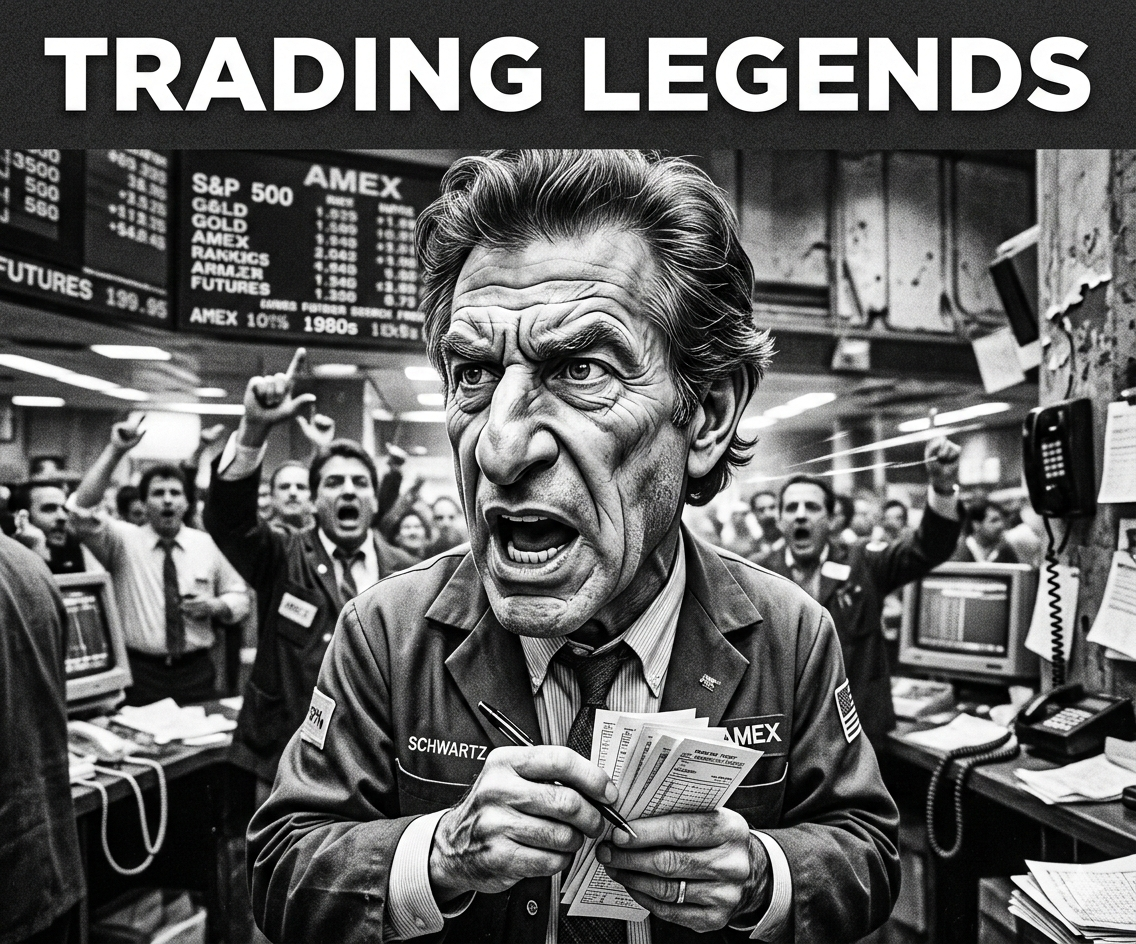
Once he stepped onto the floor of the American Stock Exchange (AMEX), the “failed analyst” disappeared. In his place was a focused, aggressive trader who earned the nickname “Pit Bull.” Schwartz moved away from the complex stories of companies and toward the cold, hard data of price action. He transitioned from fundamental analysis to technical analysis, a move he later described as the best decision of his life.
His success was almost immediate. In his first full year as an independent trader, he made $\$600,000$. The following year, he doubled it. But his fame reached a national level in 1984 when he entered the U.S. Investing Championship. This was a high-stakes competition where top traders managed real money to see who could generate the highest returns.
Schwartz didn’t just win; he dominated. In a four-month period, he generated an astounding $600\%$ return. Across nine separate championships, his average return was over $210\%$. To put this in perspective, he made more money in these competitions than all the other contestants combined. His performance proved that his success wasn’t a fluke. He had developed a systematic, repeatable method for extracting profit from the market. As he famously put it:
“I always laugh at people who say, ‘I’ve never met a rich technician.’ I love that! It’s such an arrogant, nonsensical response. I used fundamentals for nine years and got rich as a technician.”
Step 2: The Day the World Broke
Every great trader is defined by how they handle a crisis. For Martin Schwartz, that moment was the 1987 stock market crash, known as “Black Monday.” On October 19, 1987, the Dow Jones Industrial Average plummeted by over $22\%$ in a single day. Panic was everywhere.
Most traders were like deer in the headlights, watching their fortunes vanish in hours. Schwartz, however, relied on the Marine training that told him to never just sit there while being attacked. He was heavily long on S&P futures going into the crash. When the market opened and began its historic slide, he felt the physical pain of the loss.
Instead of hoping for a rebound or “averaging down”—a move he called suicidal—Schwartz bit the bullet. He sold his positions and took a significant loss. By closing out his trades, he saved himself from a potential $\$5$ million catastrophe. More importantly, it freed his mind. Because he was “flat” (holding no positions), he was able to look at the market clearly while everyone else was screaming. He eventually turned his focus toward the short side and began clawing back his losses. His ability to prioritize survival over his own ego allowed him to stay in the game when many of his contemporaries were wiped out permanently.
The Architecture of the “Pit Bull” Strategy
Schwartz’s trading was not a series of guesses; it was a mathematical architecture built on three core pillars. He approached the market like a scientist conducting a repeatable experiment.
1. The 10-Day Exponential Moving Average (EMA)
Schwartz called this his “red light/green light” indicator. He used a 10-day EMA to determine the short-term trend of the market. If the price was above the 10-day EMA, it was a “green light,” and he only looked for opportunities to buy. If the price was below it, it was a “red light,” and he only looked to sell. This simple rule kept him on the right side of the momentum.
2. The Magic T-Theory
Developed by Terry Laundry, this theory was central to Schwartz’s macro view. It suggested that markets spend an equal amount of time preparing for a move as they do making the move. By identifying these “T” patterns, Schwartz could predict how long a trend might last. This allowed him to avoid the common mistake of entering a trade just as the trend was about to exhaust itself.
3. The Divorce of Ego and Wallet
Perhaps his most important “step” was psychological. Schwartz believed that the biggest obstacle to success was the need to be right. He argued that you must separate your self-worth from your net worth. In his own words:
“The market doesn’t care how you feel. You’re really playing against yourself. The sole objective of trading is not to prove you’re right, but to hear the cash register ring.”
He followed a strict daily routine. He hand-drew his charts every day, even after computers became common. He kept a laminated checklist on his desk to ensure he never missed a step. This level of preparation ensured that when the opening bell rang, he wasn’t thinking—he was executing.
A Legacy of Discipline
By the early 1990s, the intense stress of the trading floor began to take its toll. After a health scare, Schwartz shifted his focus. He moved to Florida and began managing his own money in a more relaxed environment. He shared his life’s lessons in his bestselling book, Pit Bull: Lessons from Wall Street’s Champion Day Trader.
Martin Schwartz’s career offers a clear argument for the power of self-awareness. He was a man who spent a decade failing because he was playing the wrong game. By having the courage to admit his approach was wrong and the discipline to build a new one based on rules rather than opinions, he transformed himself into a legend.
His story remains a roadmap for anyone interested in finance. It teaches that while the market is complex, your reaction to it must be simple. You must prepare like a Marine, think like a technician, and, above all, protect your capital. In the world of Martin “Buzzy” Schwartz, the goal was never to be the smartest person in the room—it was to be the person still standing when the lights went out.