

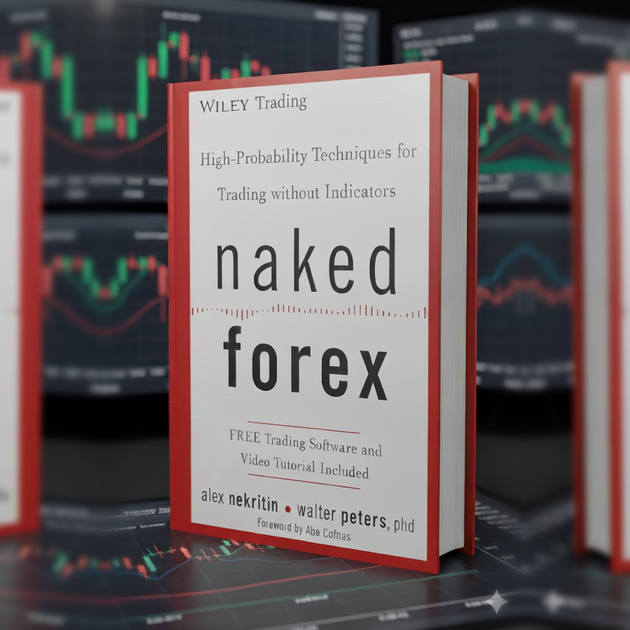
Nekritin and Peters distill trading to a plain chart: mark zones, wait for price-action triggers, and protect each trade with clear stops and sizing. It’s strong on routine and risk, but can be subjective without strict rules. Learn why this decluttered approach helps beginners trade with steadier discipline.
Naked Forex: High-Probability Techniques for Trading Without Indicators by Alex Nekritin and Walter Peters argues for a simple idea: most traders don’t need more tools—they need a cleaner view of price and a tighter process. The book’s “central theme” is naked trading, meaning you study a plain chart and make decisions from price movement instead of a stack of technical indicators.
That message still matters today. Many beginners start trading like a person trying to drive while staring at the dashboard lights. The lights are not useless, but they can distract you from the road. The authors want you to watch the road: where price is, where it has turned before, and how it behaves when it gets there.
Core ideas
A clean chart forces clear thinking.
The authors argue that indicators often “lag” because they are calculated from past prices. The book pushes you to focus on the raw material: candles, swings, and obvious turning points.
Markets leave footprints in “zones,” not perfect lines.
Instead of treating support or resistance like a single price level, the book treats them like areas where decisions tend to cluster. For a beginner, this is a useful mental model: price is more like a ball bouncing in a hallway than a laser hitting a dot.
Price-action setups are the trigger—but context is the filter.
The book teaches several named patterns and trade ideas that use candle shapes and momentum shifts. The names are memorable, but the larger lesson is more important: a pattern matters more when it appears at a meaningful area (a zone) and when the trade has a clear risk point.
Risk management is not an accessory; it’s the engine.
The authors spend real time on position sizing, stop placement, and trade management. In plain terms: you can be “right” often and still lose if your losses are large and your wins are small.
A repeatable routine beats a brilliant prediction.
The book leans toward checklists: define the zone, identify the setup, plan the entry, set the stop, set the target, and manage the trade. That structure is a quiet strength for anyone who tends to trade on impulse.
Strengths
Clarity without fluff.
This is not a theory-first book. It reads like a workshop. The authors keep returning to the same core question: What is price doing right now, and what would prove you wrong? That question alone can improve a beginner’s discipline.
A practical bridge for indicator-heavy traders.
Many traders aren’t ready to throw out indicators, but they are ready to reduce clutter. The book is a good transition because it doesn’t just say “indicators are bad.” It shows how to build decisions from simpler inputs—zones, candles, and structure—then manage risk around them.
Attention to the “boring” parts that decide results.
Entries get the spotlight in trading culture. Exits and sizing decide the P&L. The book’s steady emphasis on money management and process is well-aligned with how real trading works.
It respects the reader’s need for a system.
Beginners often fail for one reason: they don’t have rules they can follow on a tired day. The book’s method—clean chart + zones + a small set of triggers—creates something you can actually repeat.
Limitations
“Without indicators” can become a slogan.
Price action is not automatically objective. Two people can look at the same chart and draw different zones, or label different swings as “the” key level. The book does discuss structure, but readers should know that naked trading can still turn into pattern-spotting if you don’t keep strict rules.
The word “high-probability” can mislead the wrong reader.
A “high-probability” setup is not a guarantee; it is a bet with a better profile if you manage risk and keep costs low. The book is strongest when it pushes process, not when the title’s promise echoes in your head.
It is a 2012 book in a market that has evolved.
The core behaviors of price—fear, greed, hesitation at prior turning points—don’t expire. But spreads, volatility regimes, and the speed of news can change. Treat the examples as training data, not as timeless scripts.
Forex focus is both a feature and a constraint.
If you trade equities, the “clean chart” idea still transfers well. But equities have earnings, buybacks, and exchange-specific mechanics that spot FX doesn’t share. Beginners should avoid copy-pasting without adapting.
Trader’s takeaway
If you are a retail trader—or a curious investor who wants to understand trading discipline—here’s how to translate the book into action without turning it into a religion:
- Start with one market and one timeframe. Your edge can’t survive if your attention is scattered.
- Draw zones like weather systems, not like razor lines. A zone is an area where decisions happened before.
- Write your “prove me wrong” price before you enter. If you can’t define where you’re wrong, you don’t have a trade—you have a hope.
- Risk a small, fixed amount per trade. Make survival the first goal.
- Journal like a scientist, not like a judge. Collect evidence about rule-following, not just wins and losses.
A simple metaphor: think of trading like fishing with one reliable lure. You don’t change the lure every five minutes. You learn where fish gather (zones), when they bite (triggers), and how not to snap your line (risk control).
Who should read it
- New traders who feel overwhelmed by indicators and want a simpler framework
- Intermediate traders who trade “signals” but lack consistent risk rules
- Curious beginners in investing who want to understand how traders think about entries, exits, and discipline—even if they never plan to day trade
- Not ideal for readers seeking macroeconomics, deep market microstructure, or quantitative system design
Verdict
Naked Forex is best read as a decluttering manual for decision-making. Its real value is not that it bans indicators; it’s that it forces you to build a trading argument from a few sturdy parts: context (zones), trigger (price action), and protection (risk management). The title’s confidence can be louder than the reality of trading, and the approach can become subjective if you don’t keep strict rules. But as a practical guide for building a clean, repeatable method, it earns its reputation.
Rating: 8.2/10