

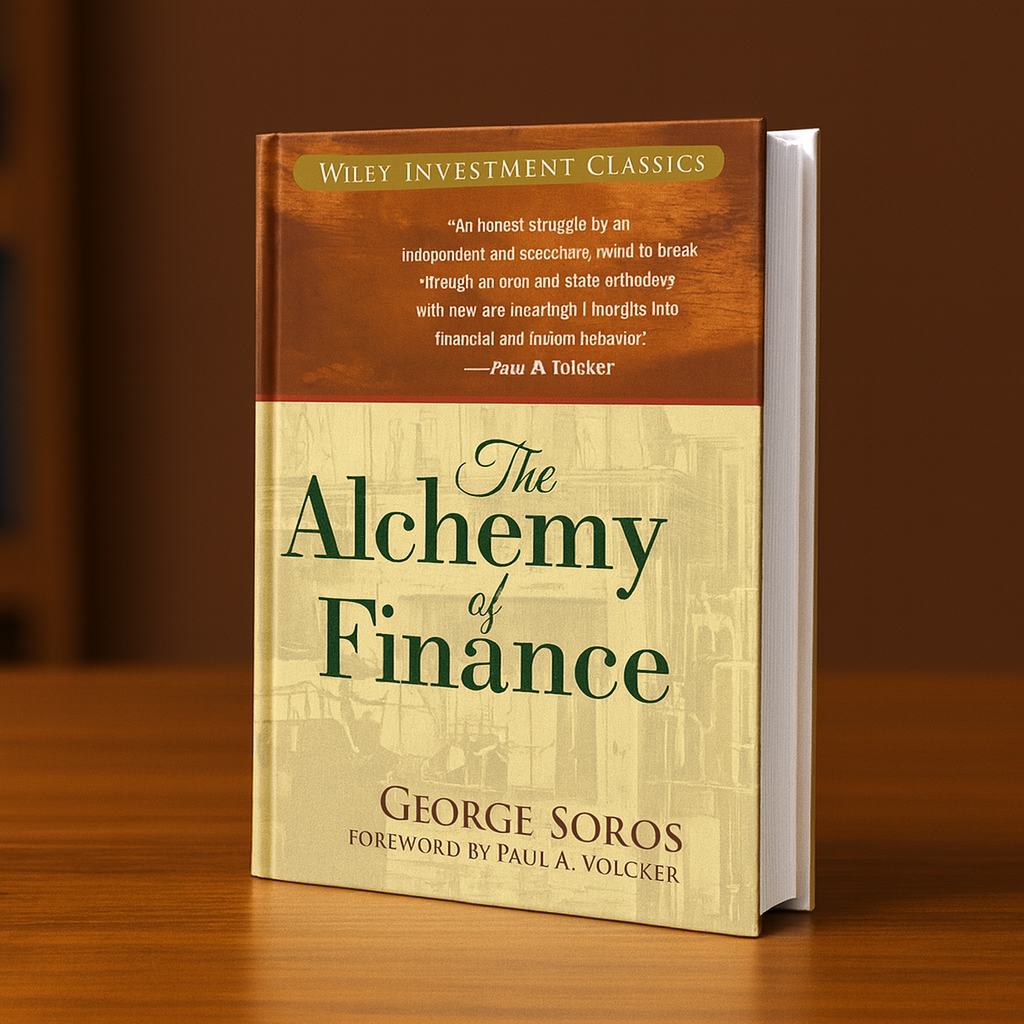
Alchemy of Finance review distills Soros’s dense ideas on reflexivity, feedback loops, and boom-bust cycles into practical mindset shifts, helping active investors read market psychology, manage risk, refine strategy, and decide if this demanding classic deserves a careful, patient read today.
If you follow the stock markets, you have likely heard of George Soros. He is the billionaire hedge fund manager famous for “breaking the Bank of England” in 1992—a single trade that made him roughly a billion dollars in one day. But long before that legendary trade, Soros wrote The Alchemy of Finance (1987) to explain how he did it.
For many new investors, finance feels like a hard science. We are taught that if you study the spreadsheets, look at the profits, and analyze the data, you will find the “true” value of a company. We are told that markets are rational and efficient.
Soros wrote this book to say: That is all wrong.
This book matters today because we live in an era of “meme stocks,” cryptocurrency swings, and massive tech bubbles. Traditional textbooks often fail to explain why a company with zero profit can double in value overnight. The Alchemy of Finance explains exactly why. It argues that markets are driven by human emotions and mistakes, not just cold, hard math.
This review will break down Soros’s complex philosophy into simple terms to help you understand the psychology behind the charts.
Core Ideas: The Soros Framework
Soros is not just a trader; he is a philosopher at heart. The book is dense, but it boils down to a few powerful concepts that change how you see money.
The Theory of Reflexivity
This is the big idea of the book. Don’t let the fancy name scare you.
In standard economics, we are taught that the market is like a thermometer. A thermometer simply measures the temperature; it doesn’t change the weather. If a company does well, the stock price goes up. The price reflects reality.
Soros argues that the market is not a thermometer. It is more like a thermostat.
Here is how it works: Imagine a company, let’s call it “TechCorp.” Investors think TechCorp is the future, so they buy the stock. The price goes up. Because the stock price is high, banks are willing to lend TechCorp more money at low rates. TechCorp uses that cheap money to buy competitors or advertise. This makes the company actually stronger.
Do you see the loop? The investors’ opinion (which might have been wrong at first) changed the reality of the company. The price didn’t just reflect the truth; it created a new truth. Soros calls this Reflexivity. It is a two-way street between what we think and what actually happens.
Humans Are Always Biased
Soros assumes that market participants (traders, investors, banks) are always acting with incomplete information. We are never seeing the full picture. Because our view is flawed, market prices are essentially always “wrong” in one direction or another. The key to making money isn’t knowing the truth; it is identifying the bias in the market’s thinking.
Boom and Bust Cycles
Because of Reflexivity, markets don’t naturally stay stable. They tend to overshoot.
- The Boom: Optimism drives prices up -> high prices help the fundamentals -> improved fundamentals drive more optimism.
- The Bust: Eventually, the reality cannot keep up with the crazy expectations. The trend reverses. Pessimism drives prices down -> low prices hurt the company -> weaker company drives more pessimism.
Soros shows that these bubbles are not accidents. They are a natural part of how humans interact with money.
Strengths: What the Book Does Well
It Destroys the “Perfect Market” Myth
Many finance books try to teach you formulas to calculate risk, assuming the market behaves logically. Soros rips that band-aid off. He validates what many retail traders feel in their gut: the market is messy, emotional, and often illogical. For a beginner, this is comforting. It means you aren’t crazy when you see prices moving for no reason.
The “Real-Time Experiment”
The middle section of the book is unique. Instead of just talking theory, Soros includes a “real-time” trading diary from the mid-1980s. He records his thoughts, his trades, and his market outlook before he knows the outcome.
Most investment books suffer from “hindsight bias” (saying “I knew it all along” after the fact). Soros shows us his doubt. He admits when he is confused. He writes about closing positions because his back hurts from stress. It humanizes a billionaire and shows that even the best traders in the world are often guessing and managing risk, rather than predicting the future with certainty.
A Focus on Currencies and Macros
While many beginner books focus on picking stocks (like buying Apple or Coca-Cola), Soros focuses on “Macro” investing—betting on entire countries, currencies, and interest rates. It opens the reader’s eyes to the bigger picture of the global economy.
Limitations: Watch Out For These
It Is incredibly Dense
We have to be honest: This is not a beach read. Soros wants to be seen as a philosopher, and he writes like one. He uses complex academic language. You might find yourself reading a page three times and still scratching your head. It scores low on the “Reading Ease” scale.
Dated Examples
The specific financial examples are from the 1980s. He talks a lot about the “Plaza Accord,” the German Mark, and the Japanese Yen of that era. If you don’t know your financial history, these sections can be boring or confusing. You have to read these parts for the logic behind the trades, not the specific details of the trades themselves.
It Can Feel Abstract
If you are looking for a “How-To” guide that says “Buy when the line crosses here,” this is not it. This book teaches you how to think, not what to do. Beginners looking for a quick strategy will be disappointed.
The Trader’s Takeaway
So, how does this book help you trade or invest today? Here are the practical lessons translated for the ordinary investor:
Identify the Feedback Loop
When you see a stock skyrocketing (like Tesla in 2020 or GameStop in 2021), ask yourself: Is the rising price actually helping the company’s business? Are they issuing new shares to raise cash? If the rising price is strengthening the business, the trend can go much further than “rational” math suggests. Ride the wave, but know it’s a wave.
Bet Against the Consensus
Soros teaches us to look for moments when the crowd is overwhelmingly convinced of one outcome, but the reality is starting to shift. The biggest profits come from spotting a “flaw” in the market’s perception.
Survival First
In his diary, Soros is quick to cut his losses. If the market doesn’t act the way he expects, he gets out. He doesn’t let his ego get in the way. The lesson? It is okay to be wrong. It is not okay to stay wrong.
Markets Are Flawed
Stop trying to find the “perfect” price. Accept that prices are a reflection of human hope and fear. Your job is to gauge the psychology of other investors, not just the balance sheet of the company.
Who Should Read This?
- The Psychology Buff: If you are interested in why people buy and sell, rather than just looking at charts.
- The Aspiring Macro Trader: If you want to understand how currency moves and interest rates affect the world.
- The Patient Reader: You need patience to get through the dry philosophical chapters to find the gold nuggets.
Who Should Skip It:
- The Absolute Beginner: If you are just starting to learn what a stock or bond is, read The Intelligent Investor or A Random Walk Down Wall Street first. Come back to Soros later.
- The Passive Investor: If you just want to buy an index fund and hold it for 30 years, this book’s focus on active boom/bust cycles might just make you anxious.
Verdict
The Alchemy of Finance is a masterpiece, but it is a difficult one. It is like a very rich, heavy dessert—brilliant, but you can’t eat it all at once.
Soros provides the best explanation ever written for why financial bubbles happen. In a world driven by social media hype and instant trading, his theory of “Reflexivity” is more relevant today than it was in 1987. However, the writing style is a barrier. It requires work to understand.
If you are willing to put in the effort, it will change how you look at every news headline and stock ticker for the rest of your life.
Rating: 8/10
(10/10 for the ideas, 6/10 for readability)
Final Thought: Read it for the concept of the “Feedback Loop.” When you understand that, you understand the modern market.