The movie tracks cousins building a straighter fiber line to beat rivals by milliseconds, only to learn edges decay. It maps HFT’s operational and legal risk, plus trader obsession, giving readers clearer risk instincts; see how speed reshapes incentives in modern markets.
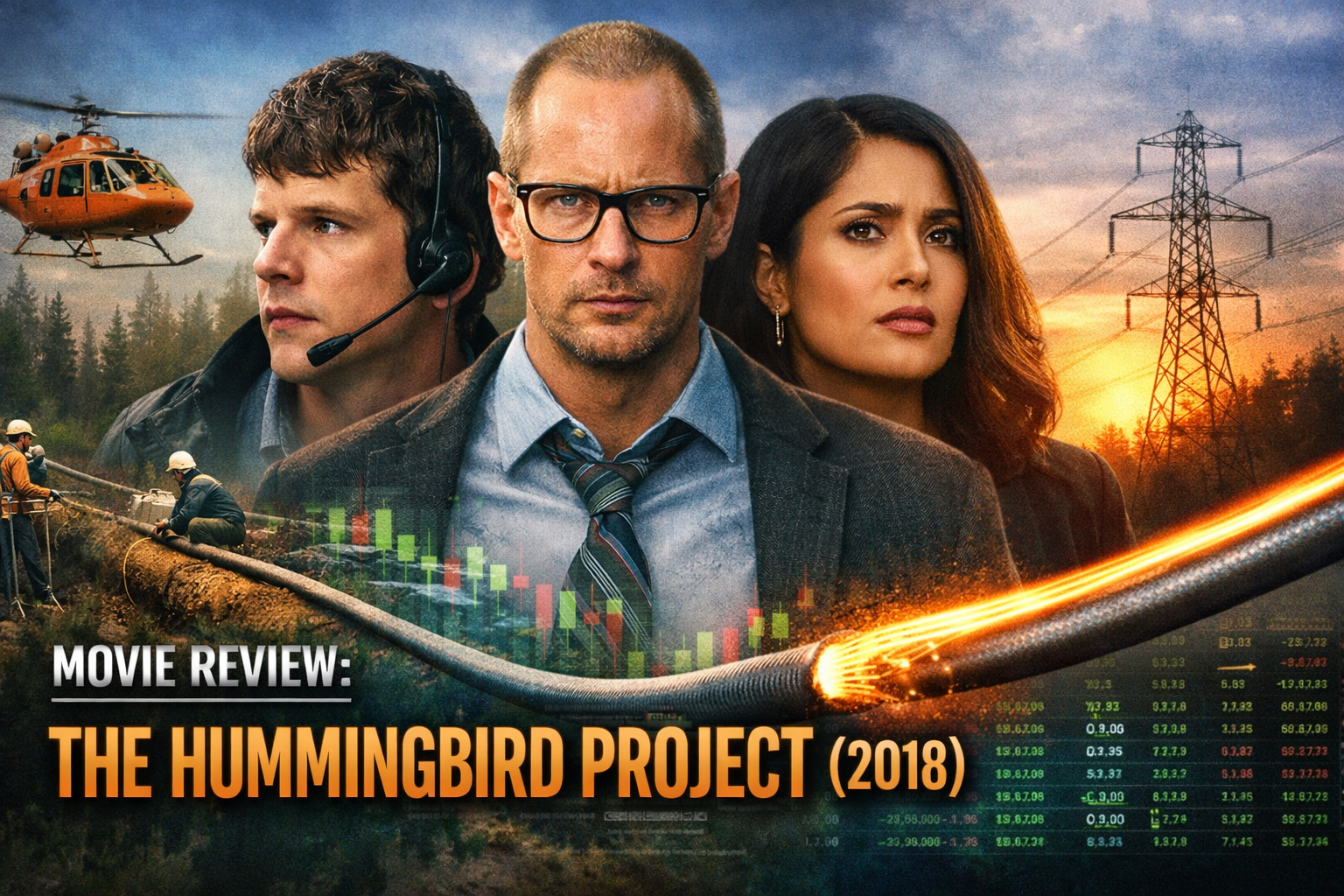
The Hummingbird Project is a race movie disguised as a finance movie—and that’s the point. Cousins Vincent Zaleski (Jesse Eisenberg), a hyper-verbal salesman-trader, and Anton Zaleski (Alexander Skarsgård), a socially brittle programmer, abandon their Wall Street employer to chase a single edge: speed. Their plan is bluntly physical for such a digital business—build an almost perfectly straight fiber-optic route from a Kansas exchange to New York/New Jersey so their orders arrive milliseconds earlier than everyone else’s. In high-frequency trading, that sliver of time is treated as destiny.
Their former boss, Eva Torres (Salma Hayek), is both antagonist and mirror: as ruthless, as brilliant, and far better resourced. The film’s most revealing line isn’t about markets; it’s about ownership. Eva insists Anton’s code—and even “the thoughts in his head,” as the film has it—belongs to the firm. The cousins’ rebellion is framed as entrepreneurship, but it’s also a messy dispute over intellectual property, loyalty, and the informal coercion of elite workplaces.
The plot turns when the “straight-line” bet collides with the real world: land rights, geology, broken equipment, health shocks, and the simple fact that physics is indifferent to ambition. While Vincent fights for a straighter path (every bend adds latency), Eva quietly pivots to microwaves—an alternate transmission method that beats their buried cable to market. She gets there first and dominates, leaving the cousins holding an expensive, late-arriving monument to yesterday’s advantage.
Then comes the film’s bleakly comic finance lesson: when Anton is arrested amid claims he used proprietary software, he retaliates by triggering a “logic bomb” that slows Eva’s system—turning the speed war into a sabotage war. The market doesn’t collapse; it simply moves on, as if human drama were background noise. In the final stretch, the cable is completed and the achieved latency is celebrated—only for Vincent to admit it no longer matters. Anton, already elsewhere mentally, proposes an even more absurd future edge: neutrino communication. In this world, victory is never a finish line—just a shorter interval before the next race begins.
Cinematic Qualities
Director-writer Kim Nguyen shoots the story like an industrial quest. Drills, mud, permits, excavators, and winter fields receive almost as much attention as trading screens—an effective choice because it externalizes what HFT usually hides: the infrastructure of advantage. The straight-line obsession becomes the film’s visual motif: a modern version of the railroad baron’s map, where geography is destiny and distance is money.
Eisenberg is calibrated for Vincent’s cadence: a man who sells certainty while privately burning through it. He speaks like a broker who learned early that confidence is a product, and that silence is a signal of weakness. Skarsgård, bald and physically coiled, turns Anton into a pressure gauge—his body registers the cost of speed before the script does. Hayek plays Eva with an executive’s stillness; she doesn’t need to shout because she controls the premises. Their performances are the film’s biggest asset: the characters feel like recognizable types from electronic markets—brilliant, narrow, competitive, and oddly fragile.
Pacing is the trade-off. The middle section—land negotiations and construction setbacks—can feel repetitive, as if the film is simulating the grind of a project plan. That may be intentional, but it costs some momentum. Still, Nguyen earns the right to linger: the story’s central claim is that modern finance is not only math; it’s logistics, legal work, hardware, and bruising persistence. The production is clean and unflashy, with a cool palette that suits a world where emotion is supposed to be eliminated—and keeps leaking in anyway.
Trader’s Lens
What trading/financial concepts are central?
This is a movie about latency competition—the arms race to shave microseconds and milliseconds in order transmission. It dramatizes the core temptation of high-frequency markets: if you can see and react first, you can systematically extract tiny gains at massive scale. In plain terms, speed becomes a toll booth. The faster player positions itself to profit from other participants’ slower information or slower execution, even when the underlying “view” is trivial.
It’s also about technology risk and strategic substitution—a concept traders understand instinctively even if they don’t label it. Vincent and Anton are not merely trading markets; they’re effectively trading a massive capex project whose payoff depends on rivals’ choices. They go all-in on fiber while their competitor pivots to microwaves. The film frames this as betrayal, but it’s closer to a classic real-options problem: commit to a path too early and you can be leapfrogged by a different technology curve.
The cousins are also exposed to something retail traders underestimate: legal and regulatory risk as a market variable. The project’s viability depends on rights-of-way, contracts, and what counts as proprietary code. In the world of institutional finance, enforcement isn’t an afterthought—it’s part of the edge.
Lessons for traders
1) Edge decay is the default, not the exception.
The film’s sharpest trading truth arrives quietly: they hit the target latency and it’s already obsolete. That’s not melodrama; it’s competition doing its job. Any edge that can be engineered can also be replicated, improved, or routed around.
2) Operational risk can dwarf market risk.
Drill bits break. Permits stall. Weather hits. Vendors fail. People get sick. A trader watching this should hear echoes of outages, bad market data, failed deployments, and “one-in-a-thousand” events that appear with depressing regularity once size and complexity increase. The movie’s message is uncomfortable but accurate: the “trade” isn’t only your model; it’s your operational chain.
3) Obsession is a position—and it can margin-call you.
Anton’s single-mindedness reads like a behavioral case study: when identity fuses with performance, setbacks become existential threats. Vincent’s salesmanship becomes a coping mechanism: talk fast enough and you can outrun uncertainty. Neither is discipline. Both are ways of borrowing emotional leverage that eventually comes due.
4) Rivalry is hidden leverage.
Eva doesn’t merely compete; she forces the cousins into worse “fills” on their business plan—more cost, more speed required, more fragility—because she exists. In markets, the most dangerous leverage isn’t always borrowed capital. It’s competitive pressure that narrows your choices and makes you treat bad trades as “necessary.”
5) The market rarely grants moral closure.
Anton’s sabotage doesn’t produce a cathartic collapse; it produces a brief distortion. That’s a useful reminder for traders who romanticize “blowing up the system.” Markets are adaptive. They route around drama.
Accuracy vs. dramatization
The broad premise is grounded: speed has been a real competitive dimension in modern electronic markets, and firms have spent heavily to reduce latency. But the film inevitably compresses complexity. It implies a near-binary world where one faster link “wins the market.” In practice, profitability depends on strategy mix, fee structures, exchange microstructure, and whether your speed advantage exists in the particular venues, symbols, and time windows that matter.
The story also simplifies the ethics. High-frequency trading is not uniformly predatory, and many participants would argue it improves liquidity and tightens spreads. The movie leans toward the suspicion that the whole game is extraction. That makes for a cleaner parable, even if the real world is messier: sometimes speed is rent-seeking; sometimes it’s simply competition in a market designed around time priority.
Where the film does feel true is the psychology: the way “a few milliseconds” becomes a narrative capable of swallowing careers, relationships, and sanity. Whether or not the exact mechanics match a specific shop, the incentive structure—win small, win often, reinvest in advantage—is credible.
Psychology & Culture
What The Hummingbird Project captures best is the culture of performance under abstraction. The traders are physically distant from the people on the other side of their trades; the moral distance grows with the speed. The construction imagery is a quiet rebuke: the “digital” economy still depends on land, labor, and hardware. Someone has to negotiate with farmers. Someone has to drill through rock. Someone has to carry the risk when the plan meets the ground.
Ethically, the movie refuses easy heroes. Vincent’s charm is inseparable from manipulation. Anton’s genius is inseparable from sabotage. Eva’s competence is inseparable from coercion. The film suggests that in an arms race, ethics become situational: once speed is the goal, almost anything can be rationalized as “necessary.” That’s recognizable not only in trading but in any winner-take-most system.
Most tellingly, the film treats time as the ultimate commodity—scarce, measurable, monetizable. It’s a trader’s dream and a human nightmare. Vincent’s illness functions as the counter-clock: while the market worships milliseconds, the body counts months. That juxtaposition is the film’s most mature observation: finance can price time, but it can’t buy it back.
Audience Fit
- Retail traders: Best as a cautionary tale about edge-chasing, obsession, and the unseen costs behind “easy” profits. Don’t watch it for a tutorial on HFT mechanics—watch it as a lesson in incentives and fragility.
- Finance students: A strong narrative gateway into market structure, infrastructure, and why “micro” advantages attract “macro” investment.
- Industry insiders: You’ll spot simplifications and may roll your eyes—yet the cultural portrait (ego, paranoia, relentless iteration) is close enough to sting.
- General audiences: Works as a rivalry drama with an unusually concrete view of finance’s plumbing—more “engineering thriller” than “stock-market spectacle.”
Verdict / Rating
7.4 / 10
Trader-focused takeaway: The Hummingbird Project argues that the purest form of speculation isn’t taking a view on price—it’s staking your life on a shrinking technological edge, in a game where the only permanent advantage is being willing to ruin yourself faster than the other side. It’s less about numbers than about incentives: when the market pays for speed, it will also pay for obsession—and eventually, for its consequences.