

The Intelligent Investor breaks investing into clear rules: treat markets like moody Mr. Market, buy with a margin of safety, and manage emotions first. The benefit is fewer big losses and steadier decisions for beginners and traders—learn how to apply it now.
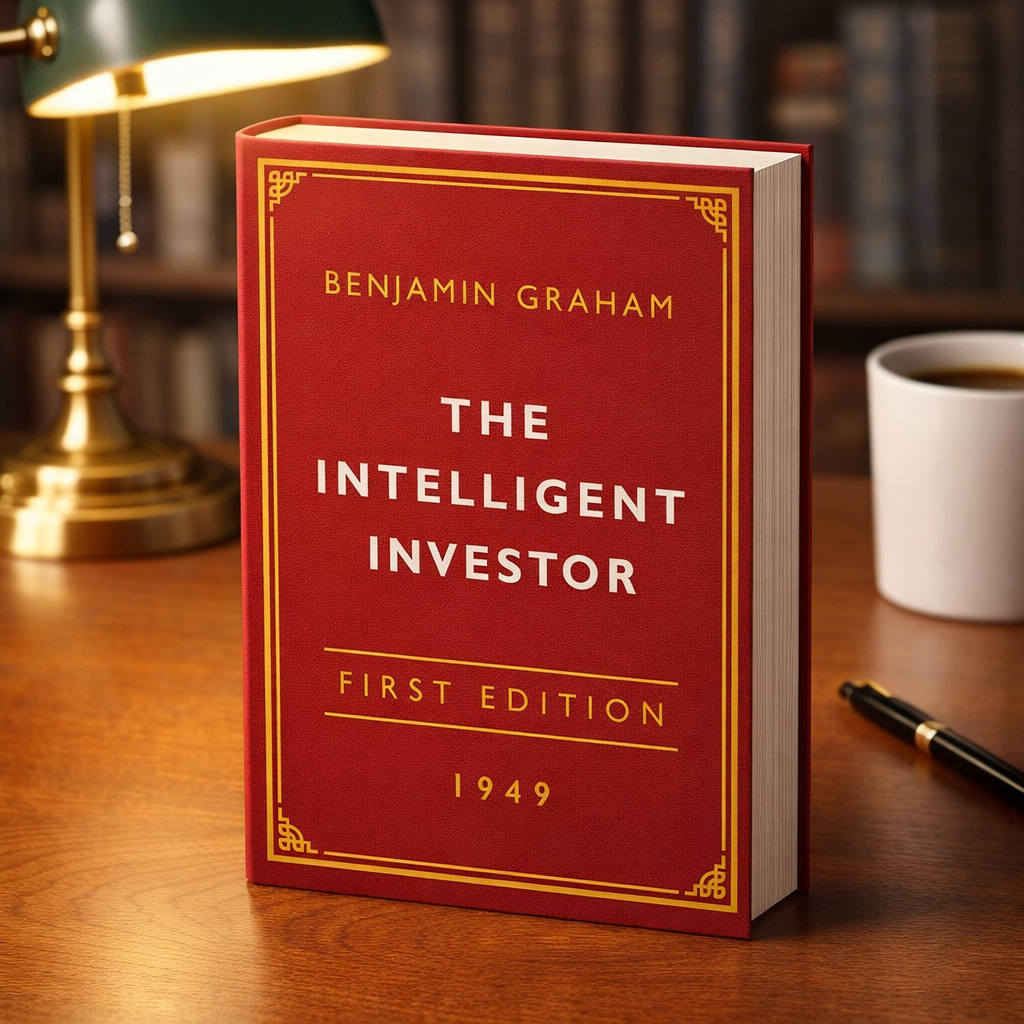
First published in 1949, The Intelligent Investor by Benjamin Graham is often described as the most important book ever written on investing. That claim sounds bold—almost suspiciously so. Yet more than 70 years later, the book continues to shape how serious investors think about risk, value, and decision-making.
At its core, this book is not about beating the market with clever tricks. It is about protecting yourself from costly mistakes—especially emotional ones. Graham’s central idea is simple: investing is not a contest of brilliance, but a discipline of patience, logic, and self-control.
In today’s world of trading apps, viral stock tips, crypto hype, and algorithmic signals, that message may be more relevant than ever. Markets move faster now, but human behavior has not changed. Fear still rises in crashes. Greed still dominates in booms. Graham wrote this book to help ordinary people navigate those cycles without losing their footing.
Core Ideas: The Logic Behind Intelligent Investing
Graham builds his argument step by step, almost like a mathematical proof. Each idea rests on the one before it.
Investing Is Not Speculation
The book begins by drawing a firm line between investing and speculation. An investment, Graham says, is an operation that promises safety of principal and a reasonable return after careful analysis. Anything else is speculation.
This distinction matters because many people believe they are investing when they are really betting on price movements. Graham does not say speculation is wrong, but he insists that investors must know which game they are playing. Investing is like buying a business; speculation is like betting on tomorrow’s weather. Confusing the two leads to disappointment and poor decisions.
Mr. Market: The Emotional Business Partner
One of the book’s most enduring ideas is Mr. Market. Graham asks you to imagine the stock market as a business partner who shows up every day offering to buy or sell shares at a quoted price. Some days Mr. Market is calm and reasonable. Other days he is wildly optimistic or deeply depressed.
The key lesson is that you are not required to agree with him. The market’s job is to offer prices, not to tell you what something is worth. Intelligent investors learn to take advantage of Mr. Market’s mood swings instead of being controlled by them.
Margin of Safety: Your Core Defense
If the book has one central pillar, it is the concept of margin of safety. This means buying assets at a price low enough that even if your analysis is partly wrong, you are still protected. It is the investing equivalent of building a bridge that can carry far more weight than expected.
You do not need perfect forecasts. You need room for error. This idea quietly challenges the obsession with prediction. Graham teaches that long-term success comes not from being right all the time, but from avoiding large losses.
Defensive vs. Enterprising Investors
Graham recognizes that not everyone wants or needs the same level of involvement. He divides investors into defensive investors, who want solid returns with minimal effort, and enterprising investors, who are willing to put in time and analysis to seek better results.
Neither approach is superior on its own. The real mistake is pretending to be enterprising without doing the work. This distinction remains especially useful today, when many retail traders overestimate their edge.
Emotion Is the Real Enemy
Although the book discusses balance sheets and valuation, its deeper focus is psychological. Graham repeatedly warns that the greatest threat to your returns is not the market but your own reactions to it. Panic selling, chasing hot trends, and overconfidence all lead to poor outcomes.
In this sense, The Intelligent Investor is as much a book about temperament as it is about finance.
Strengths: What the Book Does Well
One of the book’s greatest strengths is that it teaches how to think, not what to buy. Graham offers no stock tips. Instead, he provides a framework for reasoning that remains useful across decades and market cycles.
The book also demystifies investing. Rather than portraying markets as machines only experts can understand, Graham reduces investing to clear principles: price, value, risk, and behavior.
Another major strength is its focus on risk before return. Most investing books highlight upside. Graham emphasizes downside protection. For beginners, this shift alone can dramatically improve outcomes.
Finally, the book respects the ordinary investor. Its tone is serious but not elitist. Graham assumes readers are capable of discipline and rational thought, even if they are not professionals.
Limitations: Where Readers Should Be Careful
Some examples in the book are dated. Graham refers to companies, bonds, and market conditions that no longer exist. These examples need interpretation rather than direct application.
The book is also not a trading manual. Readers looking for short-term strategies, technical indicators, or timing tools will not find them here. Graham’s approach is firmly long-term.
The writing style reflects its era. While clear, the prose can feel dense by modern standards, and some sections reward slow, careful reading.
Trader’s Takeaway: Lessons for Modern Retail Traders
Although Graham was not a trader, his lessons apply directly to trading behavior.
Risk management must come first. If you cannot survive drawdowns, no strategy matters. Price movements do not equal truth; markets often move for emotional reasons unrelated to value. Consistency matters more than brilliance, and emotional discipline matters more than technical tools.
For traders, the most important lesson may be this: if your strategy relies on being right often, it is fragile. If it relies on limiting losses, it is resilient.
Who Should Read This Book
This book is ideal for curious beginners who want a serious foundation without hype, retail traders seeking discipline and perspective, long-term investors focused on capital preservation, finance students learning fundamentals, and experienced investors who want to revisit first principles.
It is less suitable for readers seeking quick profits, day-trading tactics, or constant excitement.
Verdict
The Intelligent Investor does not promise excitement. It offers clarity.
Its lessons are not flashy, but they are durable. In a market environment filled with noise, Benjamin Graham provides a calm, logical voice that reminds readers that patience, discipline, and humility matter more than cleverness.
This is not a book you read once and forget. It is a reference point and a mental anchor, especially useful when markets feel irrational.
Rating: 9/10
Not because it is perfect or modern, but because it teaches the hardest lesson in finance: how to protect yourself from your own worst instincts.