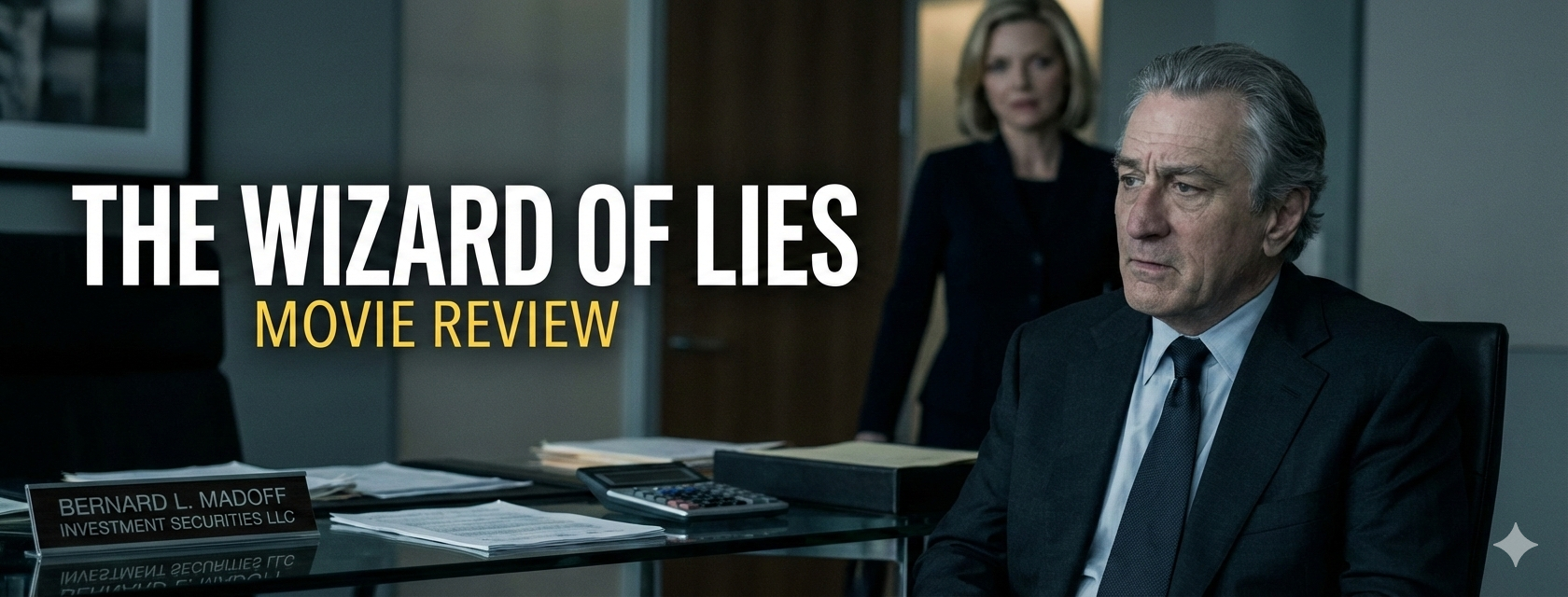
This professional The Wizard of Lies review examines the technical accuracy and psychological depth of Barry Levinson’s Madoff biopic. Beyond the cinematic qualities, the analysis explores critical concepts like affinity fraud and split-strike conversion. Learn how to protect your portfolio from systemic risks and understand why transparency is the only true hedge.
The 2008 financial crisis is often remembered for the systemic collapse of subprime mortgage-backed securities and the subsequent freezing of global credit markets. Yet, tucked within that chaotic December was a secondary explosion—one that was not a result of market forces, but of a singular, sustained, and sociopathic deception. Barry Levinson’s The Wizard of Lies (2017) serves as a cinematic autopsy of Bernard L. Madoff’s $65 billion Ponzi scheme.
As a veteran of the pits and an observer of market cycles, I find that Levinson’s film avoids the high-octane histrionics of The Wolf of Wall Street in favor of something far more chilling: the banality of financial evil. This is not a film about the thrill of the trade; it is a film about the hollow core of a legend and the terminal failure of due diligence.
Synopsis: The Collapse of a Paper Empire
Based on the definitive account by Diana B. Henriques, The Wizard of Lies centers on the final days and immediate aftermath of Bernie Madoff’s (Robert De Niro) arrest. The narrative is framed through Madoff’s prison interviews with Henriques, flashing back to the pivotal week in December 2008 when the “liquidity” Madoff promised his investors finally evaporated.
The plot pivots on a grim irony: Madoff, a former chairman of NASDAQ and a pioneer of electronic trading, ran a multi-decade fraud right under the noses of the SEC and his own family. The film details the moment the facade cracked: faced with $7 billion in redemption requests as the broader market tanked, Madoff realized the “Big Bin”—the Chase account where he simply deposited investor cash rather than trading it—was empty.
The story follows the internal implosion of the Madoff family. Bernie confesses to his sons, Mark and Andrew, who are portrayed as legitimate players in the firm’s market-making business, unaware that the asset management arm on the 17th floor was a fiction. The film concludes not with a triumphant “catch me if you can” flourish, but with the systematic destruction of the Madoff lineage—Mark’s suicide, Andrew’s terminal illness, and Ruth’s (Michelle Pfeiffer) total isolation.
Cinematic Qualities: The Aesthetics of Claustrophobia
Levinson opts for a cold, desaturated palette that mirrors the sterility of Madoff’s Upper East Side penthouse and his midtown offices. There is no warmth here. Robert De Niro delivers his most disciplined performance in a decade, eschewing his usual mannerisms for a mask of inscrutable stillness. His Madoff is a man who has lived a lie for so long that the truth has become an alien language.
Michelle Pfeiffer is equally formidable as Ruth Madoff. She captures the tragic naivety of a woman whose entire existence was subsidized by a husband she never truly questioned. The pacing is deliberate, almost funereal, which may frustrate those looking for a fast-paced “caper.” However, for the professional reader, this pacing accurately reflects the “slow-motion train wreck” that defines the discovery of a long-term fraud.
Trader’s Lens: Mechanics and Malfeasance
From a technical standpoint, The Wizard of Lies is one of the few films to correctly identify the “why” and “how” of a major financial crime without oversimplifying it into oblivion.
Key Financial Concepts
- The Split-Strike Conversion Strategy: This was the “black box” Madoff used to explain his consistent 10–12% annual returns. The strategy involved buying a basket of S&P 100 stocks and hedging with out-of-the-money put and call options. In reality, as the film clarifies, Madoff wasn’t executing these trades. He was simply fabricating the trade tickets.
- Affinity Fraud: The film highlights how Madoff leveraged his status within the Jewish community and exclusive country clubs to solicit funds. He didn’t “sell” his fund; he made it an “honor” to be invested with him, thereby bypassing the typical scrutiny a retail investor might apply to a standard hedge fund.
- The “Front” vs. The “Fraud”: A critical distinction the film makes—and one often missed by the public—is the separation between the legitimate market-making business (the 18th and 19th floors) and the investment advisory business (the 17th floor). This structural separation allowed the fraud to persist by providing a veneer of institutional legitimacy.
Lessons for the Modern Trader
- The Peril of the “Smooth Curve”: In trading, volatility is the price of admission. Madoff’s returns showed a lack of variance that is mathematically impossible in liquid markets. The lesson: if an equity curve looks like a straight line at a 45-degree angle, it isn’t trading; it’s a scam.
- The Failure of Regulatory Arbitrage: Madoff was a master of the “regulatory halo.” Because he helped build the infrastructure of the modern market (NASDAQ), regulators were psychologically predisposed to trust him. For traders, this is a reminder that pedigree is not a substitute for audit trails.
- Counterparty Risk: The film serves as a brutal reminder of counterparty risk. Many “feeder funds” placed 100% of their clients’ assets with Madoff without independent verification of the custodial accounts.
Accuracy vs. Dramatization
The film is remarkably accurate regarding the technical details. It correctly identifies that Madoff’s “proprietary” software was actually an ancient IBM AS/400 used to generate fake statements. The dramatization is reserved for the family dynamics, which, while speculative in their private moments, are based on the documented fallout of the sons’ estrangement and eventual tragedies.
Psychology & Culture: The Sociopath as Patriarch
The most unsettling aspect of The Wizard of Lies is its exploration of Madoff’s psychology. He is depicted not as a man who set out to steal billions, but as a man who couldn’t admit he had failed. He “volunteered” to manage money, lost a bit, and instead of taking the “L,” he began the “Big Lie” to preserve his status.
The culture of the firm was built on a perverse sense of loyalty. The employees on the 17th floor were often under-educated, loyalists who didn’t ask questions because their salaries depended on the status quo. This “siloing” of information is a classic hallmark of institutional fraud.
Madoff’s relationship with his sons is the film’s moral core. The movie posits a difficult question: Is it possible to be a “good father” while simultaneously destroying your children’s future? Madoff’s insistence that his sons knew nothing—while perhaps true in a legal sense—is portrayed as a final, selfish act of “protection” that ultimately left them with the stigma of his crimes and no way to defend their own reputations.
Audience Fit
- Institutional Investors & RIAs: A mandatory case study in what happens when you “trust but don’t verify.”
- Compliance Officers: A vivid illustration of how a charismatic founder can bypass internal controls.
- General Audiences: A sobering drama about the destruction of the American Dream through greed and ego.
- Finance Students: This film provides a better education on fiduciary duty and the “black box” problem than most textbooks.
Verdict & Trader’s Takeaway
Numeric Rating: 8.5/10
The Wizard of Lies is a masterclass in the psychology of the “long con.” It is a stark departure from the typical Wall Street film that glorifies the “hustle.” Instead, it focuses on the “hollow.” For those of us who spend our lives analyzing data, looking for alpha, and managing risk, the film is a haunting reminder that the greatest risk isn’t a market crash—it’s the person across the table whom you’ve decided you don’t need to double-check.
Trader’s Takeaway: Madoff didn’t beat the market; he simply ignored it. The Wizard of Lies is a visceral reminder that in finance, the absence of transparency is the presence of risk. If you can’t explain how the money is made, the money isn’t being made.