

Essential reading on the one thing risk models cannot price: your own endocrine system. The same testosterone surge that inflates your position size after a winning streak also corrupts the judgment you would use to cut it. Retail traders who size up after wins should read this before Monday’s open; anyone shopping for a hormone-based trading edge will be disappointed.
Introduction
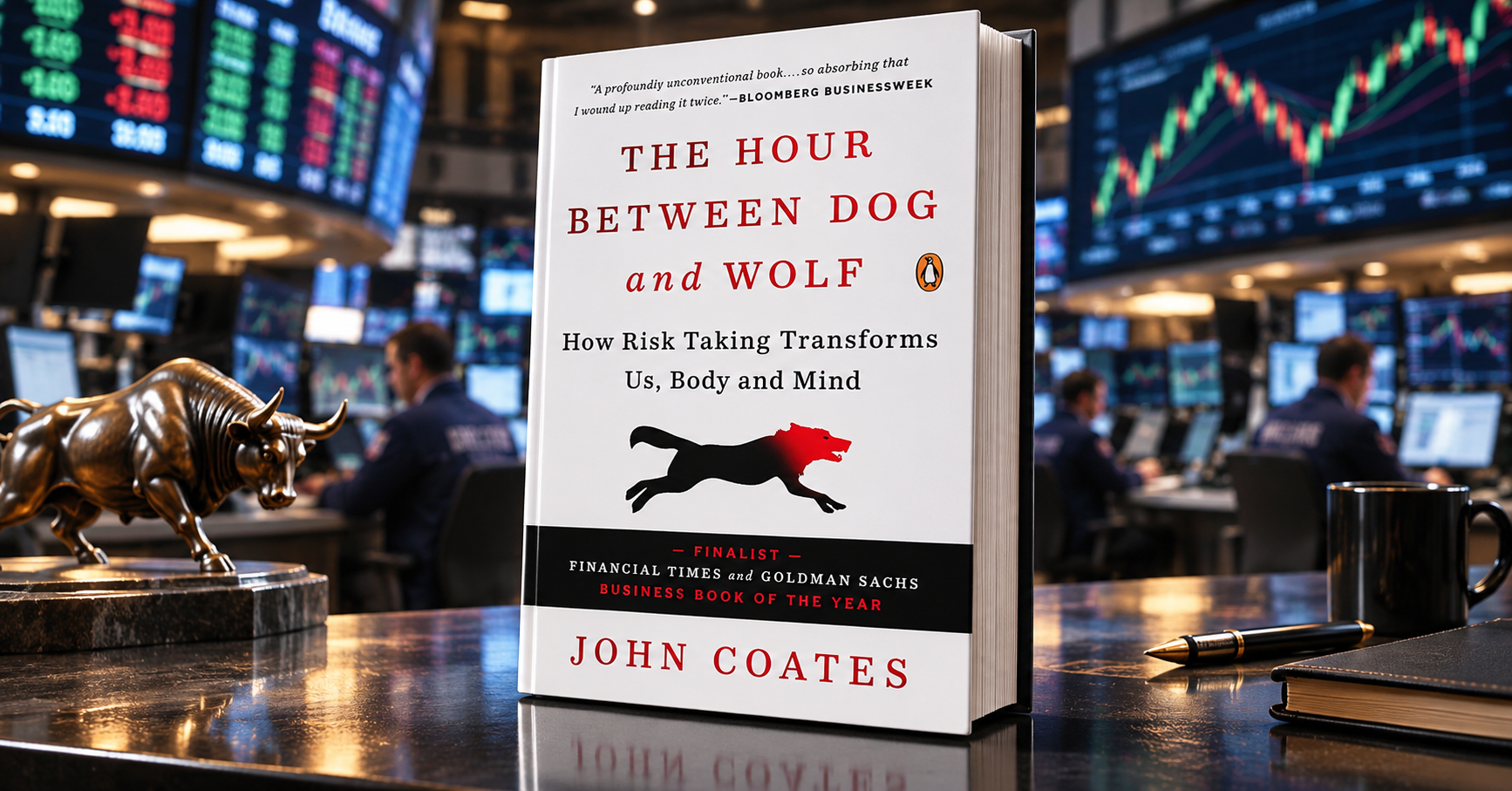
John Coates has written the rare trading-psychology book that earns its theory with lab work. His argument: bubbles are fed by testosterone, crashes by cortisol, and the trader in the middle is more passenger than pilot. He is right more often than he can prove, and he seems to know the difference better than his publisher does.
Coates traded at Goldman Sachs, Merrill Lynch and Deutsche Bank, ran a derivatives desk, then traded his screens for a Cambridge neuroscience lab. That résumé is the book’s engine and its conflict of interest. A man who watched P&L swing a floor’s mood for years is now selling the biochemical explanation for it.
In a live trading environment, the opening chapters ring true. The streak that makes you feel taller, the sizing that creeps up without a decision, the sudden certainty that the market is simply wrong: Coates names the physical sensation behind each. Anyone who has traded through a drawdown knows the other half too: the tight chest, the shortened horizon, the urge to flatten everything just to make the feeling stop.
The book landed in 2012, with 2008 still smoking and Occupy Wall Street camped downtown. Its timing is also its trap, because “it’s the hormones” is a delightfully convenient alibi for an industry that spent the 2000s denying it had any inhibitions to lose. Read it for the physiology, and watch who benefits from the framing.
Key Takeaways
- Winning changes the trader before it changes the market: a streak raises testosterone, and with it risk appetite, at exactly the point when risk should shrink.
- Stress is a pricing input: rising volatility lifts cortisol, and cortisol makes traders more risk-averse just as risk premia are widening.
- Bubbles and crashes are two halves of one feedback loop: euphoria inflates positions, panic deflates them, and neither state feels irrational from the inside.
- Risk management that ignores the risk-taker is incomplete: Value-at-Risk limits are written for a calm brain that rarely shows up for work in a crisis.
- Your gut is data, not gospel: body signals can flag risk before your model does, but they also manufacture false confidence on the way up.
Overview
Coates builds one argument across the book: financial markets are populated by animals with endocrine systems, and those systems are procyclical. Testosterone rises with wins and pushes the trader toward bigger bets. Cortisol rises with uncertainty and novelty and pushes the same trader toward retreat.
The empirical spine is a pair of studies Coates ran with Joe Herbert. In the first, published in PNAS in 2008, morning testosterone in 17 male traders on a London floor predicted that day’s profit, while cortisol climbed with the variance of their results and with market volatility. In a second PNAS paper, the ratio of index to ring finger length (the 2D:4D digit ratio, a proxy for prenatal testosterone exposure) tracked the long-run profitability of 44 high-frequency traders.
From there he scales up to the dot-com bubble and the Lehman Brothers collapse. His claim is that the winner effect helped inflate the Nasdaq into March 2000, and that a cortisol-soaked risk aversion helped freeze credit markets after September 2008. The title comes from the French twilight phrase for the hour when you cannot tell dog from wolf, a fair metaphor for any market top.
Writing & Structure
Prose Style
Coates writes like a former trader and sounds like a lecturer, which is both the book’s charm and its drag. The Wall Street scenes crackle, the endocrinology chapters are lucid, and the transitions between them occasionally creak. He explains the stress response better than most textbooks, using plain language and no condescension.
Structure & Pacing
The book moves from the trading floor to the lab bench to the global economy, and the pacing is best at the first stop. The weakest stretch is the policy material near the end, where hormone-aware risk management and more diverse trading floors are floated with far less data than the early chapters carry.
Research Depth
The scientific literature is cited fluently, and Coates deserves credit for running his own experiments on live trading floors, which nobody else was doing. The financial mechanics are thinner than the physiology. Margin calls, leverage and funding markets appear as scenery, not as machinery.
The Trader’s Lens
Central Financial Concepts
- Procyclical risk appetite: position sizes expand after gains and contract after losses, amplifying both trends.
- Volatility as a physiological stressor: realized volatility feeds cortisol, which shifts risk preferences against the grain of the opportunity.
- The winner effect: a streak of profitable trades changes confidence and hormonal state, not just the account balance.
- Herding and bubble dynamics: collective euphoria and collective panic emerge from shared chemistry as much as shared information.
Lessons for Traders
- Cap size after streaks. Set position limits before the run starts, because the chemistry will not permit a sober decision afterward.
- Treat a drawdown as a state change. After a sharp loss, you are a different risk-taker, so trade smaller or step aside until you are not.
- Study the historic tops. The Nasdaq Composite topped near 5,048 in March 2000 on a floor full of people who felt invincible, and Lehman filed for bankruptcy on 15 September 2008 amid a floor full of people who felt doomed.
- Build rules, not resolutions. Pre-committed stop-losses and size limits work because they remove the decision from the compromised moment.
Accuracy vs. Narrative Spin
Here is where a veteran earns his skepticism. A sample of 17 male traders at one firm, over a short window, is a suggestive result and not a law of markets. Correlation also runs both ways: a trader who anticipates a good day may show elevated testosterone before the trades, not because of them.
In my own experience, the leap from individual hormones to market-level bubbles skips the plumbing. Bubbles are also built from leverage, mandates and benchmarks. The 2008 selloff was forced by margin calls, Value-at-Risk breaches and funding withdrawals that would have occurred whatever any individual’s cortisol was doing.
Then there is Coates himself. His career now sits in the neuroscience of risk, so a thesis that biology explains booms and busts is also a thesis that biology research deserves attention and funding. “The hormones made them do it” also quietly absolves every bank that paid for risk-taking and called it culture.
Psychology & Culture
The trading floor Coates describes is an identity machine. Traders are rewarded for confidence, so confidence is what they perform, and the body then makes the performance real. By the time the position is oversized, the story that justifies it (“this time I see it clearly”) has already been written by the same chemistry that created the position.
The rationalization chain is the most useful thing here. A win raises testosterone, the trader attributes the win to skill, and skill justifies size. A loss raises cortisol, the trader attributes it to a hostile market, and a hostile market justifies exit. In neither state does the trader feel biased, which is why no one on the floor ever self-diagnoses.
The culture amplifies it. Floors that celebrate the big winner and quietly shun the stopped-out trader are manufacturing the loop at scale. Coates’s mild suggestion that older and more diverse trading floors might dampen the cycle is the part of the book bank compliance departments have most thoroughly ignored.
Trader Insight
Your highest-conviction trades are placed in your most chemically compromised state. The feeling of certainty that makes you size up after a winning streak is a symptom of the streak, not evidence about the market.
Reader Fit
- Retail traders: the most useful audience, because you have no risk desk to override you, but expect diagnosis without a prescription; Coates tells you what is happening to you and offers no tested protocol.
- Finance and economics students: a sharp antidote to efficient-market orthodoxy, though you will need a separate text on leverage and funding to explain why 2008 happened.
- Wall Street insiders: a flattering read, since it nearly makes you blameless, and you should resist that flattery; the risk-management chapters are too gentle to threaten anyone’s bonus.
- General readers: an accessible tour of the stress response, but the trading jargon arrives faster than it is explained, so you may skim the desk anecdotes.
Verdict
Final Score: 8/10
Composite Score
| CATEGORY | SCORE (/10) | WEIGHT | WEIGHTED | BAR |
|---|---|---|---|---|
| Financial Accuracy | 7 | 25% | 1.75 | |
| Writing & Clarity | 8 | 20% | 1.60 | |
| Trader Psychology | 9 | 25% | 2.25 | |
| Educational Value | 8 | 15% | 1.20 | |
| Lasting Relevance | 8 | 15% | 1.20 | |
| TOTAL | 100% | 8.00 |