

Worth reading as a risk-management seminar, not as a catalogue of proven edges. The headline returns are self-reported, unaudited and filtered through survivorship, so the only transferable asset is how these traders size positions and cut losses. Read it if you already blow up accounts through sloppy sizing; skip it if you are hunting for a strategy to copy.
Introduction
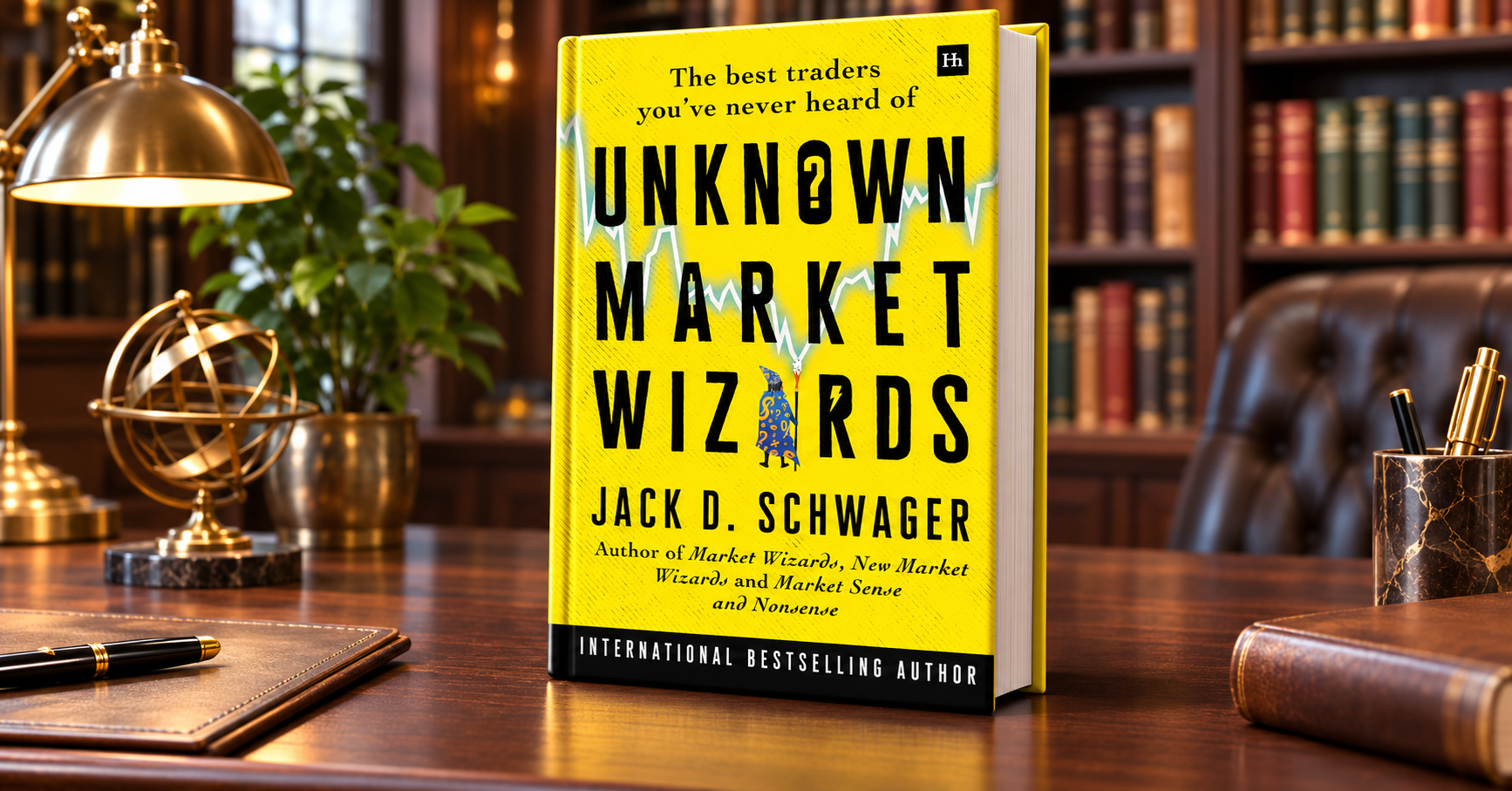
Unknown Market Wizards is a 7/10 book that teaches risk control brilliantly and proves nothing about returns. The traders are compelling. The performance records are self-reported, and nobody in the book opens a brokerage statement.
The 1989 original Market Wizards gave us pit-era legends who shouted into open outcry and filled tickets by hand. This sequel swaps the trading floor for the home office, and the prop desk for a retail account with a single human acting as trader, risk manager and compliance department. The technology changed; the ego did not.
What works is the common thread beneath wildly different methods. These traders cap the loss per trade, size positions to survive being wrong, and adapt when the market regime changes. In a live trading environment, this is the only content that matters, because I have watched far more accounts die from sizing errors than from bad ideas.
What fails is the evidence. The blurb touts a trader with a nine-year record averaging just under 300% a year, which is an arithmetic average and therefore close to meaningless without compounded return, maximum drawdown and account size. Stated that way, the number is a sales line, not a statistic.
Key Takeaways
- Survival is the edge: methods differ wildly, but every trader here limits per-trade loss so that no single position can end the account.
- Average annual return is a vanity metric: an arithmetic mean near 300% reveals nothing about geometric growth, drawdown depth or capacity.
- Survivorship bias is the invisible co-author: we meet the traders who lasted, never the identical-looking ones who blew up.
- Regime change is the real exam: the revised edition tests each trader against the 2020 crash, the V-shaped rebound, inflation and the 2022 bear market.
- Solo traders carry zero institutional guardrails: no risk committee, no prime broker margin call policy, only personal discipline.
Overview
The premise is simple: individuals trading their own accounts, unknown to the investment world, with performance that Schwager says rivals professional managers. Each chapter follows the interview format of the Market Wizards series: background, how they found trading, method, worst trades, and lessons.
The revised 2023 edition returns to every trader to ask how they handled 2020 to 2022. That window includes the S&P 500’s roughly 34% collapse from February to March 2020, a VIX close near 83 on March 16, 2020, the violent snap back to new highs, and the inflation-driven bear market of 2022.
The methods span discretionary and systematic approaches across instruments, which is the book’s quiet strength. It never pretends a single style is the answer, so the reader sees a dozen contradictory ways to make money and one consistent way to avoid losing it all.
Writing & Structure
Interview Craft
Schwager’s gift is the follow-up question. He lets a trader ramble, then pins the story to a number: what was the position size, where was the stop, how deep was the drawdown. That instinct is why the book beats most trading memoirs.
Pacing & Repetition
The Q&A format is readable on a commute, but it repeats itself. Roughly every third trader rediscovers the same lesson about cutting losses, and by the middle chapters you can predict the confession.
Research Depth
The depth is conversational, not forensic. There is no independent verification, no auditor’s letter and no third-party data, so the reader is asked to extend trust on the strength of the author’s reputation.
The Trader’s Lens
Central Financial Concepts
- Position sizing and risk per trade: the fraction of equity risked on a single idea, which determines survival far more than entry quality.
- Discretionary vs. systematic execution: judgment-driven trading against rules-based models, each with its own failure mode.
- Drawdown vs. return: the peak-to-trough loss that actually breaks accounts and psychology, which headline returns conceal.
- Leverage and tail risk: margin and derivative exposure that turns a bad week into an account-ending event.
- Regime change: the shift from trending to mean-reverting, or low to high volatility, that kills strategies calibrated to the previous environment.
Lessons for Traders
- Define the loss before the entry. The 2020 crash showed what undefined risk does to a portfolio in a month.
- Beware selling volatility without a hedge. The February 2018 collapse of the inverse-VIX note XIV is the standing proof that steady premium collection ends in a cliff.
- Treat a strategy’s best year as an outlier, not a baseline. Returns near 300% are a sample, and the next sample is rarely kind.
- Reduce size when you stop understanding the market. Adaptation beats conviction every time.
Accuracy vs. Narrative Spin
The market mechanics are accurate. The performance narrative is where the spin lives. A near-300% average annual return, as quoted for one trader, is an arithmetic average; a few outsized years can lift the mean while compounded growth and drawdown tell a very different story.
In a live trading environment, this passage should make you suspicious, because small accounts scale badly. A strategy that prints triple digits on a modest balance often cannot absorb real capital without slippage destroying the edge.
Then there is the conflict of interest. Schwager’s brand is built on discovering and vouching for traders, and he co-founded FundSeeder, a platform premised on finding undiscovered talent. That is the same premise as this book, and it deserves a disclosure that the narrative never provides.
Psychology & Culture
The defining culture here is the absence of one. No firm, no risk manager, no boss who can force a trader to cut. Every trader is their own compliance department, so the book is really about identity: the self-image of the outsider who beat the professionals.
That identity cuts both ways. It fuels the discipline that keeps losses small, but it also builds a rationalization chain: I am disciplined, therefore my results are skill, therefore my drawdowns are tuition. Every survivor tells that story, including the ones who were lucky.
The humor for veterans is the era contrast. In 1989 the legend was a pit trader with a leather jacket and a runner; in 2020 it is a person at a laptop with a margin account. The greed, fear and self-congratulation are word-for-word the same.
Trader Insight
Every trader in this book narrates their worst loss as tuition rather than evidence, and the format never asks whether an identical narrative could be told by someone who simply got lucky for nine years. Without audited statements, the reader cannot tell discipline from variance.
Reader Fit
- Retail traders: the best audience for the risk lessons, and the most exposed to the book’s trap of copying a strategy that survivorship made look easy.
- Finance and economics students: useful color on how practitioners think, but it offers no theory, no data and nothing you could cite in a paper.
- Wall Street insiders: thin gruel; professionals will find the stories familiar and the lack of audited evidence unforgivable.
- General readers: readable and engaging, yet it quietly implies that beating the market is a matter of grit, which the base rates contradict.
Verdict
Final Score: 7/10
Composite Score
| CATEGORY | SCORE (/10) | WEIGHT | WEIGHTED | BAR |
|---|---|---|---|---|
| Financial Accuracy | 7 | 20% | 1.40 | |
| Writing & Clarity | 8 | 15% | 1.20 | |
| Trader Psychology | 8 | 25% | 2.00 | |
| Educational Value | 7 | 20% | 1.40 | |
| Lasting Relevance | 7 | 20% | 1.40 | |
| TOTAL | 100% | 7.40 |