Too Big Ti Fail review explores the 2008 crisis through a trader’s lens, highlighting systemic risk, liquidity shocks, and decision-making under pressure. Learn how real-world policy moves and market psychology influence outcomes—and see why these lessons remain critical for traders today.
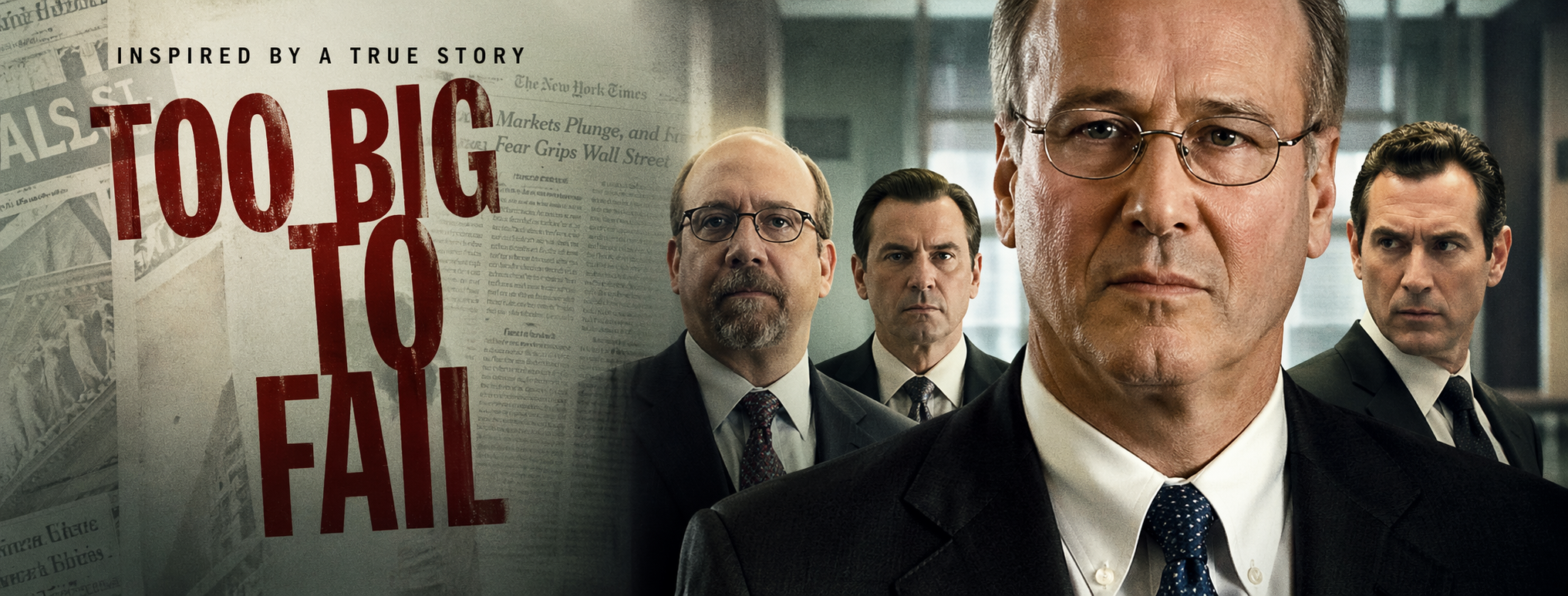
Too Big to Fail is less a traditional narrative than a dramatized case study of systemic collapse. Adapted from Andrew Ross Sorkin’s chronicle of the 2008 financial crisis, the film centers on Henry Paulson, played with stoic urgency by William Hurt. Paulson, a former Goldman Sachs CEO turned government steward, is thrust into the eye of a storm as the U.S. financial system teeters on the brink.
The film tracks a compressed timeline—from the collapse of Lehman Brothers to the emergency rescue of AIG—with key players including Ben Bernanke (Paul Giamatti), Timothy Geithner (Billy Crudup), and Wall Street executives such as Richard Fuld.
Spoilers are inherent to history: Lehman is allowed to fail, triggering market panic, while AIG receives a controversial bailout to prevent broader contagion. The narrative tension lies not in what happens, but in how decisions are made under extreme uncertainty. Paulson’s internal conflict—balancing moral hazard against systemic collapse—anchors the film’s thematic core. The story concludes with the rollout of the Troubled Asset Relief Program (TARP), a last-ditch effort to stabilize the financial system, albeit at immense political and public cost.
Cinematic Qualities
Director Curtis Hanson opts for a restrained, almost documentary-like approach. There are no cinematic flourishes or attempts to dramatize trading floors in the style of high-octane finance films. Instead, the film leans heavily on dialogue, boardroom tension, and close-ups of decision-makers navigating ambiguity.
The ensemble cast is uniformly strong. William Hurt delivers a measured performance that avoids caricature, presenting Paulson as neither villain nor savior but a pragmatic operator under duress. Paul Giamatti’s Bernanke is quietly cerebral, embodying the academic thrust into crisis management. Billy Crudup’s Geithner provides a counterbalance—urgent, occasionally exasperated, and deeply aware of systemic fragility.
Pacing is deliberate, sometimes to a fault. The film demands attention and familiarity with financial institutions; viewers expecting narrative momentum may find it dense. Yet this pacing mirrors the bureaucratic reality of crisis response—slow, procedural, and punctuated by moments of sudden urgency.
Production values are solid but unobtrusive. The visual palette—muted offices, dimly lit conference rooms—reinforces the gravity of events. There’s an intentional absence of spectacle, which may limit mainstream appeal but enhances credibility.
Trader’s Lens
Core Financial Concepts
At its heart, Too Big to Fail is a study in systemic risk and liquidity crises. The film highlights several key concepts:
- Counterparty Risk: The collapse of Lehman Brothers exposes the interconnectedness of financial institutions. When one fails, others face immediate solvency concerns.
- Leverage: Investment banks are shown operating with extreme leverage, amplifying both gains and losses.
- Moral Hazard: The decision to bail out AIG but not Lehman underscores the dilemma—rescue institutions and encourage reckless behavior, or allow failure and risk systemic collapse.
- Liquidity vs. Solvency: A recurring theme is whether institutions are fundamentally insolvent or merely illiquid—a distinction that proves critical in crisis management.
- Government Intervention: The mechanics and controversy of TARP illustrate how public capital is deployed to stabilize private markets.
Lessons for Traders
For practitioners, the film offers sobering lessons:
- Liquidity Is Paramount: Markets can remain irrational longer than traders can remain solvent—but more critically, they can become illiquid faster than models predict.
- Correlation Spikes in Crisis: Diversification fails when systemic risk materializes; correlations converge toward one.
- Risk Models Are Fragile: The crisis exposes the limitations of quantitative models that underestimate tail risk.
- Psychology Drives Markets: Fear, not fundamentals, dictates price action during panic.
- Policy Risk Matters: Government decisions—often unpredictable—can override market logic.
Accuracy vs. Dramatization
The film adheres closely to documented events, with minimal embellishment. Dialogue is reportedly drawn from real accounts, lending authenticity. However, the simplification of complex financial instruments—such as collateralized debt obligations (CDOs)—is unavoidable. The film assumes a baseline understanding of finance, which may obscure nuance for general audiences.
What rings true is the opacity and confusion even among experts. The crisis is not portrayed as a clear-cut failure but as a cascade of misjudgments, structural flaws, and unforeseen consequences.
Psychology & Culture
Too Big to Fail excels as a study in institutional psychology. The film portrays a culture where decision-making is shaped by:
- Incentive Structures: Executives are incentivized to maximize short-term gains, often at the expense of long-term stability.
- Cognitive Biases: Overconfidence and confirmation bias permeate discussions, particularly in the early stages of the crisis.
- Groupthink: Consensus-driven decision-making delays recognition of systemic risk.
- Survival Instincts: As the crisis deepens, self-preservation overtakes ideology.
Paulson’s arc reflects the tension between free-market principles and pragmatic intervention. A former advocate of minimal government interference, he ultimately orchestrates one of the largest bailouts in history. The film does not moralize but presents the dilemma starkly: in a collapsing system, ideological purity becomes a luxury.
The portrayal of Wall Street executives is nuanced. Figures like Richard Fuld are not depicted as villains but as leaders entrenched in a system they helped build yet could no longer control. The film suggests that the crisis was less about individual malfeasance and more about systemic incentives misaligned with long-term stability.
Audience Fit
This is not a film for casual viewing. Its primary audience includes:
- Finance professionals and traders: The film offers a granular look at crisis management and systemic risk.
- Finance students: It serves as a practical complement to academic theory, illustrating real-world applications and failures.
- Policy analysts: The interplay between government and markets provides valuable insights.
General audiences may find the film intellectually engaging but emotionally distant. Unlike more stylized finance films, Too Big to Fail prioritizes accuracy over entertainment.
Verdict / Rating
8.3 / 10
Too Big to Fail is less about trading strategies and more about the architecture of modern finance under stress. It strips away the glamour often associated with Wall Street and replaces it with a sobering reality: markets are human constructs, vulnerable to fear, error, and systemic fragility.
Trader’s Takeaway:
In crisis conditions, fundamentals yield to liquidity, and models yield to psychology. The film is a reminder that risk management is not merely about optimizing returns—it is about survival in scenarios where the rules themselves are rewritten.