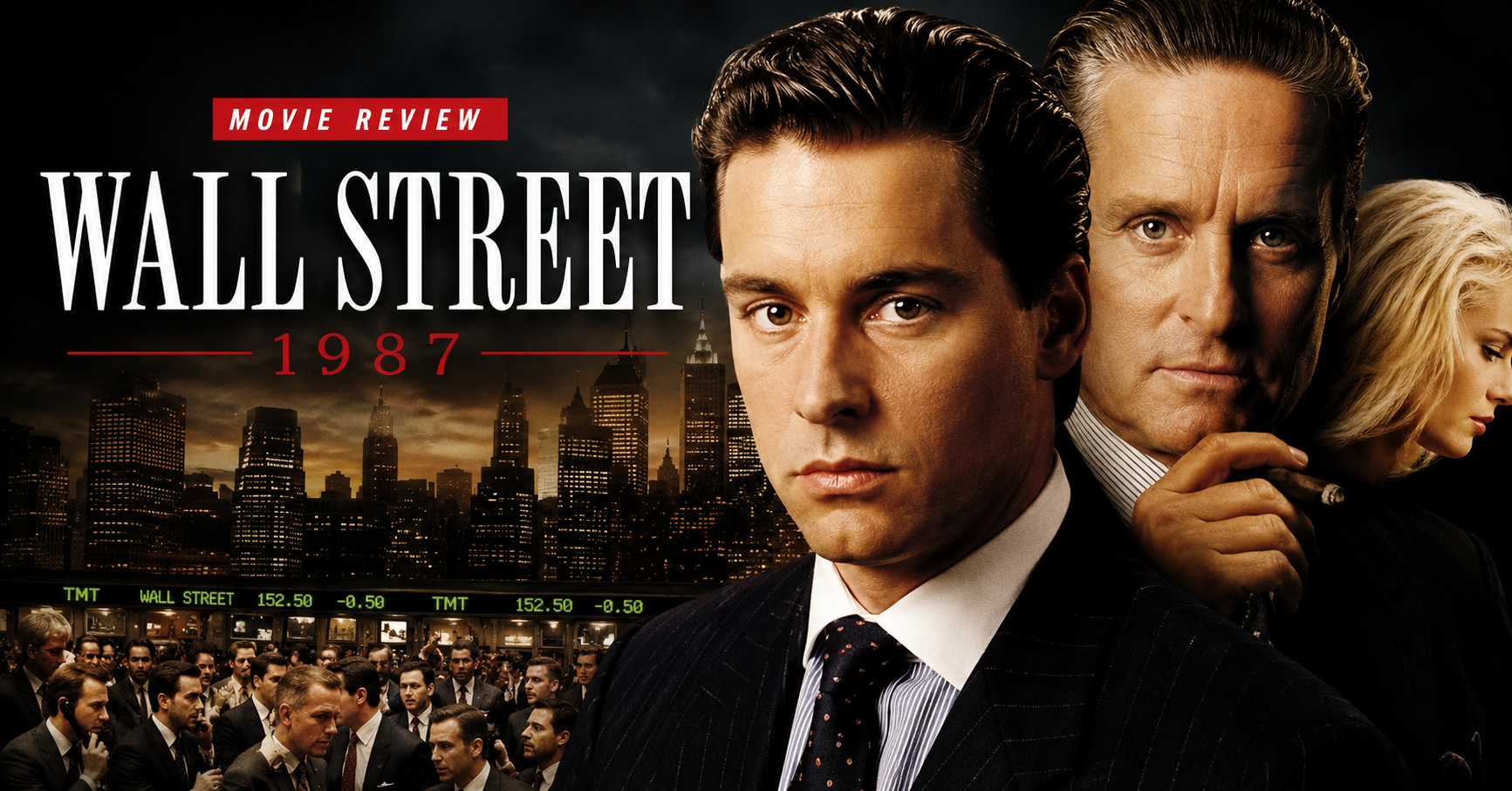
Wall Street (1987) is the most culturally dangerous finance film ever made — dangerous because its villain is more compelling than its hero, and because the insider trading mechanics it depicts are nearly textbook accurate. Essential viewing for anyone who wants to understand why information asymmetry is the only edge that matters, and what the SEC does when it finds yours.
Introduction
Eight out of ten. That is the score, and it is earned despite — not because of — the fact that Wall Street (1987) became the accidental recruitment poster for every finance-bro who followed. Oliver Stone set out to make a cautionary tale and inadvertently minted a generation of Gordon Gekko cosplayers who missed the final act entirely. That is not a criticism of the film. It is, in fact, the highest possible compliment: the financial psychology Stone captures is so accurate that audiences absorbed the ideology and tuned out the consequence.
This is the film that gave the world the phrase “greed is good” — lifted, loosely, from Ivan Boesky’s actual 1986 commencement address at UC Berkeley, delivered eighteen months before Boesky himself paid $100 million to settle insider trading charges with the SEC. The symmetry is almost too perfect. Stone knew exactly what he was documenting, and the late-1980s Wall Street he renders — the screaming equity desks, the brick-shaped mobile phones, the glowing amber of monochrome Reuters terminals — is a period piece of forensic precision.
What holds up thirty-seven years later is not the aesthetics. What holds up is the psychology of the deal, the structure of the illegal edge, and the moral corrosion that happens one small rationalisation at a time. Those have not aged a single day.
Key Takeaways
- Information asymmetry is the only durable trading edge — and Wall Street illustrates with uncomfortable clarity that the most powerful version of it is, and always has been, illegal.
- Greenmail mechanics are depicted with genuine sophistication — the film correctly shows how accumulating a minority stake can extract a premium exit from company management desperate to preserve their positions.
- The SEC investigation arc is structurally accurate — cooperation agreements, wire taps, and the use of a junior trader as a cooperating witness against the principal are standard enforcement tools, not dramatic invention.
- The film’s central villain is a better trader than its hero — Gekko’s analytical discipline, work ethic, and information network are genuinely admirable, which is exactly the point and exactly the problem.
- Emotional proximity to a trade is the most reliable indicator of compromised judgment — Bud Fox’s decision to tip Gekko on Bluestar Airlines using his father’s inside knowledge is the film’s most psychologically honest moment.
Synopsis
Bud Fox (Charlie Sheen) is a junior broker at Jackson Steinem & Co., cold-calling his way through 59 rejections a day and burning to escape his father’s world of union meetings and engine grease. His obsession is Gordon Gekko (Michael Douglas) — corporate raider, information predator, and the most feared accumulator of material non-public information in the market. After weeks of failed approaches, Fox bribes his way into Gekko’s calendar with a piece of inside information: his father, Carl Fox (Martin Sheen), is a union steward at Bluestar Airlines and has just mentioned in passing that the airline is about to be cleared of liability in a crash investigation. Fox delivers this MNPI — material, non-public, and utterly illegal to trade on — and Gekko is in.
What follows is a masterclass in the mechanics of insider trading by proxy. Gekko uses a network of offshore accounts and nominee holders to accumulate positions ahead of catalysts that Fox feeds him. Fox, in turn, is rewarded with a corner office, a luxury apartment, and enough commission to feel like he is participating in something larger than himself. The escalation is textbook: each step feels small, each rationalisation feels reasonable, and the exit feels impossibly far away.
The film pivots when Gekko targets Teldar Paper — a publicly theatrically staged hostile takeover complete with the famous shareholder meeting monologue — and then turns his attention to Bluestar itself. Here Fox discovers that Gekko’s plan is not to save the airline his father has devoted his life to, but to bust it up for parts, liquidate the pension fund, and pocket the arbitrage. Fox, in an act of conscience that arrives somewhat late in the film’s moral ledger, engineers a white knight defence by feeding false position information to Gekko and orchestrating a competing buyer. The SEC, which has been watching for some time, closes in. Bud Fox wires up. Gordon Gekko goes to prison. And Bud Fox, rather implausibly, walks away with something resembling redemption.
Cinematic Qualities
Performance
Michael Douglas won the Academy Award for Best Actor and it was not close. Gekko is not a cartoon villain — he is a genuinely disciplined operator whose work ethic, information network, and analytical precision would be admirable in any legitimate context. The performance works because Douglas plays him as a man who believes everything he says, which is far more unsettling than straightforward malevolence. Charlie Sheen is competent but outgunned in every scene they share, which is narratively convenient: Fox is supposed to be dazzled into complicity, and Sheen’s slightly glazed charisma sells it.
Direction and Period Authenticity
Oliver Stone shoots the trading floor sequences with the kinetic aggression they deserve — open-outcry pits, rows of blinking Quotron terminals, the physical noise of a market that has not yet been reduced to a blinking cursor. The contrast between the analogue chaos of the floor and the clinical calm of Gekko’s corner office is the film’s most intelligent visual argument: real information moves quietly, at the top, before the noise reaches the street. Stone’s father was a stockbroker who lost money in the 1929 crash, and the film carries the specific weight of inherited financial trauma. It shows.
Screenplay
Stanley Weiser and Stone’s script is best when it stays in the transactional register — the deal talk, the pressure sequences, the oblique negotiation of who owes what to whom. It weakens in its final act, where Fox’s redemption arc is compressed into a series of scenes that ask the audience to believe a man facing federal securities charges can orchestrate a multi-party defensive transaction while simultaneously cooperating with the government. In a live environment, that coordination would be impossible without the SEC directing traffic. Hollywood tidied the ending in ways that the actual legal process does not permit.
Production Design
The production design is now involuntarily hilarious in the way that only period-accurate technology can be. The brick-format mobile phones, the physical teletype machines, the physical paper research reports — all the infrastructure of a market operating entirely on delayed information. What the production gets exactly right is that none of this slowed Gekko down. The information advantage was structural, not technological. He was always first because he had sources. The phone was just the delivery mechanism.
The Trader’s Lens
Central Financial Concepts
- Material Non-Public Information (MNPI): the legal threshold that separates legal research from securities fraud — information is “material” if a reasonable investor would consider it significant to an investment decision, and “non-public” if it has not been disclosed to the market.
- Insider Trading by Proxy (Tipping): Gekko does not receive information directly from company insiders — he receives it from Fox, who receives it from his father. This is classical tipping liability under Dirks v. SEC (1983), and the film depicts the liability chain with surprising legal precision.
- Greenmail: the practice of accumulating a minority stake in a target company and then threatening a hostile takeover unless management repurchases the stake at a premium — a form of legalised corporate extortion that was common in the 1980s and is now largely neutralised by poison pill defences.
- Hostile Takeover and Asset Stripping: Gekko’s plan for Bluestar — buying the airline and liquidating its pension fund to finance the acquisition — mirrors the actual LBO strategies of the period, particularly the KKR playbook and Boone Pickens’ raids on oil majors.
- White Knight Defence: a target company’s strategy of finding a preferred acquirer to outbid a hostile raider; Fox engineers this for Bluestar, though his execution involves feeding false position data to Gekko, which is itself a form of market manipulation.
Lessons for Traders
- Edge decay is inevitable — every information advantage Gekko exploits is time-limited. The moment Fox delivers a tip, the clock starts on its legal and commercial shelf life. This mirrors the actual half-life of alpha in quantitative strategies: the moment an edge is widely understood, it disappears.
- The Ivan Boesky parallel is not incidental — Boesky was arrested in November 1986, one year before the film’s release. His cooperation with the SEC led directly to Michael Milken’s prosecution. Stone was documenting a scandal in real time, and Gekko’s downfall mirrors Boesky’s almost beat for beat.
- Position sizing as psychological pressure — when Gekko gives Fox $500,000 to manage, the position is not large enough to matter to Gekko but is enormous relative to Fox’s entire net worth. This is a deliberate entrapment mechanism: once Fox is personally invested, his judgment is compromised and his loyalty is purchased.
- Regulatory patience is not regulatory absence — the SEC’s surveillance of Gekko is depicted as a long-term observation exercise, not a reactive investigation. In a live environment, pattern-recognition algorithms now do this work continuously. The film gets the institutional patience exactly right.
Accuracy vs. Dramatization
In a live trading environment, the insider trading mechanics ring almost uncomfortably true. The use of offshore nominee accounts, the layering of trades across unrelated instruments to obscure the pattern, and the speed with which a well-positioned raider can move from information receipt to position establishment — all of this reflects actual enforcement case records from the period. The SEC’s Boesky investigation files, which became public in the early 1990s, read like a slightly less dramatic version of what Stone depicts.
Where the film departs from reality is in the resolution. Bud Fox’s counter-manipulation of the Bluestar situation — feeding false intelligence to Gekko to drive the stock — is itself market manipulation under Section 10(b) of the Securities Exchange Act. The film presents this as heroism. A federal prosecutor would have presented it as count two of the indictment. Fox’s cooperation agreement would have been extraordinarily complex to structure given his own ongoing conduct, and the idea that he walks away to start again in banking requires a suspension of disbelief that the film does not earn. Hollywood needed a moral exit for its protagonist. The actual legal system would not have provided one.
The Teldar Paper shareholder meeting — the “greed is good” set piece — is also theatrically compressed. Real activist shareholder campaigns at this scale involve months of proxy solicitation, 13D filings, and regulatory disclosure requirements that would make for a considerably less cinematically efficient sequence. But the psychological content of the speech, the framing of corporate inefficiency as a moral failure and shareholder returns as a civic obligation, is a precise transcript of the ideology that actually powered the 1980s takeover wave.
Psychology & Culture
The film’s deepest and most enduring insight has nothing to do with insider trading mechanics. It is about the psychology of the talent trap — the specific cognitive distortion that occurs when a genuinely capable person is granted access to an environment that validates their ambition while systematically dismantling their ethical framework. Bud Fox is not stupid. He is not weak. He is precisely smart enough and precisely ambitious enough to rationalise each step as reasonable given the step that preceded it.
Gekko’s genius — as a character, and as a depiction of a real psychological type — is that he does not corrupt Fox. He simply creates conditions in which Fox corrupts himself. The information Fox delivers on Bluestar Airlines is not extracted under duress. It is offered voluntarily, in the first meeting, as an audition. Fox has already decided who he wants to become before he walks into that office. Gekko just schedules the appointment.
The firm culture Stone depicts — Gekko’s operation specifically, but also Jackson Steinem’s boiler-room energy — selects for psychological profiles that are constitutionally unsuited to the kind of patient, rule-governed behaviour that legitimate markets require. The people who thrive in these environments are precisely the people who should be most closely supervised. The regulatory implication is obvious. The industry’s historical record suggests it has not yet fully absorbed it.
Trader Insight
The most psychologically accurate moment in Wall Street is not the “greed is good” speech. It is the scene in which Fox delivers the Bluestar tip and then watches Gekko’s face for approval. He is not selling information. He is purchasing identity. The trade is not financial — it is existential. Fox is buying access to the version of himself he has decided he wants to be, and Gekko is the only vendor. This is the psychological mechanism that drives every instance of market misconduct from insider trading to rogue trading: not greed alone, but the weaponisation of identity against judgment.
Audience Fit
- Retail traders — Essential, with the caveat that they must watch the entire film and not stop at the shareholder meeting. The mechanics of how information advantage is sourced, layered, and eventually detected are directly relevant to understanding why certain trading patterns attract regulatory scrutiny.
- Finance and economics students — Exceptional pedagogical value, particularly when paired with the actual SEC enforcement chronology of the period. The Boesky case, the Milken prosecution, and the contemporaneous passage of the Insider Trading Sanctions Act of 1984 provide a regulatory frame that transforms the film into a primary source document.
- Wall Street insiders — Complicated. The film is accurate enough to be recognisable and dramatised enough to be irritating in its tidiness. The Gekko character will be immediately legible as a composite of multiple real operators. The resolution will feel legally implausible to anyone who has sat in an SEC enforcement conference room.
- General audiences — Accessible and genuinely entertaining, though the financial mechanics will recede into background texture for viewers not tracking the instrument-level detail. The emotional arc — son tries to escape father’s world, nearly destroys it, comes back — is universal enough to carry the film without a securities law degree.
Verdict
Final Score: 8/10
Composite Score
| Category | Score (/10) | Weight | Weighted | Bar |
|---|---|---|---|---|
| Financial Accuracy | 8/10 | 30% | 2.40 | |
| Cinematic Quality | 9/10 | 25% | 2.25 | |
| Trader Psychology | 9/10 | 20% | 1.80 | |
| Educational Value | 8/10 | 15% | 1.20 | |
| Rewatchability | 7/10 | 10% | 0.70 | |
| Composite Weighted Score | 8.35 | |||