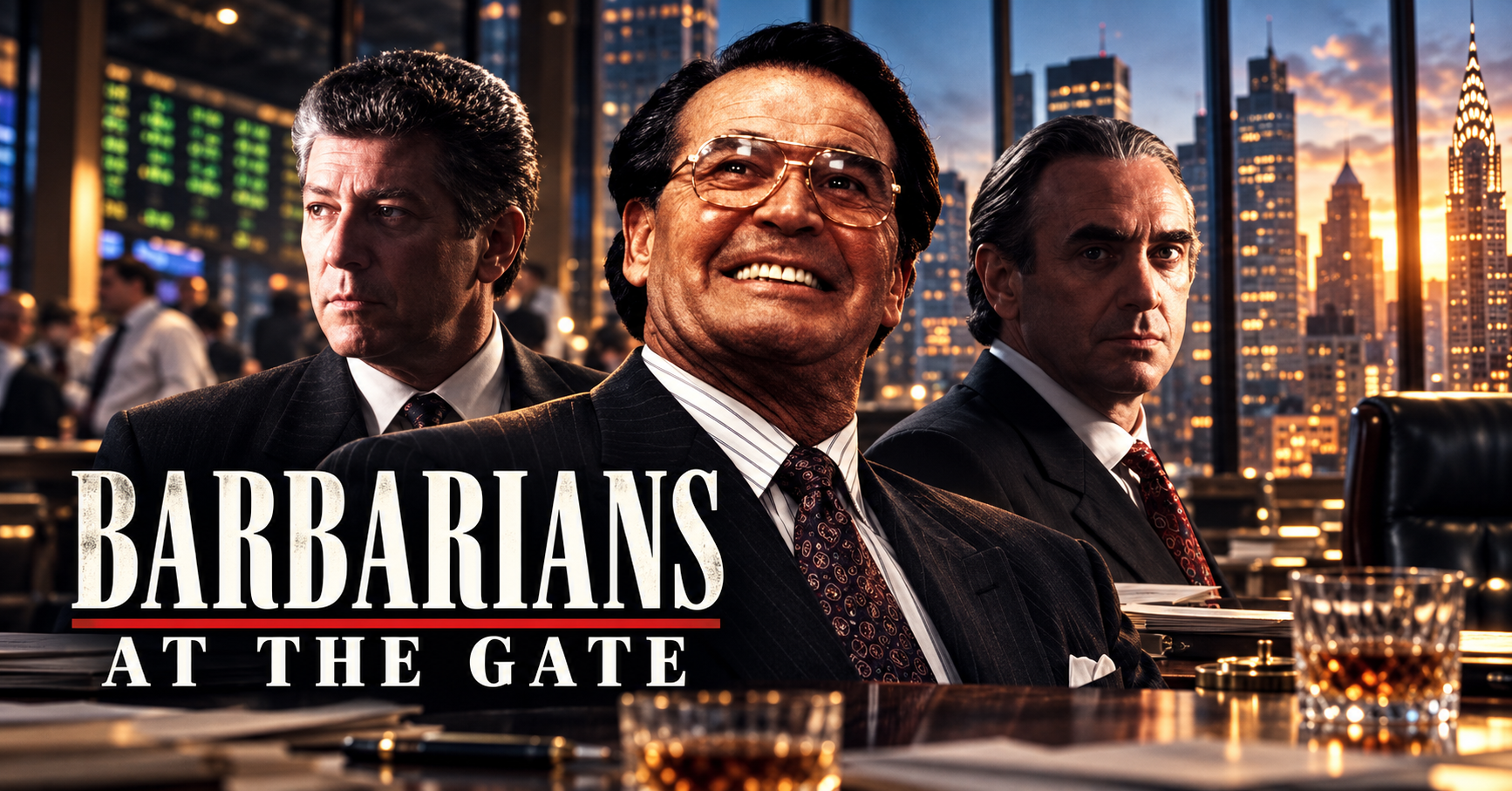
Essential viewing: a near-forensic dramatization of the RJR Nabisco leveraged buyout, and the best screen lesson in how incentives, not valuations, set the price of a deal. Watch it before you ever trust a bidding war.
Introduction
Barbarians at the Gate is the best film ever made about leverage, and it never needs a single chart to prove it. This HBO dramatization of the 1988 RJR Nabisco takeover gets the mechanics of a roughly $25 billion auction almost entirely right, then buries them under a dozen bruised egos. It earns an 8 out of 10 from me.
The setup is pure market theater. A CEO tries to buy his own company at a bargain, Wall Street smells blood, and the price climbs by nearly half in a matter of weeks. The stock was never the story; the auction was.
In a live trading environment, this rings true because the moment a name goes “in play,” fundamentals become a rumor and price action becomes a personality contest. I have watched desks reprice a stock on nothing more than a whisper about who was calling whom.
Then there is the hardware. Brick-sized mobile phones, faxes curling off the machine, and conference tables long enough to need their own zip code. The gadgets look like museum pieces, but the greed has not needed a software update since.
Key Takeaways
- A CEO bidding for his own company is holding an information advantage that no outside buyer can ever match.
- In a bidding war, price stops tracking value and starts tracking who is willing to lose face.
- Advisors paid on completion are structurally biased toward the bigger, dirtier, more expensive deal.
- Leverage does not create value; it moves risk onto whoever is left holding the paper.
- The “winner” of a hot auction is often the party that overpaid the most convincingly.
Synopsis
The film is based on the 1989 book by Wall Street Journal reporters Bryan Burrough and John Helyar, with Larry Gelbart writing the script. It follows F. Ross Johnson, the freewheeling CEO of RJR Nabisco, a tobacco and food conglomerate with a stock price he believed was far below its true worth.
Johnson and Shearson Lehman’s Peter Cohen propose a management buyout at $75 a share in October 1988. Within days, Henry Kravis of KKR arrives with a rival offer, and the board forms a special committee to run an auction.
The rest is escalation. Both sides lean on junk bond financing and exotic paper such as payment-in-kind securities, and the film shows the RJR “Air Force” and the flop of the smokeless cigarette, a project that burned through hundreds of millions of dollars. KKR wins at the end of November 1988 at roughly $109 a share, narrowly beating Johnson’s higher headline offer on perceived certainty and structure.
Cinematic Qualities
Performances
James Garner plays Johnson as a Southern-fried charmer who genuinely believes the rules are for other people. Jonathan Pryce gives Kravis the icy, hurt-pride precision of a man who cannot tolerate losing a deal, and Peter Riegert makes Cohen a study in ambition dressed as loyalty.
Direction and Writing
Gelbart, of M*A*S*H fame, writes Wall Street like a farce with a body count, and the tone is exactly right. Glenn Jordan keeps the boardroom scenes moving, which is no small feat when the central action is people arguing over securities structures.
Production Design
This is a cable-television budget, and it shows in a charming way. The smoke-filled offices and huge desktop hardware are a period piece that reminds you how recently this was the whole ecosystem.
The Trader’s Lens
Central Financial Concepts
- Leveraged buyout (LBO): acquiring a company mostly with borrowed money secured against the target’s own cash flows and assets.
- Junk bond financing: high-yield debt, in this era largely associated with Drexel Burnham Lambert, that made deals of this size possible.
- Management buyout: insiders bidding for the firm they run, a textbook conflict of interest.
- Special committee and fiduciary duty: independent directors obliged to get the best deal for shareholders, not for management.
- Golden parachute: compensation arrangements that reward executives for leaving after a change of control.
Lessons for Traders
- Follow the fee, not the story. Advisors paid when the deal closes will always find a reason it should close.
- Leverage is a timing bet in disguise. Drexel’s collapse in 1990 and the wave of overleveraged buyouts that struggled afterward show how fast easy credit can vanish.
- Record deals invite records for the wrong reasons. The RJR Nabisco price stood as the largest LBO for nearly two decades, until the mega-buyouts of 2006 and 2007 (such as TXU) repeated the same cycle of cheap credit and confident bidding.
- Beware the winner’s curse. When several well-funded parties chase the same asset, the one who wins has usually paid the most.
Accuracy vs. Dramatization
The structural accuracy is excellent. The sequence of bids, the role of the special committee, the tension between cash and securities, and the way the committee weighed certainty against headline price are all faithful to what happened. In a live trading environment, this scene rings true because I have seen more than one auction turn on structure, not on the number printed in the press release.
Where the film drifts is in its sympathies. Johnson’s buyout is framed as a swashbuckling defense of the company, yet it was an insider using superior knowledge to try to acquire the firm cheaply, with a generous equity slice for management. The film knows this, but Garner’s charm makes it easy to forget that a conflict of interest is still a conflict of interest, and that fiduciary breach territory is not a heroic place to stand.
Kravis, by contrast, is cast as the cold outsider, even though his bid was the one that put more money in shareholders’ pockets. Hollywood likes a lovable rogue, but the market pays the boring guy with the cheque.
Psychology & Culture
Every major player in this story is making decisions from identity, not arithmetic. Johnson needs to be the generous, larger-than-life boss, Kravis needs to be the man who never loses, and Cohen needs to prove he belongs at the top table. Once a deal becomes a referendum on who you are, the price becomes negotiable and the ego does not.
The rationalization chain is textbook. “We are saving the company from itself” becomes “shareholders deserve a fair price,” which becomes “we deserve the upside.” At each link the previous justification is quietly discarded, and by the end nobody remembers the first one.
The firm cultures do the rest. RJR’s perk-heavy executive culture, from the corporate jets to the club memberships, selects for people who believe the company is an extension of themselves. Wall Street’s culture of paying on completion selects for people who cannot say no to a deal, and it is impossible for a desk to be objective about a fee it has already spent.
Trader Insight
In this film, nobody is bidding for a company; they are bidding for a version of themselves. That is why the price keeps rising after every rational justification has been exhausted, and why the same script plays out in every boom.
Audience Fit
- Retail traders: a superb lesson in why “in play” stocks behave irrationally, though it offers nothing you can trade on directly.
- Finance and economics students: a better primer on LBO incentives than most syllabi, but it skips the modeling and skips the tax mechanics that make the debt attractive.
- Wall Street insiders: painfully familiar, and the boardroom manoeuvring will feel less like history than like a Tuesday.
- General audiences: funny and fast, but the jargon comes thick and a few lines will sail over anyone who has never heard the words “bridge loan.”
Verdict
Final Score: 8/10
Composite Score
| Category | Score (/10) | Weight | Weighted | Bar |
|---|---|---|---|---|
| Financial Accuracy | 8/10 | 25% | 2.00 | |
| Cinematic Quality | 7/10 | 15% | 1.05 | |
| Trader Psychology | 9/10 | 25% | 2.25 | |
| Educational Value | 8/10 | 20% | 1.60 | |
| Rewatchability | 8/10 | 15% | 1.20 |