


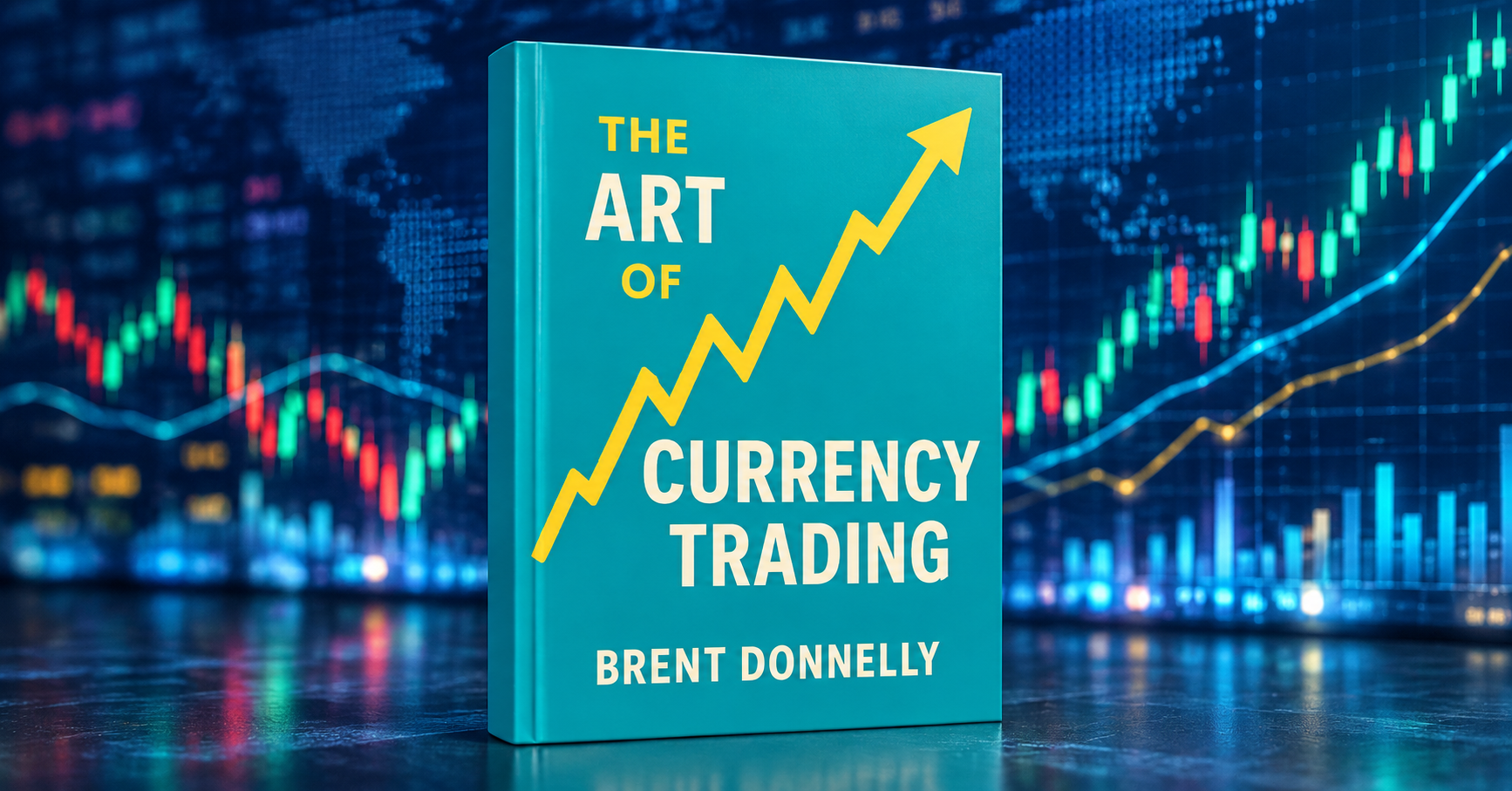
Essential reading, and the case that FX profit is a sizing problem dressed up as a forecasting problem. The sharpest insight is that a 40% hit rate with a 2-to-1 payoff out-earns a 65% hit rate that risks three to make one. Read it if you trade spot or options and still think conviction is a risk management tool; skip it if you want a bank desk’s edge in a paperback.
Introduction
The Art of Currency Trading is the best modern FX manual because it treats position sizing as the strategy and your market view as an accessory. Brent Donnelly, a veteran of bank FX desks, spends more pages on what you lose when you are wrong than on why EUR/USD should go up. That ratio is the tell of a trader who has survived.
Published by Wiley in 2019, the book walks through spot, forwards and options-based sentiment gauges like 25-delta risk reversals. It layers on IMM positioning from the CFTC’s Commitments of Traders report. Nothing in it is decorative.
The pitch is deliberately unglamorous. FX is a zero-sum, high-turnover market where central banks, corporate hedgers and real-money accounts trade for reasons unrelated to profit. In a live trading environment, this framing rings true, because the counterparty on your ticket is often a treasurer rolling a hedge, not a genius you must outsmart.
Once you accept that you are trading against price-insensitive flow, edge becomes a matter of timing, asymmetry and survival. The book is a manual for that arithmetic. It is also why it will outlast the glossy memoirs on the same shelf.
Key Takeaways
- Payoff beats hit rate: a 40% win rate at 2-to-1 earns positive expectancy, while 65% at risking three to make one bleeds.
- Carry pays slowly and crashes fast: funding a long in a high-yielder against JPY or CHF is a short-volatility trade wearing a yield costume.
- Positioning is a fuel gauge, not a trigger: crowded IMM longs do not tell you when to sell, only how expensive being wrong will be.
- Stops are not insurance: overnight gaps and central bank shocks fill you at the market’s price, not yours.
- Process outlives opinion: journaling, review and predefined risk survive regime changes that kill favorite theses.
Overview
Donnelly builds the book in layers. It opens with market plumbing: base and quote currencies, pips, T+2 spot value dates, and forward points that fall out of covered interest parity. It then moves to drivers: rate differentials, growth, terms of trade and how markets price central bank reaction functions.
The middle stretch assembles a toolkit mixing fundamentals, positioning and technicals without pretending any one of them wins alone. The cast is the usual one: the Fed, ECB, BoJ, SNB and BoE, plus macro hedge funds, real-money accounts and corporate hedgers. The closing stretch is the real point: risk management, trade journaling and the psychology of drawdowns.
The spoiler is that there is no secret indicator. The thesis is that edge comes from asymmetry, timing and survival, and everything else is decor.
Writing & Structure
Prose Style
The voice is a desk veteran talking to a promising junior: plain, direct, faintly amused by his own past mistakes. There is no Wall Street mythmaking and no fake-humble war stories. It reads like a trader who would rather be understood than admired.
It is also, mercifully, allergic to the genre’s usual sermon about “discipline” without numbers. When Donnelly says size down, he shows you the expectancy math.
Structure and Research Depth
The progression from plumbing to drivers to risk is disciplined, and chapters work as standalone references. The trade-off is density: this is a book you annotate, not one you devour on a flight. In a live trading environment, that density is a feature, because a checklist is only useful if it is dull enough to follow at 3 a.m. New York time.
The dated flavor is charming. A 2019 manual that leans on chat rooms, broker screens and headline-driven flow already reads like a field guide to a market that algorithmic liquidity providers have since rewired. Yet the human behavior underneath has not aged a day.
The Trader’s Lens
Central Financial Concepts
- Carry trade and covered interest parity: forward points encode rate differentials, so a “free” yield is really compensation for tail risk.
- 25-delta risk reversals: options skew shows which direction the market pays up to protect, a cleaner sentiment read than any oscillator.
- IMM/CFTC positioning: weekly futures data that flags crowding in currencies like JPY, EUR and GBP, with a reporting lag you must respect.
- Central bank reaction functions: the market trades what a bank is expected to do next, so surprises versus pricing matter more than the policy rate.
- Value anchors such as PPP and real effective exchange rates: useful for direction over years, useless for your stop level this week.
Lessons for Traders
- Gap risk is real: on January 15, 2015, the SNB scrapped the 1.20 EUR/CHF floor and the pair fell roughly 30% in minutes, briefly trading near 0.85. Retail broker FXCM needed a $300 million rescue from Leucadia, and Alpari UK went insolvent.
- Carry unwinds are regime events: the August 2024 yen unwind saw USD/JPY drop from above 160 to the low 140s within weeks. The book predates it but describes its shape exactly.
- Trade the distribution, not the story: your P&L is decided by the losers you cut, not the winners you narrate.
- Size for the gap, not the stop: assume the exit price you wrote down is fiction.
Accuracy vs. Narrative Spin
The mechanics are correct: forward points, carry and options skew are described the way a working desk would describe them. On a live desk, the section on positioning rings true, because crowded trades hurt precisely when a plausible catalyst appears. Where Donnelly softens reality is by selection: worked examples tend to be trades that make sense in hindsight, which flatters the framework.
Then there is the conflict of interest, which the review is obliged to name. Donnelly runs a research franchise through Spectra Markets and later published Alpha Trader, so this book doubles as a top-of-funnel for a paid audience. That does not make it dishonest. It does mean the “here is how a professional thinks” framing is also a sales posture.
Also treat structure-dependent edges with suspicion. The post-2013 benchmark-manipulation reforms and the rise of algorithmic liquidity providers have eroded some flow patterns, such as month-end and fix-time distortions. A bank desk sees client flow, and a retail account never will.
Psychology & Culture
The book’s culture is the bank FX desk: high turnover, thin edges, and a mandatory relationship with being wrong. Its psychology is identity-based. Traders who define themselves as “a macro guy” or “a carry guy” defend the thesis long after the tape has amended it. In my experience, that identity is more expensive than any spread.
The ego-driven rationalization chain is depressingly predictable: “I’m early” becomes “the market is wrong”, then “adding is conviction”, then a margin call. The pit-and-phone era has been replaced by algorithms and electronic matching engines, but the chain is the same. Greed and pride never needed a bandwidth upgrade.
Trader Insight
Donnelly’s quietest and most unsettling point is that your edge is not what you know but what it costs you to be wrong. A trader whose identity depends on the thesis will always size that thesis too large.
Reader Fit
- Retail traders: buy it for the risk and process chapters, which apply at any account size, but do not confuse it with a bank desk’s edge. You lack client flow, institutional spreads and funding, and the book cannot supply them.
- Finance and economics students: valuable for seeing theory meet practice, but thin on formal treatment of uncovered interest parity and market microstructure. Pair it with an academic text or you will graduate fluent in trading slang and shaky on derivations.
- Wall Street insiders: you will learn little on flows and structure. The value is the checklist and the mirror, and you will nod at mistakes you have already paid for.
- General readers: skip it. There is no narrative arc, the jargon is unapologetic, and this is not Liar’s Poker.
Verdict
Final Score: 8/10
Composite Score
| Category | Score (/10) | Weight | Weighted | Bar |
|---|---|---|---|---|
| Financial Accuracy | 9 | 25% | 2.25 | |
| Writing & Clarity | 7 | 15% | 1.05 | |
| Trader Psychology | 8 | 20% | 1.60 | |
| Educational Value | 9 | 25% | 2.25 | |
| Lasting Relevance | 7 | 15% | 1.05 |