

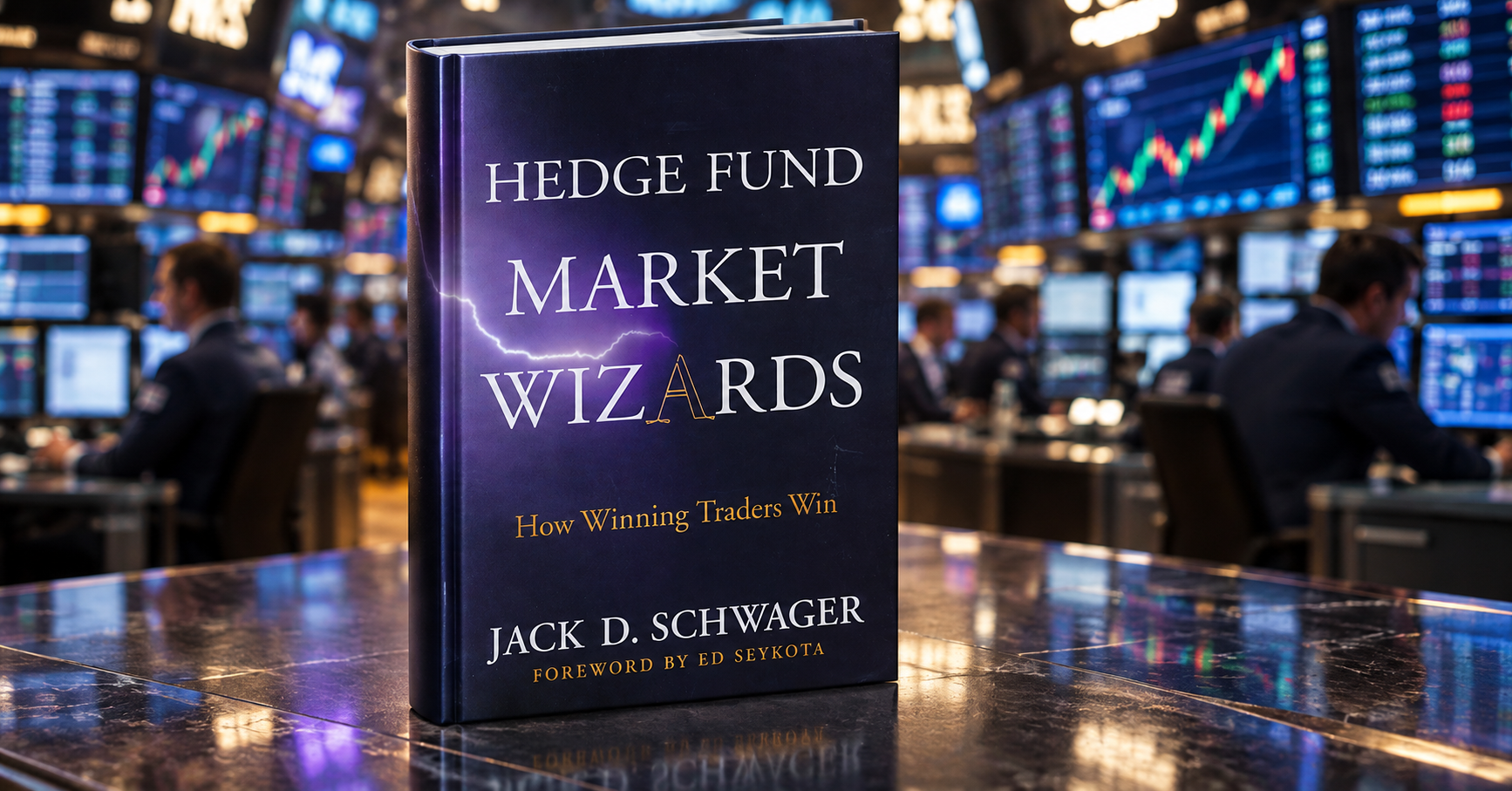
Essential reading for anyone who still confuses returns with risk management: this is a masterclass in surviving first and compounding second. The finding that should stop you scrolling is that across strategies as different as convertible arbitrage and subprime credit default swaps, the winners’ edge is sizing and loss control, not prediction. Read it if you trade your own money and hate being wrong expensively; skip it if you want a replicable system or an audited track record, because this is a highlight reel of survivors, not a backtest.
Introduction
Hedge Fund Market Wizards is the rare finance book where the risk lessons outlive the returns it celebrates. Jack Schwager’s 2012 sequel to his Market Wizards franchise interviews more than a dozen elite managers, from Ed Thorp to Ray Dalio to Michael Platt. Nearly every one of them says the same unglamorous thing: survival first, alpha second.
That refrain is the payoff, and it is worth the cover price. The catch is structural: Schwager interviews winners, so the book cannot tell you how many equally smart traders followed the same principles and got carried out. In a live trading environment, that omission is the difference between a lesson and a legend.
The vintage is delicious. This was written when the 2008 crash was still an open wound, when “2 and 20” was scripture, and when a hedge fund manager was a superhero rather than a fee-compression case study. The sovereign-debt panics and quantitative-easing anxiety read like a museum exhibit, while the human greed underneath has not aged a day.
Then there is the conflict of interest. Schwager’s career sits in manager selection and trading-talent research, so a book celebrating manager talent doubles as a shop window. That does not make it dishonest, but it deserves the scrutiny you would give any fund’s marketing deck.
Key Takeaways
- Sizing explains survival better than entry signals do, and every profiled manager can tell you their worst-case loss before they tell you their thesis.
- Diversification across uncorrelated return streams is the only free lunch on offer, with Dalio claiming roughly fifteen such streams can cut portfolio risk by about 80%.
- Asymmetry beats accuracy: Cornwall Capital’s cheap deep out-of-the-money options and subprime CDS paid off because the losses were capped and the payoffs were not.
- Edge is a statistical claim, not a feeling, which is how Thorp concluded from the outside that Madoff’s return stream could not be real.
- No single style dominates, but conviction without humility shows up in every blow-up story the wizards tell about their own early careers.
Overview
The book follows the Market Wizards formula: long-form Q&A interviews, edited for flow, ending with Schwager’s distillation of common traits. It is the fourth in the series after Market Wizards (1989), The New Market Wizards (1992), and Stock Market Wizards (2001).
Ed Thorp is the intellectual anchor. His Princeton Newport Partners ran convertible arbitrage and statistical arbitrage: long the convertible bond, short the underlying stock, delta-hedged so the position profits from mispricing rather than direction. He sized with the Kelly criterion, and the fund’s run was cut short by a late-1980s federal racketeering prosecution linked to the Drexel Burnham Lambert orbit that hit his partners, not Thorp himself.
Ray Dalio explains Bridgewater’s logic of combining many uncorrelated return streams, plus his 1982 Depression call that went badly wrong and taught him humility. Michael Platt describes running BlueCrest as a multi-manager platform where drawdown limits are enforced and losing traders are cut fast.
Jamie Mai and Charlie Ledley of Cornwall Capital, later famous through Michael Lewis’s The Big Short, explain how they bought credit default swaps on subprime mortgage tranches and long-dated out-of-the-money options because the market underpriced tail risk. The rest of the roster covers equity long/short, discretionary macro, and short-term trading specialists.
Writing & Structure
Prose Style
Schwager’s genius is getting out of the way. He asks tight, technical questions, then lets the manager talk, which produces prose that is clean, unshowy, and refreshingly free of ghostwritten heroism.
The flip side is that he rarely pushes back. When a manager offers a tidy narrative about their own genius, the transcript usually lets it stand.
Pacing & Structure
Each chapter is modular, so you can read Thorp, skip to Cornwall, and lose nothing. The cost is repetition: by chapter six, the phrase “risk management” has the weight of a hold music loop.
Research Depth
The follow-up questions on drawdowns, position sizing, and stop-loss logic are sharp and clearly informed. What is missing is verification: track records appear as summaries, not audited statements, and the reader is asked to trust them.
The Trader’s Lens
Central Financial Concepts
- Convertible arbitrage: long convertible bond, short the underlying equity, delta-hedged and rebalanced as the stock moves.
- Kelly criterion: position size proportional to edge, the math behind not going broke on a good idea.
- Uncorrelated return streams: Bridgewater’s diversification thesis, the closest thing to a free lunch in the book.
- Credit default swaps and OTM options: convex payoffs where the premium is the maximum loss.
- Counterparty and fraud risk: Madoff appears as a case study in returns too smooth to be real.
Lessons for Traders
- Cut the trader, not just the trade: Platt’s BlueCrest model treats loss limits as non-negotiable.
- Leverage is a timing bomb: compare Thorp’s sized-to-survive approach with Long-Term Capital Management’s 1998 collapse, run at roughly 25-to-1 balance-sheet leverage on convergence trades.
- Buy convexity when the market prices it as free: Cornwall’s subprime CDS positions capped losses at the premium while the payoff exploded in 2007-08.
- Size for the trade that goes wrong, because the one you are certain about is the one that will teach you.
Accuracy vs. Narrative Spin
The mechanics are technically sound. The hedging of convertible bonds, the payoff structure of CDS on subprime tranches, and the sizing logic all check out against how these instruments actually behave.
The spin lives in selection. In a live trading environment, survivorship bias is the difference between a strategy and a story, and this book is 100% story. Dalio’s and Platt’s chapters double as brand-building for firms that manage other people’s money, and the FCA fined BlueCrest’s UK arm £40 million in 2019 over conflicts of interest between its flagship fund and an internal trading team. That does not erase Platt’s risk lessons, but it does mean his chapter reads differently in hindsight.
Schwager’s own incentive is worth naming too. His business depends on the premise that identifiable, repeatable trading talent exists, and a book of hand-picked survivors is Exhibit A for that premise.
Psychology & Culture
The managers profiled tend to build their identity around being disciplined, and then quietly admit how often they failed to be. Dalio’s Depression call in 1982 is the classic case: a smart, well-argued view fused to ego, then punished by the market until humility was the only rational response.
The rationalization chain runs the same way in every failure story: I am right, the market is temporarily wrong, adding to the position proves conviction. Platt’s culture is the industrial answer, a firm that assumes traders will rationalize and builds rules to cut them before they finish the sentence.
Trader Insight
The wizards’ real edge is pre-commitment: rules written while calm and obeyed while scared, because the person holding the position on a limit-down day is not the person who wrote the plan. Intelligence gets them to the table, but outsourcing discipline to process is what keeps them there.
Reader Fit
- Retail traders: The best fit. You cannot copy Bridgewater, but sizing, loss limits, and asymmetric payoffs scale down cleanly. Skip anything that tempts you to think you can replicate a Thorp-style arbitrage book on a brokerage app.
- Finance and economics students: Strong on how strategies actually work in practice, weak on formal derivation. You will learn what delta-hedging is for, but not how to price it.
- Wall Street insiders: Solid refresher, thin surprise. The Madoff and Cornwall material still lands, but you have heard most of these stories at conferences.
- General readers: Readable, but the technical density will lose anyone without basic market vocabulary. Start with Reminiscences of a Stock Operator instead.
Verdict
Final Score: 8/10
Composite Score
| Category | Score (/10) | Weight | Weighted | Bar |
|---|---|---|---|---|
| Financial Accuracy | 8 | 25% | 2.00 | |
| Writing & Clarity | 7 | 15% | 1.05 | |
| Trader Psychology | 9 | 25% | 2.25 | |
| Educational Value | 8 | 20% | 1.60 | |
| Lasting Relevance | 8 | 15% | 1.20 | |
| Total | 100% | 8.10 |