
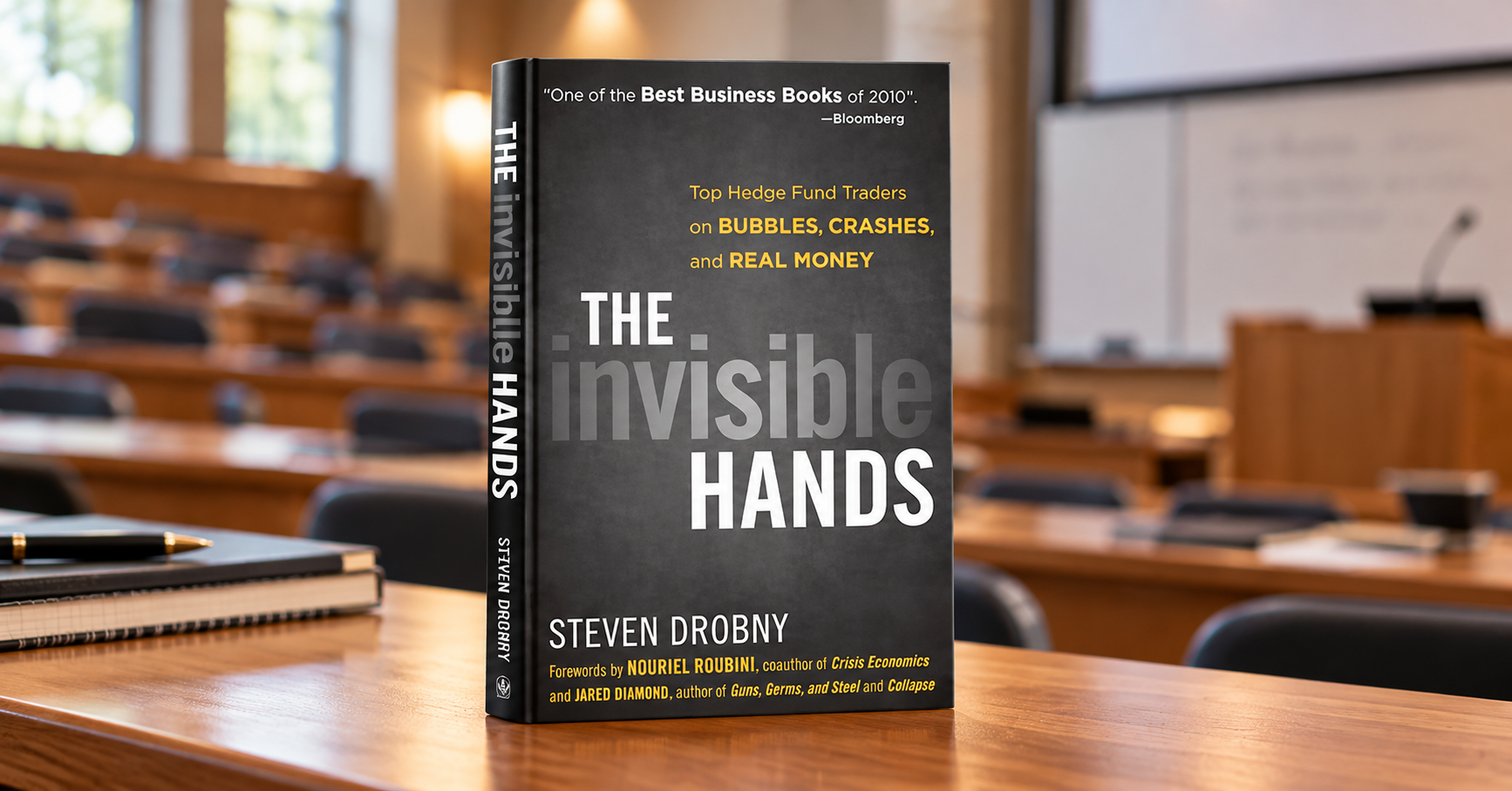
Worth reading, because it shows that 2008 was a liquidity and career-risk failure dressed up as a market crash. The sharpest insight is that benchmark-hugging protects the allocator’s job while the portfolio takes the hit. Read it if you allocate capital or size risk for a living; skip it if you want setups, because there is nothing here to click “buy” on.
Introduction
Steven Drobny’s The Invisible Hands is a useful autopsy of how 2008 flattened the world’s biggest pools of capital, performed by a surgeon whose practice depends on the patients. The diagnosis is sharp. The prescription comes with a sales pitch.
The damage was not abstract. Yale’s endowment lost nearly $7 billion, close to 30%, and Harvard’s fell by almost a third. Those were the institutions everyone had spent a decade calling geniuses for copying the endowment model.
Drobny’s thesis is that “real money” (pensions, endowments, foundations, insurers) should borrow the risk discipline of the macro traders who got through the crash. He makes the case through interviews rather than argument, which is both the book’s charm and its structural weakness.
In a live trading environment, the central complaint rings true immediately. Most real money runs on committee meetings, quarterly benchmarks and consultant decks, while the market runs on liquidity that vanishes on a Tuesday. The book’s era, with its post-Lehman panic and its fear that the Fed would print the dollar into oblivion, is dated and a little funny. The human machinery underneath is not.
Key Takeaways
- Diversification is a fair-weather friend: in 2008, correlations across equities, credit and “alternatives” converged toward one exactly when protection was needed.
- Illiquidity is a leveraged bet in disguise: unfunded private equity commitments turned into cash demands while liquid assets were being marked down.
- Drawdowns are asymmetric: a 30% loss needs roughly a 43% gain to get back to even, so managing loss size beats chasing return.
- Benchmark risk is career risk: tracking a policy portfolio keeps the allocator employed even when it drags the fund into the same hole as everyone else.
- Macro traders think in scenarios, not forecasts: they size positions for being wrong, which is the habit real money never had to learn.
Overview
The book opens with Part One, “Real Money and the Crash of ’08,” which reconstructs how pension funds, endowments and family offices got caught. Chapter 2 interviews Jim Leitner of Falcon Management, a family office manager, as the bridge between the institutional and hedge fund worlds.
Across the whole book, Drobny conducts 13 interviews with top investors who navigated the 2008 crisis. Part Two then rotates through archetypes: the House, the Philosopher, the Bond Trader, the Professor, three commodity chapters (Trader, Investor and Hedger), the Equity Trader, the Predator, the Plasticine Macro Trader and the Pensioner. Later editions add a chapter with Andres Drobny, the author’s business partner (no relation), who supplies the macro backdrop.
The structure is global macro and commodity heavy. That means rates, currencies, physical commodities and equity indices, traded top-down and sized around scenarios. It is a far cry from stock-picking, and the book never pretends otherwise.
Most participants hide behind their archetype labels, though Hugh Hendry of Eclectica Asset Management is identified as the “Plasticine Man.” You are reading what they said, not what an auditor could confirm.
Writing & Structure
Interview Format
Drobny mostly gets out of the way, and that is the right instinct. Traders talking about their own mistakes are more useful than an author explaining them from a distance.
The cost is repetition. By the third chapter you have heard “manage the downside” phrased six ways.
Pacing and Research Depth
Part One is the tightest writing in the book, with real numbers and a clear causal chain from benchmark to loss. Part Two is looser and depends entirely on who is in the chair that chapter.
In practice, the commodity chapters carry the most transferable mechanics. The Hedger’s view of producers and consumers locking in prices differs sharply from the speculator’s view, and the contrast is worth the price of the book.
The Trader’s Lens
Central Financial Concepts
- Global macro: top-down positioning in rates, FX, commodities and equity indices, sized around scenarios rather than point forecasts.
- Benchmark (tracking error) risk: the risk of underperforming a policy portfolio, which institutions often treat as more dangerous than absolute loss.
- Illiquidity and capital calls: unfunded commitments to private equity and similar funds that come due while the liquid book is falling.
- Denominator effect: as public assets drop, illiquid holdings swell as a share of the portfolio and break allocation limits.
- Correlation convergence: in a liquidity crunch, assets that looked independent sell off together.
Lessons for Traders
- Respect the recovery math: a 50% drawdown demands a 100% return, so position sizing is the whole game.
- Liquidity is a risk factor, not a footnote: the 2008 endowment squeeze echoes LTCM in 1998, where paper diversification met a market that would not trade.
- Know who your counterparty is: the book’s better chapters treat prime broker and funding risk as core, not administrative.
- Size for being wrong: scenario thinking means asking what happens if the trade fails, before asking what happens if it works.
Accuracy vs. Narrative Spin
The mechanics are accurate. Drawdown asymmetry, capital calls and correlation spikes are described correctly, and I have watched every one of them play out on a live account in some form.
The spin is in the selection. The managers profiled were mostly macro funds that finished 2008 up, with two marginally down. That is survivorship bias with a book contract. You are hearing from the ones who lived, not from the ones who ran the same playbook and blew up.
Then there is the conflict of interest. Drobny founded and runs Drobny Global Asset Management, an advisory and consulting firm focused on global macro and commodity hedge fund strategies. The book tells real money to go where his firm lives. That does not make it wrong, but it is exactly the incentive a trader should price in.
Anonymity compounds it. When a chapter’s hero is “the Philosopher,” you cannot pull a track record, check a drawdown, or verify a claim. And even the identifiable ones do not guarantee durability: Eclectica announced its closure in late 2017. A great 2008 is a data point, not a permanent edge.
Psychology & Culture
The book’s real subject is identity-based decision-making. Allocators are not paid to be right; they are paid not to be uniquely wrong. Every rationalization in the chain, from “everyone is down” to “the policy portfolio did what it was designed to do,” protects the seat, not the fund.
The macro managers embody the opposite culture, which is not necessarily healthier. They are paid on absolute returns, so they wear ego like a uniform, and the interviews hum with the confidence of people who were right once, loudly.
The comedy for any veteran is that two subcultures spent 2008 telling opposite stories about the same wreckage. The endowments blamed a hundred-year flood. The macro crowd blamed everyone else’s leverage, and both were partly right and partly self-serving.
Trader Insight
The book’s most unsettling lesson is that the pension fund investment committee is rewarded for failing in a crowd: a benchmark-tracking loss shared with every peer costs nobody a job, while a contrarian loss ends a career. The structure does not just tolerate herding; it pays for it.
Reader Fit
- Retail traders: take the drawdown and sizing lessons, ignore the institutional plumbing, and do not expect a single tradable idea, because the book underdelivers on anything you can execute Monday.
- Finance and economics students: this is a good corrective to the textbook portfolio, but the anonymity means you cannot cite most of it, so use it for framing and not for evidence.
- Wall Street insiders: you already know the pension story, and the interviews rarely tell you anything you could not get on a bad night at the bar.
- General readers: the jargon load is heavy and the prose is flat in places, so expect to work for it and skip the middle chapters if the commodity mechanics lose you.
Verdict
Final Score: 7/10
Composite Score
| Category | Score (/10) | Weight | Weighted | Bar |
|---|---|---|---|---|
| Financial Accuracy | 7 | 25% | 1.75 | |
| Writing & Clarity | 6 | 15% | 0.90 | |
| Trader Psychology | 7 | 20% | 1.40 | |
| Educational Value | 8 | 25% | 2.00 | |
| Lasting Relevance | 7 | 15% | 1.05 | |
| Total | 100% | 7.10 |