
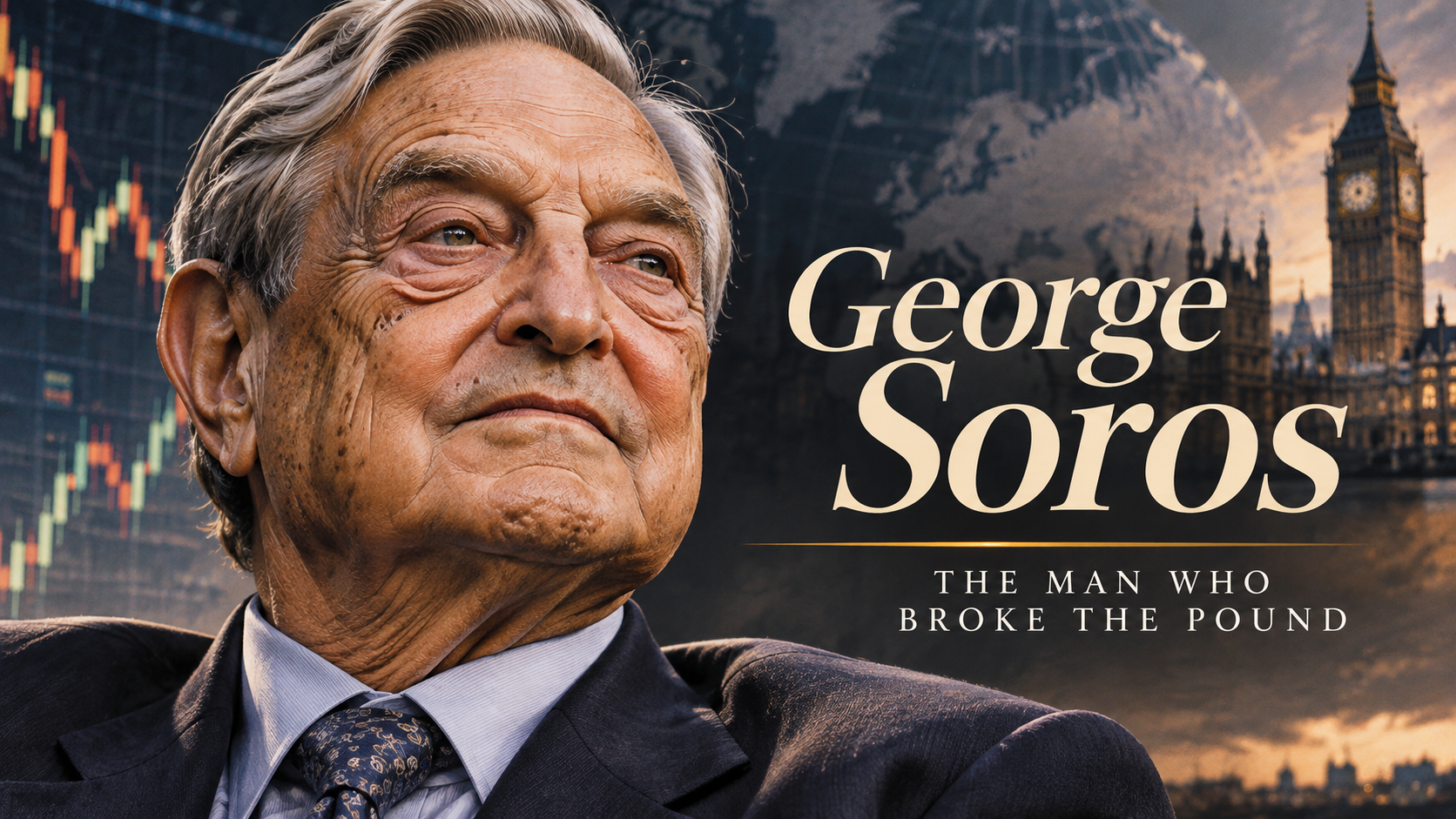
George Soros built his reputation on one idea: markets are wrong more often than they admit. The record shows how much of that reputation holds up.
On 16 September 1992, Britain raised interest rates from 10% to 15% in a single day. It still could not keep the pound inside the European Exchange Rate Mechanism. By evening, the government gave up. Reports say George Soros’s Quantum Fund held a short position of about $10 billion against sterling. The George Soros trading strategy behind that bet shaped his reputation for decades.
The trade made Soros famous as the man who broke the Bank of England. The reported profit was about $1 billion, although no official record gives that figure. Soros’s approach was less a formula than a habit of mind. He assumed the crowd was wrong, hunted for the flaw in his own thesis, and bet heavily only when the odds looked lopsided.
That raises the question this profile tests. How much of the Soros legend belongs to Soros, how much to his lead trader, and how much to a currency peg that could not last?
Survival Before Strategy
Soros was born in Budapest in 1930. He studied at the London School of Economics and began on Wall Street in 1956 as an arbitrage trader at F. M. Mayer. He moved to Wertheim & Co. in 1959 and to Arnhold & S. Bleichroeder in 1963.
In 1967 he persuaded Bleichroeder to set up an offshore fund for him to run. In 1969 the firm launched a second one, the Double Eagle Fund. Accounts disagree on its starting capital, with figures from $250,000 to $12 million. The fund later became the Quantum Fund, Soros’s flagship hedge fund.
His own explanation of his risk philosophy reaches back further. In Soros on Soros (1995), he says his father taught him the art of survival in wartime Hungary. He adds that the lesson bore on his investment career. That link is Soros’s later interpretation, not contemporary evidence of how he traded.
The market lesson is easier to document. In June 1981, Institutional Investor called him the world’s greatest money manager. That same year Quantum lost money. By September he had cut his staff and handed most of the fund’s active management to outside managers. Success had not made him certain, and the pattern would repeat.
How George Soros Actually Made Money
Soros made money by finding markets where a widely held belief had pushed prices away from what the economics could support. He then took large, often leveraged positions before that belief broke.
His framework was reflexivity, which he set out in The Alchemy of Finance. Prices do not merely reflect reality, he argued. They also change it, and the feedback creates booms and busts. Most of the time, he said, going against a trend is punished. The reward comes at the inflection point.
In practice, he traded currency forwards and futures, stock index futures, equities and bonds. His style was discretionary and top-down. He treated every idea as a hypothesis and looked for its flaw. If events stopped matching his expectations, he re-examined the thesis.
Leverage was central. In 1985, according to company histories, Quantum took positions worth more than its entire assets, betting that the German mark and Japanese yen would rise against the dollar. Quantum also reportedly borrowed £5 billion and swapped it into marks in 1992.
Execution changed over time. From about 1989, Stanley Druckenmiller ran Quantum day to day as lead portfolio manager. One company history reports that Quantum averaged annual gains near 40% in 1989 to 1993 under him. That was higher than under Soros’s own management. Soros supplied the macro framework and pressed on position size.
Holding periods, entry triggers and stop levels are not publicly documented. Any rule with a precise number attached should be treated as invented.
George Soros’s Core Trading Rules
Soros never published a rulebook. These five principles come from his books and from Druckenmiller’s accounts of working with him.
| Principle | Market Logic | Modern Relevance |
|---|---|---|
| Treat every thesis as a hypothesis | Prices carry a biased view of the future, so every idea has a flaw worth finding. | Timeless. Works at any account size. |
| Trade the inflection point | Trends usually punish contrarians. Reversals reward them once feedback loops reach excess. | Adaptable. Needs clear invalidation points, which Soros did not publish. |
| Size up when the asymmetry is clear | A strong thesis earns little if the position is too small to matter. | Dangerous without limits. Exact sizing rules are not publicly verified. |
| Correct errors quickly | Imperfect understanding is normal. The failure is refusing to adjust. | Timeless. Specific loss limits are not documented. |
| Change style with conditions | No single approach suits every regime, so he mixed trend-following and contrarian probes. | Mixed. Flexibility also invites style drift. |
The tension sits between rules two and three. Soros preached fallibility, yet his largest bets were his most confident ones. The record shows both habits.
The Bet That Defined His Career
Britain joined the European Exchange Rate Mechanism in October 1990. The system required it to keep sterling within a set band against other European currencies, notably the German mark. By 1992 the country was in recession, and the pound sat near the bottom of its band.
The thesis, as later accounts describe it, was that Britain’s reserves were too small to defend the floor. High interest rates were also politically hard to sustain. Several accounts credit Druckenmiller with the idea. One 2010 report says Soros’s contribution was pushing him to take a gigantic position.
A popular version has Druckenmiller proposing about $1.5 billion and Soros urging him to go larger. The story has been repeated widely, but no primary account confirms its details. What most sources do agree on is the final scale. The short position reached roughly $10 billion.
The UK side is better documented. Treasury papers released in 2005 show it sold about $28 billion of reserves on 16 September alone, and nearly $40 billion across August and September. The Treasury’s best estimate of the cost, measured at February 1994, was about £3.3 billion.
Soros’s profit is murkier. Most reports say about $1 billion. Others say $1.5 billion or almost $2 billion. No Treasury or Bank of England paper gives his gain, and many traders sold sterling that autumn.
The episode shows what Soros added: nerve at the right moment, and a willingness to size up a trade that was already working. It does not show that he alone saw the opportunity.
What the Record Actually Shows
The record shows an exceptional manager with large, well-reported losses. It does not offer an audited, year-by-year return series that anyone can check.
Contemporary reports confirm a $2 billion Quantum group loss on Russia in 1998. They confirm that Quantum fell about 22% in early 2000 and that Druckenmiller and Roditi left.
A one-day loss of about $600 million on the yen in February 1994 is widely reported. The Treasury’s own estimate of Britain’s 1992 cost is on record.
The sterling profit, the exact position size and the 1992 return for Quantum all vary by source. The 1987 crash loss is reported anywhere from $300 million to $800 million.
The famous 30% average annual return largely comes from the fund’s own description. Another widely cited figure puts the long-run average nearer 20%.
| Metric | Result | Context |
|---|---|---|
| Average annual return, Quantum | About 30% | Roughly 1969 to 2000s. Fund-sourced; reportedly audited only since 1994. |
| Average annual return, long run | About 20% | Roughly four decades, including the lower-return period after 2000. |
| Quantum, 1989–1993 | About 40% a year | Net asset value gains under Druckenmiller, per a company history. |
| Quantum, 1995 | +39% | After fees. |
| Quantum, 1996 | −1.5% | Quantum held about $7 billion of the group’s $17 billion. |
| Quantum, 1999 | +35% | Helped by a move into technology stocks. |
| Quantum, 2000 (to 28 April) | −22% | Partial year; almost all of the loss came after March. |
These are fund returns. They are not Soros’s personal trading returns, and they are not investor returns after every layer of fees.
From Soros to Druckenmiller
Druckenmiller became Quantum’s lead portfolio manager in 1988 or 1989, depending on the source. He later said that Soros taught him to go for the jugular when he held strong conviction. That phrase is Druckenmiller’s retelling, and the original interview was not located.
The pairing worked for years. A 2000 Bloomberg report put Druckenmiller’s own record at about 30% a year from 1989 to 1999. He left in April 2000 after the technology losses and later ran Duquesne Capital, which he closed in 2010 with more than $12 billion in assets.
The relationship shows how Soros worked best. He supplied the framework and the pressure to be bold. Others carried much of the daily execution.
Where Soros’s Approach Broke
The approach broke when timing failed at a regime turn, or when conviction ran ahead of the evidence. The pattern recurs across four decades.
In 1987, Soros expected a correction but lost heavily after mistiming his exit. In 1994, a yen position cost about $600 million in a day. In 1998, Russia’s default cost the Quantum group about $2 billion. MoneyWeek reports that Soros later admitted his wish to promote democracy there made him less objective.
The 2000 episode was the sharpest. Soros and his team had spent months discussing how to prepare for a technology sell-off, according to a Wall Street Journal account excerpted online. The funds were still heavily invested when it began. Quantum was down about 22% by the end of April. Druckenmiller later blamed himself for buying near the top.
Soros relaunched Quantum that July as the lower-risk Quantum Endowment Fund. In 2011 he returned outside investors’ money and converted the firm into a family office.
Documented weak points: mistimed turns in 1987, 1994 and 2000; ideology clouding judgment in Russia; and dependence on a few key managers. Quantum also grew so large by 1991 that Soros created a separate fund, Quasar, run partly by outside managers.
Some risks are modern inferences. Central banks now hold larger reserves and communicate more, so clean peg breaks like 1992 are probably rarer. Instant information also makes crowded macro views easier to spot. Those points are analysis, not documented failures.
Can George Soros’s Trading Strategy Still Work Today?
Parts of it can. His thinking habits transfer well to individual traders. His scale, access and information network do not.
| Principle | Still Relevant? | Modern Difficulty |
|---|---|---|
| Hunt for the flaw in every thesis | Yes | Requires discipline, not capital. |
| Admit and correct errors fast | Yes | Soros left no numeric loss limits to copy. |
| Reflexivity as a lens | Adaptable | A framework, not a testable rule set. |
| Size up on clear asymmetry | Adaptable | Retail leverage and margin limits cap the scale. |
| Attacking fixed exchange rates | Largely historical | Depended on a specific peg and thin reserves. |
| $10 billion in currency forwards and futures | Institutional only | Needed dealer access, financing and research staff. |
Past results do not predict future ones, and this is not personal investment advice.
TraderVerified Verdict
Soros’s real contribution was a disciplined way of being wrong. He tested his own ideas, corrected mistakes and pushed size when the payoff looked lopsided. Those habits survive verification.
Less survives on the numbers. The sterling profit, the famous 30% average and many position sizes rest on reports, not audited records. The 1992 idea also appears to belong largely to Druckenmiller.
Modern traders should keep the humility and the flaw-hunting. They should not copy the leverage. Britain’s bad day in 1992 made one trade famous, but the losses of 1987, 1994, 1998 and 2000 show the full cost of the method.