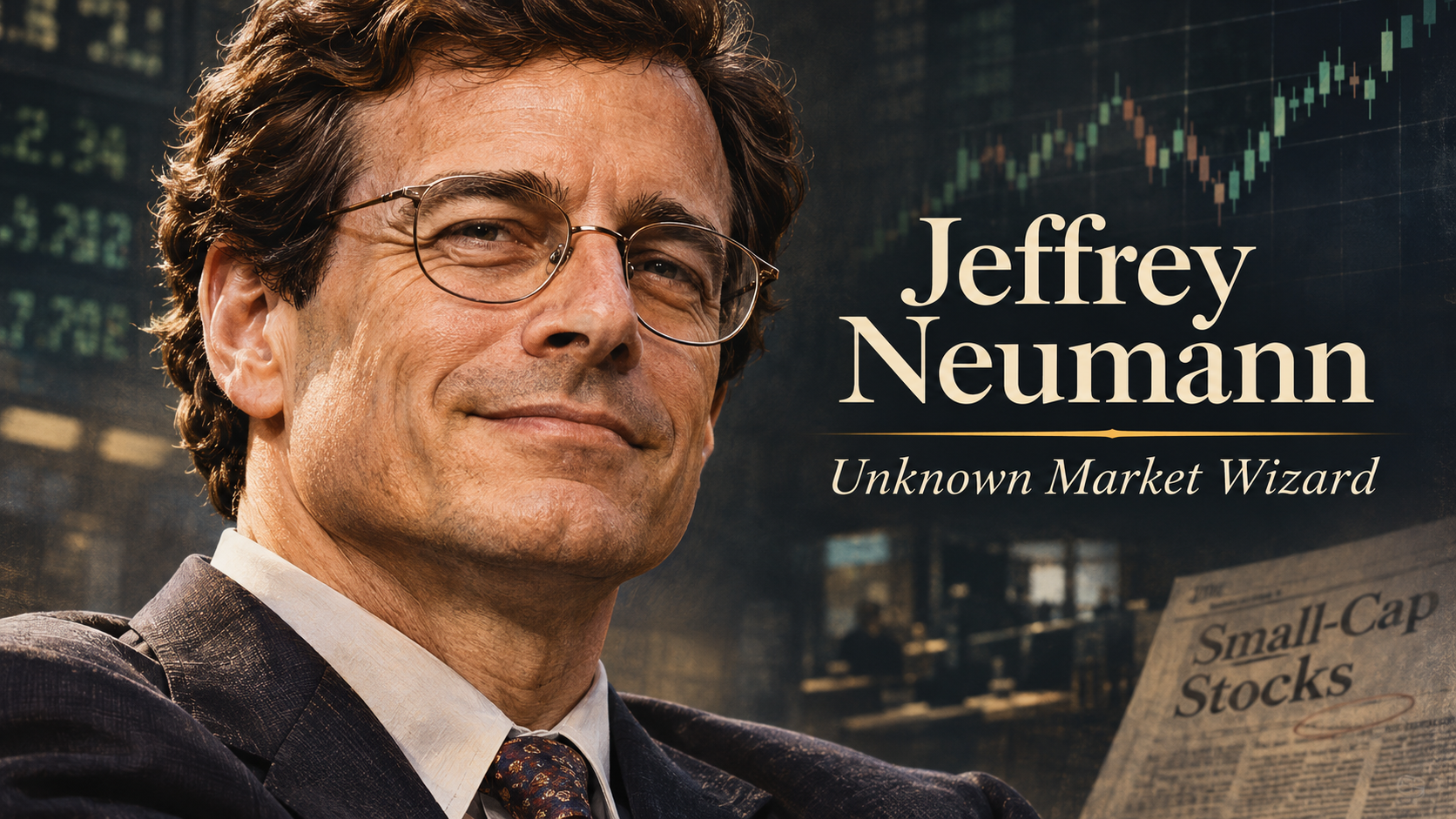
He reportedly turned a hail-damage insurance check into tens of millions by trading obscure stocks. The method is more interesting than the myth.
In the summer of 2009, Jeffrey Neumann was on safari in Kenya, far from a trading screen. A friend’s text said Spongetech, a stock Neumann held, had climbed to 25 cents. By his account, he bribed a camp receptionist for her slow dial-up connection and sold his remaining position. Why he sold into the frenzy explains the Jeffrey Neumann trading strategy better than any chart pattern.
The stock fell to five cents the same day, he says. In 2010 the SEC charged Spongetech and its executives with a pump-and-dump scheme built on fictitious customers and sales. Neumann says he sold because friends who never discussed stocks had begun discussing this one.
That instinct, to leave when the crowd arrives, sits at the center of his story. So does a harder question. Neumann says he started with $2,500 and made about $50 million in profits. How much of that is skill, and how much is a good story?
The Penny Trick That Made His First Million
Neumann expected to become a doctor like his father. He studied chemistry, then spent a summer backpacking through Europe and lost interest in more school. Trading looked like an easy way out. He started in his college computer lab.
A hailstorm paid for the start. An insurance check for $2,500 opened his first account. Jack Schwager, the author who later profiled him, put his true starting equity at $7,700 after reviewing his records. The difference was a stock his father had left him.
His first edge came from a quirk. Stocks had just moved from fractions to pennies. Neumann’s broker accepted orders two decimal places past a penny, and most brokers did not. One stock sat frozen at seven cents bid and eight cents offered. He bid 7.01 cents and offered at 7.99. Each round trip earned about 13% after commission, by his account.
He says he made his first million in a little over a year, at age 23. Then others copied him. The spread shrank until a round trip earned a few hundredths of a cent.
One mistake from that period stuck. He broke his routine to buy a stock with a good story, an animal-tracking company. It lost him about 30% of his account in a day.
When the penny trick faded, he rebuilt around themes and catalysts. A chat-room post described a bill to raise the ethanol share of gasoline from 1% to 5%. Neumann saw a fivefold jump in ethanol demand. He bought before the story reached national media and sold the day the bill reached Congress. He says that trade earned more in two weeks than all his earlier trading combined.
How Jeffrey Neumann Actually Made Money
Neumann made money by buying obscure small-cap stocks shortly before a theme and a catalyst pushed them higher. He then sold as the story became popular. It was a bet on being early, not on being right forever.
He started with the theme. Ethanol, 3D printing, CBD, lithium: he defined his own niche sectors, many of which standard classifications ignore. He then bought a small starter position, as little as $1,000, in nearly every stock in the group.
Research came next. He read filings, visited companies, attended conferences and tried the products himself. For one CBD drink, he bought a case and visited the store that sold it almost daily.
His timing tool was a plain trendline. He wanted a stock breaking above a downtrend line that had lasted one to five years. Entering at the break gave him a low price. If the stock did not move at once, he sold, usually near breakeven.
When conviction grew, he added aggressively. At times one stock took a third or more of his account. He sold into publicity and rising liquidity, with no fixed profit target. By his own account, most of his trades lose. The winners paid for everything else.
The Four Corners Behind the Trades
Neumann calls his filter the four corners. He needs all four in place before he sizes up.
“I look at trading like a puzzle.” Jeffrey Neumann, in Unknown Market Wizards (2020)
| Principle | Market Logic | Modern Relevance |
|---|---|---|
| Four corners: chart breakout, clean share structure, right sector, hard catalyst | Few options and warrants, and preferably under 200 million shares, let new demand move the price. | Testable. Any screener can check share count and dilution. |
| Buy the downtrend breakout, then leave fast if it fails | Entering at the break means correct trades move at once. Wrong ones reveal themselves quickly. | Crowded. Breakout buying is widely known, and false breaks are common. |
| Start small, then pyramid into winners | Small probes are cheap. Adding into strength lowers the average cost of a large position. | Useful. Exact add-on sizes are not public. |
| Sell into publicity | Once everyone knows the story, the edge is gone, but liquidity is at its best. | Faster now. Social media shortens the window. |
| Bet big only on complete setups; look for roughly 10-to-1 reward to risk | With a win rate below half, a few large winners must carry the results. | Dangerous. One-third positions in micro-caps can end an account. |
| Stay long only; step aside in poor markets | He never shorts. He liquidated at the 2020 crash and traded far less in 2022. | Timeless. Sitting out is a position. |
One caveat matters. Neumann describes behavior, not formulas. He gives no stop-loss percentage and no sizing rule. Schwager also warns that chart breakouts alone probably lose money over time. The filters around the signal, in his view, are what separate Neumann from the crowd.
When Conviction Paid Off: The Organovo Trade
Neumann calls Organovo his most profitable trade. The company made 3D bioprinters that build human tissue. He found it while buying 3D-printing stocks and first bought about two months after it listed on the over-the-counter market. He recalls a market value near $40 million.
He kept adding as the sector rose. He says he visited the founder, met an early angel investor and saw a bioprinter work. Then the company moved to a major exchange and sold new shares at the same time. The price dropped about 30%. Neumann treated that as the best entry and went all in. At his peak, he says, he owned 3% to 4% of the company.
He sold most of it near $12, he says. That was the year he made about $10 million. The stock later slid back toward $1.
Filings show Organovo began trading on the NYSE MKT on July 11, 2013. A $46.6 million share offering closed on August 7, 2013.
Neumann recalls a Nasdaq listing and a $3.50 price. Filings show the NYSE MKT, and the stock traded above $5 in July 2013. His sale price and ownership stake are unconfirmed.
The episode shows the whole method. He found a theme, researched it in person and sized up on a hard catalyst. He also left before the theme collapsed.
What the Record Actually Shows
Neumann’s record is credible enough to take seriously, but it has not been verified the way a fund’s would be. The best evidence is one author’s review of his paperwork.
Schwager reviewed ten years of monthly brokerage statements. Tax returns covered the earlier years, giving a 17-year record. Outside events Neumann describes also check out. The SEC case against Spongetech is public. Apple agreed to buy AuthenTec, another of his holdings, for $8 a share in July 2012.
The statements are not public, and no audited record appears to exist. Yearly returns, drawdowns and results since about 2018 are unavailable. Neumann asked to be left out of the book’s performance table. His claim of much larger gains since then is unverified.
| Metric | Result | Context |
|---|---|---|
| Average annual return | About 80% | 2002 to about 2018, personal account. Early years with tiny balances lift the average. Schwager says withdrawals in 2002–2008 understate it. |
| Compounded return, later decade | About 53% | Ten years from $2.3 million in January 2009. |
| Starting equity | $7,700 | Neumann cites $2,500. The records include his father’s stock. |
| Cumulative profit | About $50 million, pre-tax | His own figure from around 2018–19. It is profit, not net worth. |
Treat “80% for 17 years” cautiously. The source does not say whether it is a true compound rate or a simple average of yearly returns. The popular line about turning $2,500 into $50 million blends two different measures.
Where the Neumann Approach Breaks
The method fails when he is late, when a stock is rigged, or when a large position meets bad news. Several of those risks show up in his own account.
Edge decay came first. Copycats erased the penny trick within about a year. Themes also round-trip. Schwager notes that the 3D-printing stocks and Organovo gave back their entire advance. Timing, not the thesis, protected Neumann.
Concentration is the sharpest risk. Neumann says AuthenTec grew to more than a third of his account. It paid off because Apple bought the company. A different headline would have produced a different result. Schwager warns that copying this sizing could end an account.
Neumann also admits a flaw. He calls himself a poor seller. He sold GameStop near $11 in early 2021 and watched it reach about $500. And in August 2022 he called lithium stocks the biggest trade of his life. No source says how that ended.
In today’s market, the early-information edge would probably be harder to keep. Social media and scanners spread themes in hours. Liquidity that appears during a mania can vanish in a selloff. These are present-day judgments, not documented failures.
Can Jeffrey Neumann’s Trading Strategy Still Work Today?
Parts of it can. The research habits and the exit discipline translate. The original tricks are gone, and the information edge is thinner. This is analysis, not advice, and his results cannot be assumed to repeat.
| Principle | Still Relevant? | Modern Difficulty |
|---|---|---|
| Theme-first research and product trials | Yes | Themes spread faster, so the early window is narrower. |
| Share-structure and catalyst screen | Yes | Easy to run, which makes it easy to crowd. |
| Selling when everyone is talking about it | Yes | The signals are online now, and moves reverse sooner. |
| Downtrend-breakout entries | Partly | Widely known, with frequent false breaks. |
| One-third account positions | High risk | Gap risk and thin liquidity in micro-caps. |
| Sub-penny queue-jumping; SPAC redemption trades | Historical | Tied to conditions that no longer exist in the same form. |
TraderVerified Verdict
Neumann’s real contribution is a worked example of thematic, field-research trading in small caps. He found stories early, tested them with small positions and left when the crowd arrived.
Much of the reputation survives. A respected interviewer reviewed years of statements and tax returns. The outside events he describes check out.
Important gaps remain. No audited record is public. Drawdowns, yearly returns and results after 2018 are unverified. The $50 million figure is cumulative profit, not net worth.
Modern traders can keep the theme-first research, the small starting positions and the habit of selling when everyone is talking about a stock. They should not copy one-third positions in micro-caps. That sizing worked for a man quick to exit, and it still carries the risk of ruin.
The opening question has an answer. Neumann sold into the frenzy because, in his method, the edge ends when the crowd arrives.