

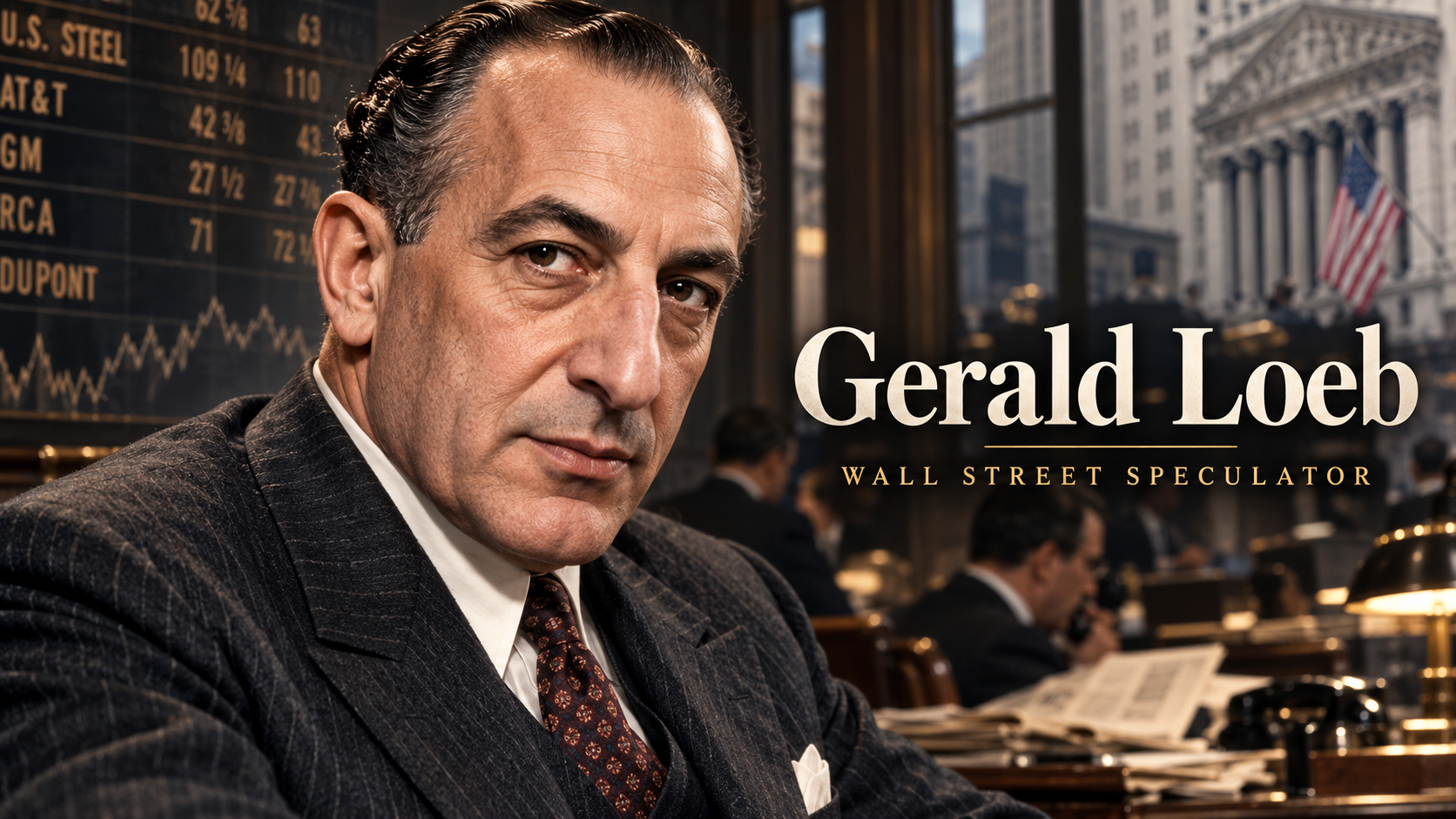
Gerald Loeb became the most quoted voice on Wall Street without ever publishing a trading statement. His story raises an uncomfortable question about how reputations get made.
By the mid-1950s, Forbes was calling Gerald Loeb “probably the most quoted man on Wall Street.” Reporters phoned him for opinions on stocks, crashes, and the psychology of markets. Loeb’s investment philosophy centered on a single, often-repeated line: put your eggs in one basket, and watch the basket closely. It was the opposite of everything a cautious broker was supposed to say. Yet nobody quoting him could point to an audited return, a fund statement, or a verified track record.
The Gerald Loeb trading strategy became famous through conviction and prose, not through numbers anyone could check. That gap between reputation and proof is the real story.
The Bond That Taught Him Caution
Loeb’s early life gave him little cushion. His father died in a train collision in 1908. His grandfather died the same week. The family’s Gold Rush-era wealth had already been thinned by the 1906 earthquake. Loeb, still a boy, faced money worries as well as a bout of childhood polio. His widowed mother moved the family into a boardinghouse.
At 21, he inherited about $13,000 and entered the bond business in San Francisco. His first purchase was a real estate bond paying 6% interest. Something about it bothered him. The collateral was questionable, and the bond was hard to resell. He got out early, for a small loss, just before the bond collapsed to nothing for the investors who stayed.
His second purchase was a plain, high-quality British bond that paid his broker a far smaller commission. It rose steadily, and Loeb took the profit a year later.
He drew a lasting lesson from the contrast: the products that pay brokers the most are often the ones investors should trust the least. That instinct, repeated for decades afterward, became the foundation of his approach to markets. He is also said to have quit a sales job rather than push bad bonds onto a client for a bigger commission. Both stories come from later retrospective accounts rather than contemporary documents. They point in the same direction, though: toward a career built on skepticism of anything oversold.
How Gerald Loeb Actually Made Money
Loeb earned his living as a commissioned broker at E. F. Hutton, where some clients gave him discretionary authority to buy and sell on their behalf. That income stream is well documented. His personal investing philosophy, laid out across three books, is a separate matter. No surviving performance figures back it.
As he described it, the method combined two things. First, a fundamental screen: management quality, earnings growth, and financial soundness. Second, close observation of price behavior, tracked through the ticker tape, which he treated as real evidence rather than noise. He wanted to know a small number of stocks extremely well rather than spread his attention thin.
Loeb bought into positions that were already confirming his thesis through rising prices, adding more as they climbed. He refused to add to a losing position simply to lower its average cost. When a trend clearly reversed, he closed the trade “for a reason,” accepting that he might be wrong and could always re-enter later if the setup returned. He also treated uninvested cash as a legitimate position. It was something to hold while waiting for a genuinely attractive setup, not a failure to act.
He gave market psychology more weight than static valuation. Public sentiment, in his view, was the single largest force shaping prices in the short run. That is why price behavior mattered as much to him as a company’s balance sheet.
Loeb’s Core Trading Rules
Loeb never reduced his approach to a formal rulebook, but the same principles surface again and again across his writing. Five stand out as the backbone of the method.
| Principle | Market Logic | Modern Relevance |
|---|---|---|
| Concentrate, don’t diversify blindly | Deep knowledge of a few stocks beats shallow knowledge of many | Still debated. Amplifies single-stock risk today |
| Cut losses fast, without exception | Small losses protect capital; large ones are hard to recover from | Widely accepted. Easier to enforce with hard stop orders |
| Pyramid winners, never average losers | Add to strength that confirms the thesis, not weakness that denies it | Still practiced by momentum and trend traders |
| Close a position “for a reason” | A real trend change carries a cost if ignored, even if later proven temporary | Requires discipline. Easy to second-guess in choppy markets |
| Hold cash when nothing qualifies | Avoids forced participation in mediocre setups | Contrasts with modern always-invested index strategies |
Loeb was careful to qualify his most famous line. In the foreword to the 1965 edition of his book, he reserved concentration for investors experienced enough to know what they owned in real depth.
The Crash That Made His Reputation
October 1929 is the best-documented turning point in Loeb’s career, even though the details are thin. Wall Street collapsed, and fortunes were destroyed across the industry. Loeb, according to the record, largely avoided personal losses. No specific trade, position, or dollar figure survives to explain how.
What is clear is the effect. The crash hardened his distrust of buy-and-hold investing and set him apart from brokers who had simply ridden the market down with their clients. His public profile began rising soon after, and by 1955 Forbes was describing him as the most quoted man on Wall Street. The reputation built steadily over the following decades, but its origin traces back to a crash he apparently survived better than most of his peers.
What the Record Actually Shows
No audited personal or client return exists for Gerald Loeb, at any point in his 53-year career. There is no disclosed fund, no CAGR, no drawdown history. That absence is not evidence of a hidden failure. E. F. Hutton clients simply left no public performance trail, the way a modern hedge fund would.
His career timeline, his authorship of three influential books, his partnership and later vice-chairmanship at E. F. Hutton, and his direct, on-record meeting with William O’Neil are all well documented.
Any personal trading return, his exact loss-cutting threshold, and even the commonly repeated description of him as a “founding partner” of E. F. Hutton should all be treated with caution. The firm existed two decades before he joined it.
One popular claim, that a “1923 crash” wiped out client funds early in his career, appears in a single promotional book summary and nowhere else. No such crash occurred in U.S. market history. It is likely a confusion with either his early bond losses or the far better documented 1929 crash.
The Line to William O’Neil
Loeb’s clearest legacy runs through William O’Neil, the broker who later founded Investor’s Business Daily and the CAN SLIM method. O’Neil read The Battle for Investment Survival early in his career and later met Loeb in person. He asked Loeb directly whether he always sold after a stock fell 10% from his purchase price. Loeb said he preferred to be out well before that point.
That exchange fed directly into O’Neil’s own, far more measurable trading rules. Where Loeb’s philosophy exists mostly as prose, O’Neil built systems around it that could be tested and tracked. It is the clearest evidence that Loeb’s ideas, whatever his own results were, outlived him in a form other traders could actually verify.
Where Loeb’s Approach Could Fail
No source documents a period where Loeb’s own strategy visibly broke down. That silence is a limitation of the record, not proof of a flawless career across five decades of markets.
Concentration cuts both ways. Knowing a handful of stocks deeply can produce real insight. It also means a single accounting scandal, lawsuit, or regulatory shock can devastate a portfolio that diversification would have cushioned.
Loeb’s other core advantage was informational. As a well-placed broker, he could watch the ticker tape and sense shifts before the general public did. In today’s markets, with real-time data available to everyone and trading dominated by algorithms, that specific edge would be difficult to reproduce.
His discretionary authority over client accounts, which let him act instantly without approval, is also a structure most retail traders don’t have access to now.
Can Gerald Loeb’s Trading Strategy Still Work Today?
Parts of it, yes. Others no longer apply. Loeb’s discipline around cutting losses and his skepticism toward being “sold” an investment remain as relevant now as they were in the 1930s. His specific informational edge from reading the tape does not.
| Principle | Still Relevant? | Modern Difficulty |
|---|---|---|
| Fast loss-cutting | Yes | Low. Enforceable with stop-loss orders |
| Independent research | Yes | Low, but requires real effort without a trusted broker |
| Concentrated positions | Partly | Medium. Higher idiosyncratic risk than in Loeb’s era |
| Ticker-tape reading | Largely obsolete | High. Information asymmetry has mostly disappeared |
| Discretionary client authority | Not replicable | High. Modern brokers rarely operate this way |
TraderVerified Verdict
Gerald Loeb’s real contribution was never a set of numbers. It was a philosophy, delivered with enough clarity and conviction that it survived him. His warnings about over-diversification, his insistence on cutting losses without hesitation, and his distrust of anything heavily “sold” still hold up as sound trading discipline.
What doesn’t survive scrutiny is the idea that Loeb proved any of it with his own money. No audited return exists. The “most quoted man on Wall Street” earned that title through influence and communication, not a verifiable track record. Modern traders can borrow his discipline. They should not assume his reputation was ever backed by numbers anyone actually checked.