
TL;DR — Quick Facts
- Who: Bruce Stanley Kovner (born February 1945, Brooklyn, NY) — billionaire hedge fund manager and philanthropist
- Firm: Founder and CEO of Caxton Associates (1983–2011); now chairs CAM Capital
- Market focus: Global macro — currencies, commodities, interest rates, and equities across world markets
- Peak AUM: Over $14 billion at Caxton Associates’ height
- Net worth (2024): Estimated $7.7 billion (Forbes)
- Core methodology: Macro trend following + strict risk management; max 1–2% capital risk per trade
- Notable achievement: Turned $3,000 borrowed on a credit card in 1977 into one of the largest hedge fund empires in history
- Famous for: Featured in Jack Schwager’s Market Wizards (1989); mentor lineage: Ed Seykota → Michael Marcus → Bruce Kovner
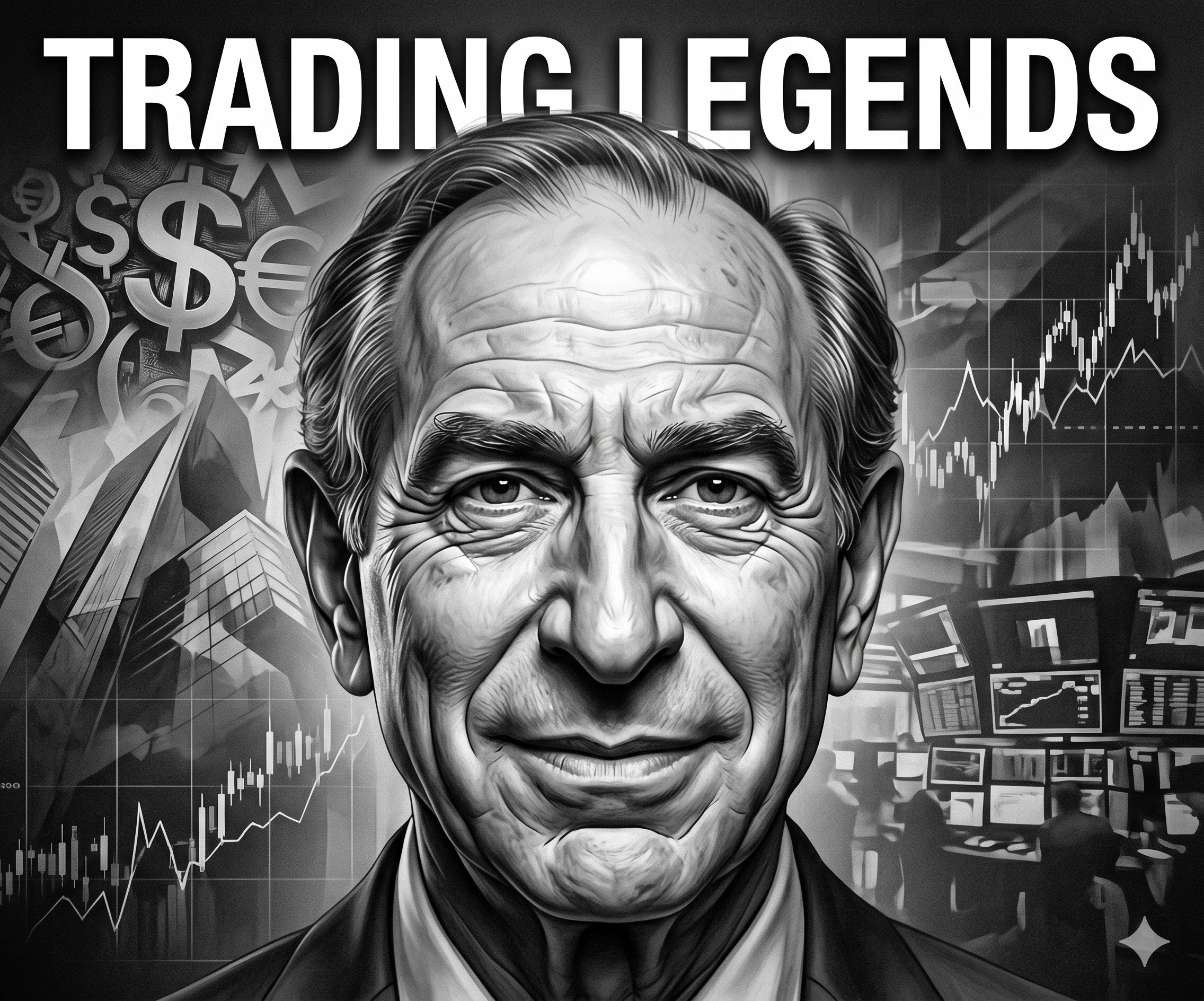
Trading Legends: Bruce Kovner
Picture a quiet office in Manhattan, sometime in the mid-1980s. The phones are ringing. Currency markets in Tokyo have just lurched on surprise central bank data out of Germany. While other traders scramble, Bruce Kovner — seated at his desk with a yellow legal pad — has already mapped three possible scenarios. He is not reacting. He is confirming.
That discipline, the refusal to be surprised, is the engine behind one of the most remarkable careers in financial history. Kovner started with $3,000 borrowed on a MasterCard. He built Caxton Associates into a global macro hedge fund managing over $14 billion at its peak. He did it without fanfare, without a reality-TV trading persona, and without breaking his own rules — even once, after learning the hard way what happens when you do.
The Early Life and Influences of Bruce Kovner
Bruce Stanley Kovner was born in February 1945 in Brooklyn, New York, to a Jewish family whose roots traced back to Tsarist Russia. His grandparents had fled persecution in the early 1900s, and that immigrant hunger for security and self-reliance appears to have seeped into Kovner’s DNA. When he was eight years old, the family relocated to suburban Los Angeles, settling in the San Fernando Valley.
At Van Nuys High School, Kovner was the kind of student teachers remember. He played varsity basketball, served as class president, and organized school initiatives to send books and educational supplies to secondary schools in Kenya. He was not just bright — he was driven by something larger than personal ambition.
He earned a scholarship to Harvard College, where he studied political economy at the John F. Kennedy School of Government, immersing himself in the work of economists who would later shape his understanding of why governments make the mistakes that move markets. He never finished his doctorate. Instead, he drifted through a series of jobs — cab driver, harpsichord teacher, political campaign manager — each one widening his view of how the world actually works, as opposed to how it is supposed to.
That gap between theory and reality would become the foundation of his trading edge.
Key Career Moments That Shaped a Market Wizard
1977 — The Trade That Changed Everything
Kovner was 32 years old and largely broke when he borrowed $3,000 against his MasterCard and placed his first trade in copper and interest rate futures. He made roughly $1,000 on those first two positions. Small. Encouraging. Then came soybeans.
A supply shortage sent the market surging. Kovner’s $4,000 soybean position ballooned to $45,000 in just six weeks — an extraordinary run. Then, in a moment he would describe for the rest of his life as a lesson in humility, he removed a hedge that had been capping his losses if the market turned. The market turned. In a single hour, he watched roughly half that profit evaporate. He liquidated, escaping with around $22,000 — still five times what he started with — but was, by his own account, physically ill for a week afterward.
“I had a huge gain but lost half before getting out. In retrospect that was a very good thing. It helped me understand risk and create structures to control risk.”— Bruce Kovner, Market Wizards (1989)
That soybean trade did not break him. It made him. The visceral memory of watching a winning position collapse because he abandoned his rules became the foundation of every trade he would ever make afterward.
1978–1983 — The Commodities Corporation Years
Kovner’s talent was noticed early. He joined Commodities Corporation — a pioneering Princeton-based firm, later acquired by Goldman Sachs — where he worked under Michael Marcus, one of the legendary figures in systematic trend following. Marcus had been trained by Ed Seykota, creating a direct lineage of macro discipline that would echo through the entire hedge fund world.
At Commodities Corporation, Kovner was not just trading — he was learning an entire philosophy. The firm operated like a research lab for market talent: rigorous, analytical, deeply skeptical of emotion. Kovner absorbed it all. He generated millions in profits for the firm during his tenure, building a track record that gave him both the confidence and the credibility to go out on his own.
“Michael taught me that you could make a million dollars. He showed me that if you applied yourself, great things could happen. It is very easy to miss the point that you really can do it.”— Bruce Kovner, Market Wizards (1989)
1983 — Founding Caxton Associates
Kovner launched Caxton Associates in 1983 with a clear mandate: trade global macro — meaning he would bet on the big, slow-moving forces that shape entire economies. Interest rate differentials between countries. Currency misalignments driven by government policy errors. Commodity cycles tied to geopolitical stress. These were not short-term chart patterns. They were the kind of structural dislocations that take months to play out — and that reward patient, disciplined traders willing to hold a conviction through the noise.
$14B+Peak assets under management
28 yrsAs CEO of Caxton Associates
$7.7BEstimated net worth (2024)
1992Closed to new investors
Caxton became so successful that it stopped accepting new investors in 1992 — less than a decade after launch. At its peak, it was among the ten largest hedge fund families in the world, with offices in New York, London, Sydney, and Princeton. Kovner ran it for 28 years before stepping back as CEO in 2011. In 2012, he founded CAM Capital to manage his private assets, and the Kovner Foundation to oversee his philanthropic work.
Inside the Bruce Kovner Trading Strategy and Core Rules
Kovner is a global macro trader, which means he builds positions based on his reading of macroeconomic conditions — government policy, central bank decisions, inflation dynamics, and geopolitical shifts — rather than individual company earnings or stock-specific catalysts. He blends both fundamental analysis (the “why” behind a market move) and technical analysis (the “when” to enter and exit) into a single, unified framework.
“Fundamentalists who say they are not going to pay any attention to the charts are like a doctor who says he’s not going to take a patient’s temperature.”— Bruce Kovner, Market Wizards (1989)
His approach is built on a set of core rules that have remained consistent across nearly five decades of markets. They are simple on the surface. Executing them under pressure is anything but.
| Rule | What Kovner Actually Does |
|---|---|
| Pre-set every stop-loss | “Whenever I enter a position, I have a predetermined stop. That is the only way I can sleep. I know where I’m getting out before I get in.” Stop placement is driven by technical levels, not gut feel. |
| Undertrade your conviction | “Whatever you think your position ought to be, cut it at least in half.” Even when the thesis is strong, smaller size protects capital through inevitable volatility. |
| Cap single-trade risk at 1–2% | Novice traders risk 5–10% per trade. Kovner caps it at 1–2% of total portfolio equity. This rule alone keeps losing streaks from becoming career-ending events. |
| Watch for portfolio correlation | “If you have eight highly correlated positions, then you are trading one position that is eight times as large.” True diversification means positions that move independently, not just positions with different names. |
| Scenario-map before committing | “One of the jobs of a good trader is to imagine alternative scenarios.” Kovner builds multiple mental models of how a trade could unfold — then waits for one to be confirmed by the market before acting. |
| Detach from losses emotionally | “If you personalize losses, you can’t trade.” The ability to close a losing position cleanly — without ego, without revenge trading — is, in Kovner’s view, one of the rarest skills in the market. |
| Exploit government policy errors | Kovner has attributed much of his success to the tendency of policymakers and central banks to create market distortions that disciplined macro traders can identify and position around. |
The Bruce Kovner trading strategy is not built on a secret formula. It is built on the compounding effect of consistent discipline — doing the boring, unsexy work of risk management on every single trade, in every single market, for decades.
The Legacy of Bruce Kovner in Modern Finance
Bruce Kovner never sought the spotlight. He built one of the most profitable hedge funds in history from a borrowed credit card stake, then quietly stepped away when he was done. His legacy is not a brand or a media presence. It is a lineage: the traders and institutions shaped by his methods, the risk management principles embedded in how serious macro funds operate today, and a body of wisdom preserved in one celebrated Market Wizards interview that practitioners still study more than three decades later.
Beyond finance, he has given hundreds of millions to arts and education — serving as board chairman at the Juilliard School, supporting the American Enterprise Institute, and funding education reform initiatives across the country. The same rigorous standards he applied to markets, he applies to philanthropy.
For anyone studying the Bruce Kovner biography, the core lesson is both simple and difficult: the edge in trading is not information. It is behavior. Risk managed, size reduced, ego removed. That is what $3,000 on a credit card eventually looks like.