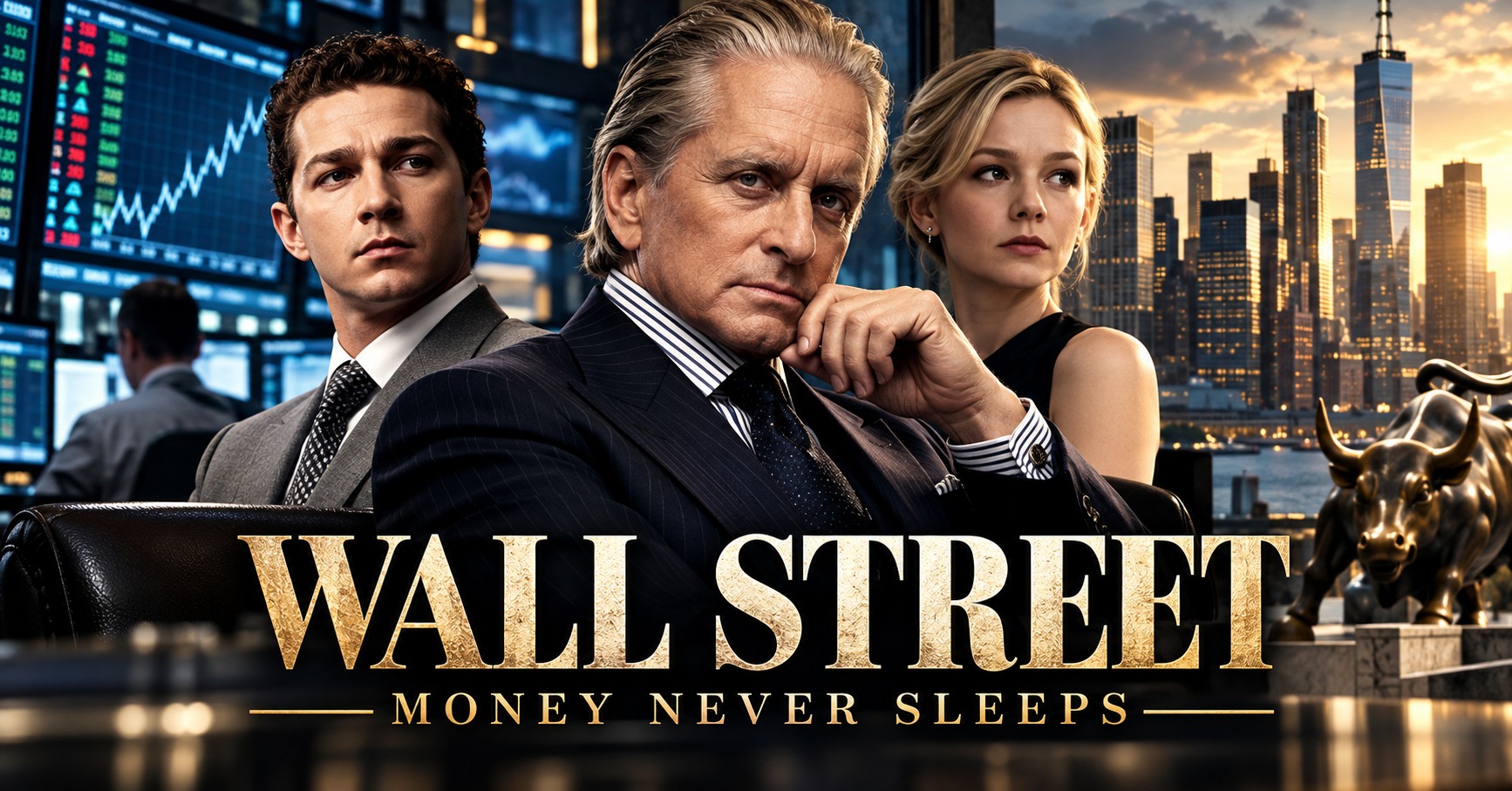
Worth watching: a sharp autopsy of a rumor-driven bank run wrapped in a soft family melodrama. The crash mechanics are the asset; the redemption arc is the liability. Watch it for the Fed meeting, then ignore the wedding.
Introduction
Money Never Sleeps gets the crash right and the hero wrong. Its best forty minutes show how a rumor, a funding squeeze and a stingy regulator can vaporize a storied investment bank in one week. Everything after that is a family drama with a trading floor painted on the back.
In a live trading environment, the collapse sequence rings true because counterparties never wait for insolvency; they wait for a headline. I have watched a desk go from “we’re fine” to “pull every line” inside a single session, and Stone captures that vertigo well.
The film arrives 23 years after the original, and it opens with Gordon Gekko walking out of prison in 2001 to collect his belongings. That includes a cellphone the size of a cinder block, which is still the most honest joke in the picture: the hardware shrinks, the greed does not.
Stone then jumps to 2008, when leverage of 30-to-1 was called “efficiency” right up until it was called “insolvency.” That timing gives the movie a real advantage over its predecessor, because this time the villains are not stealing from the system. They are the system.
Key Takeaways
- Liquidity kills banks faster than losses do: confidence is the collateral, and once it leaves, no balance sheet survives.
- A rumor is a weapon with a P&L: short the stock, feed the story, then buy the wreckage at a discount.
- Leverage is a loan against a future you have not yet survived.
- The Fed meeting scene is the film’s finest work: it dramatizes moral hazard as a live negotiation rather than a textbook term.
- Gekko’s “redemption” is still a con: a better-intentioned fraud is still a fraud, and the film keeps forgetting that.
Synopsis
Jake Moore (Shia LaBeouf) is a proprietary trader at Keller Zabel Investments, where his mentor Louis Zabel (Frank Langella) has run the firm for decades. Jake is also engaged to Winnie Gekko (Carey Mulligan), the estranged daughter of the man who once taught Wall Street to worship greed.
Then the firm’s mortgage-backed securities exposure becomes a rumor, the rumor becomes a run, and the stock is sold into oblivion. Zabel rushes to a meeting at the Federal Reserve seeking a lifeline, only to watch the rival bank that helped engineer the panic sit on the other side of the table.
That rival is Churchill Schwartz, run by Bretton James (Josh Brolin), who buys the carcass for pennies on the dollar. Keller Zabel is finished, and Zabel himself does not survive the week.
Jake wants revenge and turns to the one person who understands how the game is rigged: Gekko, now the author of a bestselling book, Is Greed Good? Gekko offers help in exchange for a reconciliation with Winnie, and the spoiler is that his real target is her Swiss trust fund. The final act is a chain of double-crosses that ends with Bretton exposed and Gekko cheerfully back in the game.
Cinematic Qualities
Performances
Michael Douglas has aged Gekko like a rare Barolo: smoother, darker and more expensive. Josh Brolin is the real surprise, playing Bretton James as a man who genuinely believes he is the responsible adult in the room.
LaBeouf and Mulligan are decent, but they are stuck in a love story that has all the market impact of a rounding error. Frank Langella gets the film’s emotional peak and plays it beautifully.
Direction & Production Design
Stone’s visual grammar is subtle as a margin call. Split screens, wipe transitions and, yes, a literal child blowing soap bubbles to explain speculative bubbles. Winnie’s baby is basically a mark-to-market metaphor in a onesie.
The production design is a time capsule of 2008: BlackBerrys everywhere, Bloomberg terminals glowing like campfires, and cable-news tickers screaming crimson. It feels authentic because the technology looks so quaintly stuck in its era, while the panic looks exactly like today.
The Trader’s Lens
Central Financial Concepts
- Repo and short-term funding: the plumbing that lets a bank borrow overnight against collateral, and the first pipe to burst when confidence cracks.
- Mark-to-market on mortgage-backed securities: when buyers vanish, “value” becomes whatever the last panicked bid says it is.
- Rumor-driven short attack: spreading a story to move the price, which is textbook market manipulation, not clever trading.
- Moral hazard: the argument that bailing out reckless firms teaches every other firm that reckless is free.
- Margin calls and counterparty contagion: one firm’s forced selling becomes everyone else’s losses.
Lessons for Traders
- Watch funding, not just earnings: Bear Stearns was in the Fed’s crosshairs in March 2008, with the Fed backstopping roughly $29 billion of assets to get JPMorgan to take it.
- Lehman filed on September 15, 2008, after no rescuer appeared. The film’s Fed meeting is a compressed version of that weekend’s brutal arithmetic.
- Gekko’s book-tour warning is the point: the one person who admitted the system ran on debt was the convicted felon.
- Size positions for the day the exit door closes, not the day it is open.
Accuracy vs. Dramatization
The collapse of Keller Zabel is largely faithful to how the real dominoes fell. A rumor hits, the stock gaps, lenders demand more collateral, and the firm discovers that its “assets” are worth what the market will pay in a hurry.
In a live trading environment, this scene rings true because the price of a bank’s stock and the cost of its funding move together, and each one feeds the other. That feedback loop is the whole story of 2008, and Stone gets it right.
Where the film goes off the rails is the finale. Gekko’s “heroic” solution is itself a different variety of fraud: he manipulates his daughter to get at her trust fund, then acts as if the outcome redeems the method. In a real desk investigation, “I did it to hurt the bad guy” is not a defense; it is an aggravating fact.
Psychology & Culture
Every major character makes decisions based on identity, not analysis. Zabel’s self-image is inseparable from his firm, so when the firm dies, so does he. Jake defines himself by revenge, which is exactly why Gekko can steer him.
Bretton James is the most instructive case. He has built a rationalization chain in which the firm’s survival justifies the rumor, the rumor justifies the timing, and the timing justifies the purchase price. Every link is small, and every link is deniable.
Firms like Churchill Schwartz do not hire monsters; they select for people who can compartmentalize. I have sat across the table from traders who could describe a counterparty’s death spiral without changing their tone, and they were considered the “steady” ones.
Trader Insight
The most dangerous person on a trading floor is not the one who knows he is a villain. It is the one whose story has cast him as the adult fixing the system, because he will never stop to audit his own trade.
Audience Fit
- Retail traders: Useful for the liquidity-risk lesson, but it says almost nothing about position sizing, execution or risk management at your scale.
- Finance and economics students: Strong as a moral-hazard case-study opener, weak as a technical primer, since instruments are name-dropped rather than explained.
- Wall Street insiders: The Fed meeting will earn a knowing nod; the trust-fund subplot will earn an eye-roll, because no compliance department signs off on that.
- General audiences: Approachable and fast-moving, though the family melodrama drags the second half and the jargon may leave newcomers behind.
Verdict
Final Score: 6/10
Composite Score Table
| CATEGORY | SCORE (/10) | WEIGHT | WEIGHTED | BAR |
|---|---|---|---|---|
| Financial Accuracy | 7/10 | 30% | 2.1 | |
| Cinematic Quality | 5/10 | 20% | 1.0 | |
| Trader Psychology | 7/10 | 20% | 1.4 | |
| Educational Value | 6/10 | 20% | 1.2 | |
| Rewatchability | 5/10 | 10% | 0.5 |