
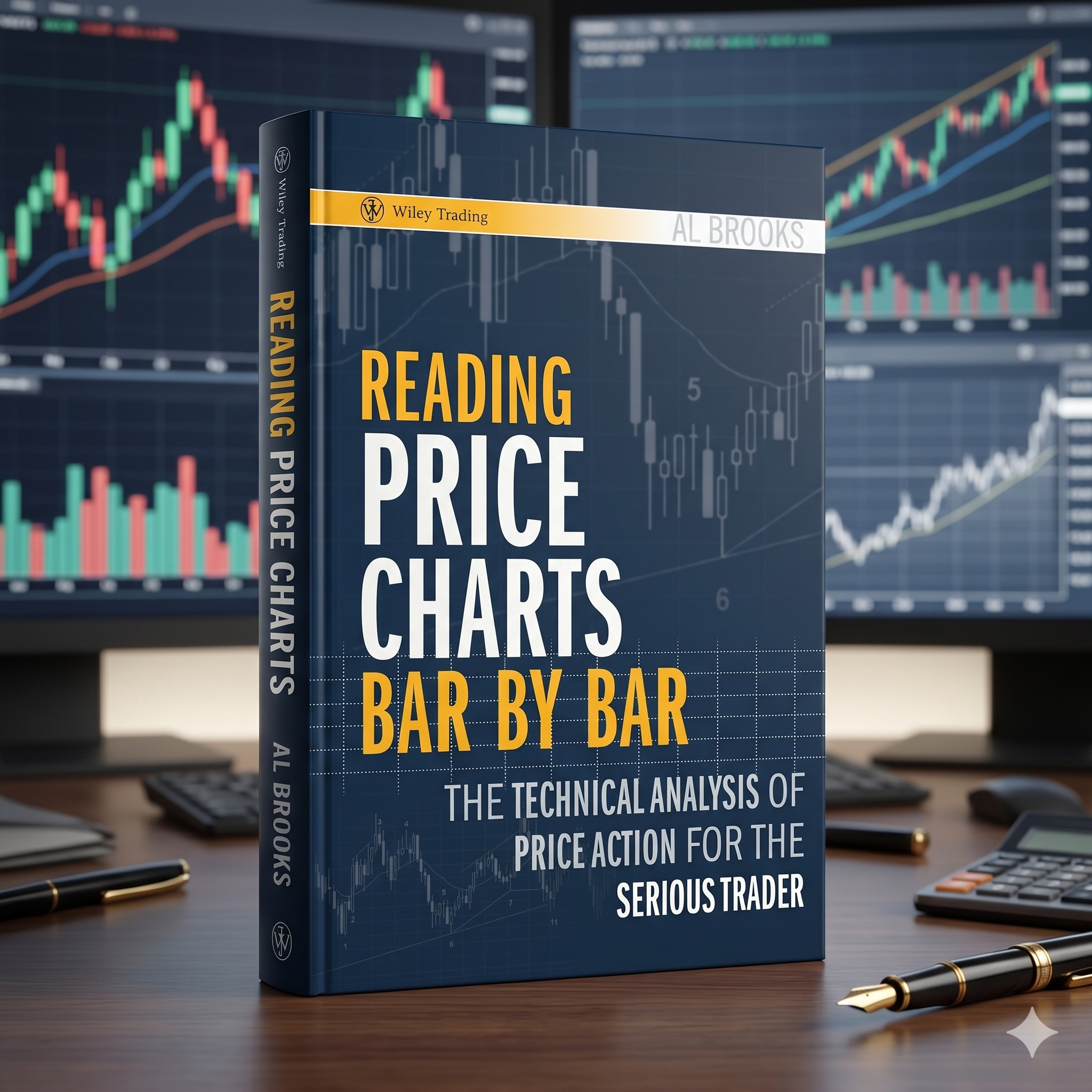
Al Brooks price action trading book offers rare chart-reading depth — but demands serious study time. Best for intermediate traders who want to move beyond indicators. Four key takeaways make it worth reading even if you never finish it. Learn why context and patience are your real edge.
There are books that teach you about trading. Then there are books that try to rewire the way you see a price chart. Al Brooks’ Reading Price Charts Bar by Bar firmly belongs to the second group — and that ambition is both its greatest strength and its most serious flaw.
Brooks is a physician-turned-trader who spent years studying what he calls “price action” — the raw, unfiltered story told by each candlestick bar on a chart. His premise is simple but bold: forget indicators, forget moving averages, forget the noise. If you learn to read individual price bars the right way, the market will tell you everything you need to know.
Published in 2009, the book remains a landmark in the world of technical analysis. It is dense, demanding, and deeply personal — the product of one man’s obsessive study of how markets move, tick by tick. For traders willing to put in the work, it offers a genuinely different way of thinking. For everyone else, it may feel like trying to drink from a fire hose.
Core Ideas
Brooks builds his entire system around a single belief: price action is the most honest signal in any market. Every bar on a chart — every open, high, low, and close — tells a story about who is winning the battle between buyers and sellers. His job, and yours if you follow him, is to learn to read that story in real time.
The book introduces a vocabulary of patterns. You will learn about “trend bars” and “doji bars.” You will study “climactic reversals” and “failed breakouts.” Brooks explains concepts like “always in long” (the market is so strong that you should only be looking for reasons to buy) and the idea of “two-legged pullbacks” — a pattern where the market pauses twice before resuming its trend.
Think of it like learning to read weather by watching the sky directly, rather than checking a weather app. Brooks is teaching you to feel whether it’s about to rain by the color of the clouds, the direction of the wind, and the pressure in the air — not by waiting for someone else to interpret it for you.
His core method centers on finding what he calls “high-probability setups.” These are moments when multiple signals line up: the trend is clear, the pattern is recognizable, and the risk is manageable. He also spends considerable time on the concept of always having a reason to be in a trade — not trading on gut feeling, but on a repeatable, observable pattern.
Strengths
The book’s greatest strength is its specificity. Brooks does not deal in vague generalities. He annotates real charts with hundreds of detailed explanations. Each example shows exactly what he was thinking, why he entered a trade, and what he expected to happen next.
This level of detail is rare. Most trading books speak in broad strokes. Brooks goes line by line, bar by bar — literally. If you want to understand why a price moved, not just that it moved, this level of granularity is deeply valuable.
Second, the book has longevity. Price action patterns do not expire. The strategies Brooks describes in 2009 still appear on today’s charts because human psychology — fear, greed, hesitation, panic — has not changed. The setups he identifies are grounded in crowd behavior, which means they remain relevant in stocks, futures, forex, and even cryptocurrency markets.
Third, Brooks rewards serious students. This is not a weekend read. But traders who return to it repeatedly — and many do — report that new insights emerge each time. It functions almost like a reference manual, one you return to as your experience grows.
Limitations
Let’s be honest about what the book is not.
It is not beginner-friendly. Brooks writes the way he thinks — in dense, layered prose that assumes a baseline familiarity with charts and trading concepts. Sentences can run long and complex. The logic is rigorous but the communication is often exhausting. A new trader picking this up cold may close it before reaching Chapter 3.
It is also highly subjective. Price action trading, at its core, involves a lot of interpretation. What looks like a “high-probability setup” to Brooks may not be obvious to anyone else. He acknowledges this himself — his method requires thousands of hours of screen time before it clicks. That is not a criticism of the method itself, but it is a limitation the author could have addressed more directly.
The writing and layout are a weakness. The charts, while numerous, can be hard to follow in print. The annotations are small, the explanations long, and the organization of chapters feels more like a stream of consciousness than a structured curriculum. A skilled editor could have cut the book by a third and made it twice as useful.
Finally, the book is long-form and slow-paced in a world that moves fast. Modern traders have access to tools, platforms, and communities that did not exist in 2009. Brooks does not engage with algorithmic trading, high-frequency markets, or the structural changes that have reshaped price behavior in the past decade. His framework still works, but the context has shifted.
Trader’s Takeaway
Here is what a retail trader or curious beginner should actually take away from this book — even if they never finish it:
1. Price tells a story. Before you add any indicator to your chart, spend time just watching price move. Where does it stall? Where does it surge? Learn to ask why before you ask what.
2. Context matters more than any single pattern. Brooks constantly asks: what is the market doing right now, in the big picture? A buy signal in an uptrend is very different from the same signal in a downtrend. Always zoom out.
3. Risk management is built into every trade. Brooks teaches you to identify your exit point before you enter. If the trade goes wrong, you already know what you’ll do. This mindset — plan the exit before the entry — is one of the most valuable habits any trader can build.
4. Patience is the edge. Brooks is not looking for trades every minute. He waits for the clearest setups, skips the ambiguous ones, and accepts that doing nothing is sometimes the best trade.
Even if you never master his full system, internalizing these four principles alone will make you a more disciplined, less reactive trader.
Who Should Read This
Reading Price Charts Bar by Bar is best suited for:
- Intermediate traders who already understand basic charting and want to go deeper into price action methodology.
- Day traders and swing traders focused on futures, equities, or forex who rely on short-term chart patterns.
- Self-directed investors with serious interest in technical analysis who are willing to invest significant study time.
- Advanced beginners who have read one or two introductory trading books and are ready for a step up in complexity.
It is not recommended as a first trading book. New investors would be better served starting with something like How to Make Money in Stocks by William O’Neil or The Little Book of Common Sense Investing by John Bogle — books that give context before complexity.
Verdict
Reading Price Charts Bar by Bar is a serious, sincere, and genuinely valuable book for the right reader. Al Brooks is not selling a fantasy. He is not promising easy profits or a magic formula. He is offering something harder and rarer: a disciplined framework for reading markets that, with enough practice, can become second nature.
But the book demands a lot from you. It asks for time, patience, and a willingness to sit with confusion until things click. It is poorly organized, occasionally repetitive, and not always kind to the reader’s attention span.
Think of it the way you might think of a brilliant but disorganized professor — someone who knows more than almost anyone in the room, but whose lectures require you to take your own careful notes to extract the real value.
If you are serious about price action trading and willing to put in the work, this book belongs on your shelf. Just do not expect it to be an easy read. Expect it to be a rewarding one.
Final Rating: 6.5 / 10
Strong on substance. Challenging on accessibility. Essential for dedicated students of price action. Optional for everyone else.