

Essential reading for discretionary traders who mistake conviction for a process. The insight that should stop your scroll: your position size must breathe with volatility, because most blown accounts are sizing failures wearing a strategy costume. Read it if you trade on feel and call it edge; skip it if you want a system to print money while you sleep.
Introduction
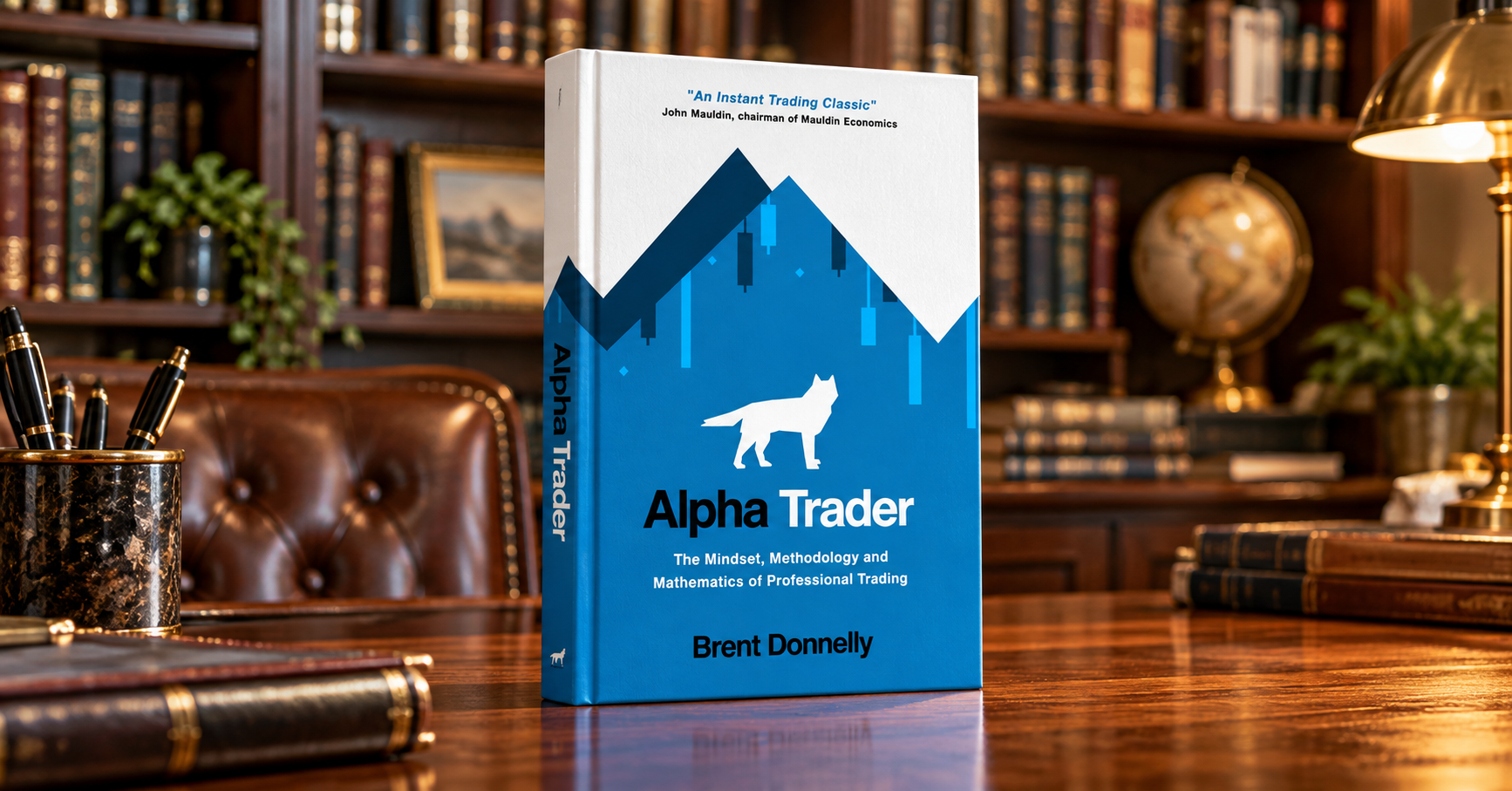
Alpha Trader is the rare psychology book written by someone who has actually been stopped out. Brent Donnelly, an FX macro trader, has produced a manual that treats your own brain as the primary counterparty. It is discretionary trading with the guardrails bolted on.
The book opens with a confession rather than a victory lap. A trader sits on a $2.8 million profit in USDJPY, gets impatient, flips long on the same pair, and then a flash crash in equities drags the yen cross out from under him. It is the most honest first chapter in the genre.
Most trading books sell you a setup. This one sells you a checklist, a sizing spreadsheet, and a mirror. In a live trading environment, that ordering is correct, because the setup was never what separated the accounts that survived from the accounts that didn’t.
It carries a foreword by Dr. Ben Hunt and a structure that runs from why traders fail, through mindset, through methodology and mathematics, to adaptation and attitude. It is also a book with an author who runs a macro research business, which we will get to.
Key Takeaways
- Position size is the first risk control. Trade smaller when volatility rises and larger when it falls, and stop pretending a fixed lot size is discipline.
- Your edge must clear costs. Execution, technology, and operational drag mean a small edge is a negative-expectancy business.
- The last trade before news is the reference point. Donnelly’s NewsPivot idea turns headline chaos into a level you can actually trade against.
- Smart people do stupid things. Intelligence does not protect you from impulsive re-entry, revenge sizing, or anchoring to your entry.
- Build friction where you misbehave. Willpower is finite, so the process has to make the bad trade harder than the good one.
Overview
Part One asks why some traders succeed and most fail. Donnelly opens with self-assessment, then walks through the research on how hard sustained trading success is, and what predicts success outside markets. Conscientiousness and IQ show up as positive predictors, and neuroticism as a negative one.
Part Two is the mindset section. It covers the traits and habits that compound, then a chapter on “kryptonite”: bad discipline, sloppy thinking, and the leaks that bleed P&L. The chapter on smart people doing stupid things is the emotional centerpiece.
Part Three is where the mechanics live. Microstructure covers participants, liquidity, and intraday patterns. Then come narrative and reflexivity, trends and catalysts, technical analysis, sentiment and positioning, and a risk management chapter that argues survival beats cleverness.
Part Four covers adaptation and attitude. It closes with a conclusion, a last story, and appendices, including a list of 21 ways to succeed at trading and 13 ways to fail. In a live market, the failure list is the one worth taping to your monitor.
Writing & Structure
Prose Style
Donnelly writes like a trader briefing a junior at 6:45 a.m.: short, specific, and mildly annoyed that the mistake is so predictable. He has no patience for mysticism, which is refreshing in a genre that regularly confuses journaling with alpha.
The tone occasionally drifts into the self-help register. That is the cost of a book that has to cover mindset alongside math.
Pacing & Depth
The first nine chapters are the strongest, and readers on Goodreads say so too. The back half slows and leans toward a beginner’s pace, which is a fair complaint from anyone with a few years of screen time.
The trading stories are sparse but land hard. I wish there were more of them, because the opening anecdote does more teaching than several chapters of framework.
Technology Time Capsule
The book was published in 2021, so the dated-reference comedy is mild: FinTwit, Zoom-era desks, and retail-flow anxiety. The comedy is that the specific technology changed and the impulse to double up on a winner did not.
The Trader’s Lens
Central Financial Concepts
- Volatility-adjusted position sizing: a spreadsheet that sets size and stop from a volatility input, so risk per trade stays constant while the market’s temperament does not.
- Market microstructure: who is in the market, how deep liquidity is, and when intraday flows distort price. It matters most in FX, where the session handoff moves more than most opinions do.
- NewsPivots: the final trade before a market-moving release, used as a reference level for what the market believed before the shock.
- Narrative and reflexivity: the internal story of a market, and how price feeds the story that feeds price.
- Risk of ruin: the probability that a bad run ends the game before your edge has time to show up.
Lessons for Traders
- Size down into fast markets. Fast markets are temporary, but volatility regime changes can stick, and the 2015 Swiss franc de-peg is the classic case of a calm market that was not calm at all.
- Log leaks, not just trades. Impulsive re-entries after a winner are a pattern, not a bad day, and patterns can be tracked and priced.
- Specialize before you diversify. Deep knowledge of one or two markets beats shallow coverage of twelve.
- Put friction between you and your worst habits. Delete the app, add the checklist, or require a written reason before size goes up.
Accuracy vs. Narrative Spin
The mechanics are correct. Volatility scaling, microstructure, and risk of ruin are named and used properly. That is not a low bar in a genre that routinely waves at “risk management” without ever defining a stop.
In a live trading environment, the vol-adjusting section rings true because it is where most retail accounts actually break. Fixed lot sizes in a volatility spike are how a 1% idea becomes a 6% loss.
The spin is the generalization. The process is distilled from one professional FX macro career, and the book carries the quiet survivorship assumption that it ports cleanly to a retail account with wider spreads and no desk. Donnelly is candid that most traders fail, but less candid that his own path is a sample of one.
The author has a business to protect. Donnelly runs a macro research operation through Spectra Markets, and a bestselling book about professional-grade process is excellent top-of-funnel for that credibility. That is not disqualifying, but a working trader should price it the way they price any research vendor’s own conviction.
Psychology & Culture
The book’s central claim is that you are a bundle of emotions, memory, and bias, and that you can be smart and still do something stupid. This is the professional’s version of humility, which is different from the retail version. The retail version says “stay disciplined,” and the professional version says “assume you won’t, then build the rules that assume it.”
Donnelly’s identity-based trap is the competence rationalization chain. A trader wins, credits skill, sizes up, gets stopped, blames noise, and re-enters bigger to prove the original thesis. The opening USDJPY story is that chain compressed into a single morning.
The desk culture the book depicts is unsentimental. Profit is not proof, process is proof, and the trader who cannot tell the difference is the one who gets carried out.
Trader Insight
The most dangerous moment in Alpha Trader is not the loss, it is the $2.8 million winner. Donnelly’s opening story shows that a large profit does not just add to your account, it inflates your sense of what your judgment is worth, and the very next trade is where you pay for that inflation.
Reader Fit
- Retail traders: the best fit in the room, particularly discretionary traders sizing on feel. The catch is that the microstructure material assumes FX and macro familiarity that a first-year account may not have.
- Finance and economics students: useful for the behavioral research and the risk-of-ruin logic, but it is a practitioner’s field guide, not a textbook, and it will not give you a derivations-heavy education.
- Wall Street insiders: the mindset section will feel familiar, and the back half will feel elementary. Read Part Three for the NewsPivot and sizing discipline, then close it.
- General readers: the opening story and the “smart people do stupid things” chapter travel well, but the book is not written for anyone who does not already care what a stop-loss is.
Verdict
Final Score: 8.7/10
Composite Score
| Category | Score (/10) | Weight | Weighted | Bar |
|---|---|---|---|---|
| Financial Accuracy | 9 | 25% | 2.25 | |
| Writing & Clarity | 8 | 20% | 1.60 | |
| Trader Psychology | 9 | 25% | 2.25 | |
| Educational Value | 9 | 20% | 1.80 | |
| Lasting Relevance | 8 | 10% | 0.80 | |
| TOTAL | 100% | 8.70 |