

Worth reading, as a manual for treating trading losses as behavioral patterns instead of technical failures. The edge is not in fixing your flaws but in measuring your behavior and rehearsing your best trades, because most traders never audit themselves. Read it if you own a working method and keep bleeding it through emotion; avoid it if you want a setup that prints money.
Introduction
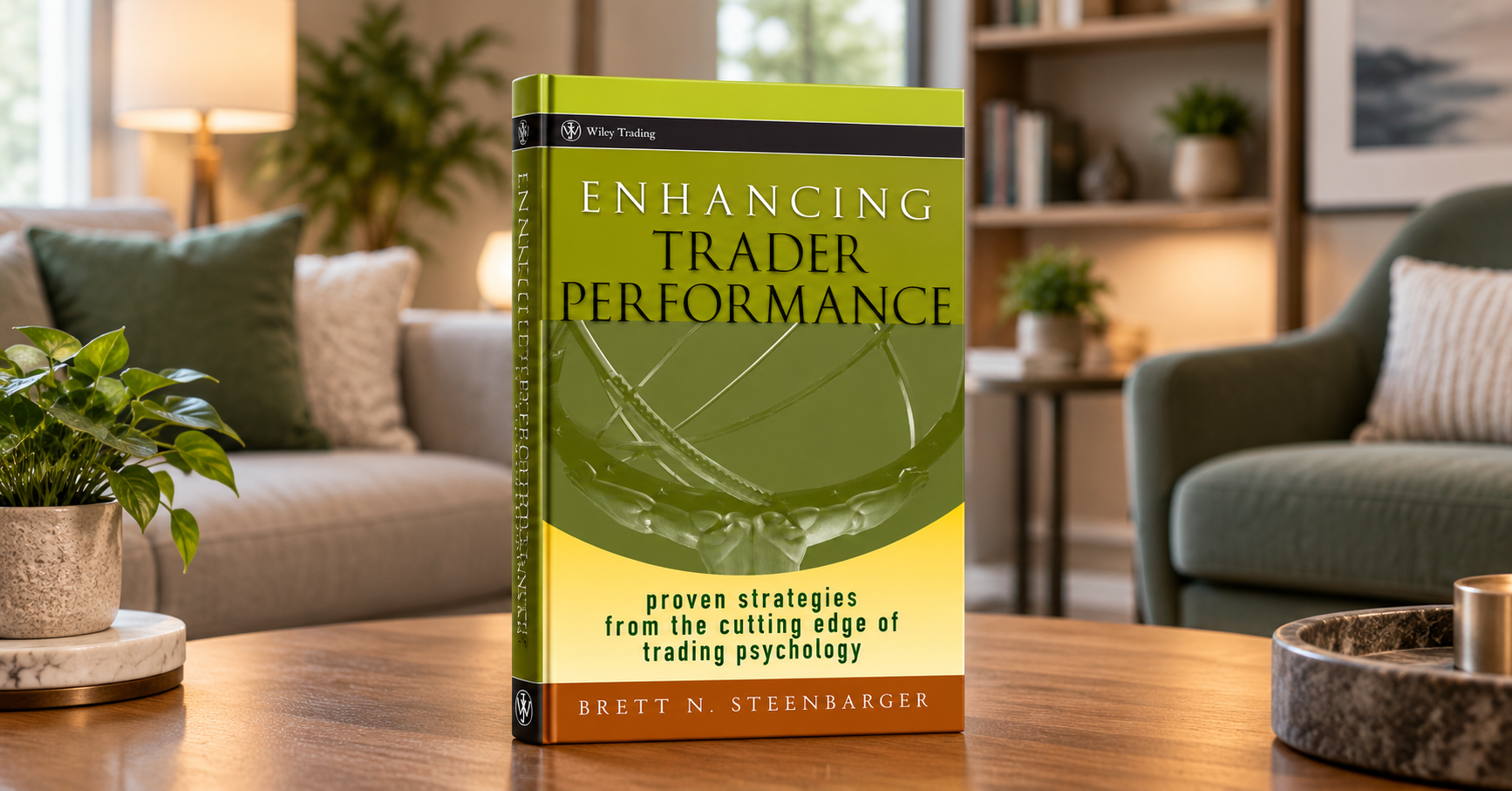
Enhancing Trader Performance is the rare trading psychology book that treats your P&L as a symptom, not a diagnosis. Brett Steenbarger, a clinical psychologist, imports brief-therapy methods and performance coaching into a field otherwise clogged with affirmations and candlestick folklore. It offers no entry signals and no holy grail, only a blunt claim: your edge leaks through behavior.
The thesis is that traders rarely fail from ignorance of chart patterns; they fail by repeating the same emotional loops under uncertainty. In a live trading environment, this rings true, because every blown account I’ve reviewed ran on a workable method and a trader who couldn’t follow it. The market was fine. The operator wasn’t.
Published by Wiley in 2006, the book is also a time capsule. It lands in the hangover from the dot-com day-trading boom, when retail accounts lived under the $25,000 pattern day trader minimum, journals lived in Excel, and heart-rate-variability biofeedback gadgets were pitched as the next edge. Nobody had FinTwit to blame for their tilt yet.
Read it with one eyebrow raised. Steenbarger sells the solution through books, speaking, and coaching, and a self-improvement narrative flatters the buyer by implying the problem is fixable. Still, the method underneath is sound and more rigorous than most of the shelf.
Key Takeaways
- Trading performance is a skill built through deliberate practice, not a personality trait you either have or lack.
- Your recurring losses are patterns, and patterns can be tracked, so the trade journal is a dataset, not a diary.
- Building on strengths beats fixing weaknesses: replicate the conditions of your best trades.
- Emotional regulation is trainable, while suppressing emotion just defers the bill.
- Without a performance feedback loop, “experience” is years of repeating the same mistake.
Overview
Steenbarger builds the book around trader development as a process: learn, track, correct, repeat. He borrows from cognitive-behavioral and solution-focused therapy, strengths-based development, and the deliberate practice research popularized by K. Anders Ericsson.
His home turf is intraday index futures, notably the E-mini S&P 500, where leverage and speed compress the feedback loop between decision and pain. A bad tick sequence can burn a week of discipline before lunch. That is the environment where his behavioral diagnostics earn their keep.
The central argument: identify the emotional patterns that trigger your worst trades, then engineer routines that displace them. The constructive core is rehearsing the conditions of your best trades, which is the opposite of the usual advice to “stop being emotional.”
Writing & Structure
Prose Style
Steenbarger writes like a clinician: measured, specific, and mostly allergic to swagger. That’s refreshing after a shelf of gurus, though few sentences will make you laugh or sweat. Dry is the price of credible.
Structure and Pacing
The chapters build from self-assessment to skill training to stress management, which suits a workbook mindset. It drags when repeated frameworks replace new material. A reader hunting for a plot will not find one.
Research Depth
The psychology is well grounded; the market side is thinner. Examples serve the behavioral point rather than test it, and there is no backtested evidence that following his program improves a Sharpe ratio. Expect clinical rigor, not quantitative proof.
The Trader’s Lens
Central Financial Concepts
- Intraday E-mini S&P 500 futures: leverage plus speed shrinks the gap between a decision and its emotional consequence.
- Drawdown and risk of ruin: revenge trading and size escalation turn an ordinary losing streak into an account-ending one.
- Position sizing and stop discipline treated as behaviors to be trained, not parameters to be optimized.
- Regulatory backdrop: FINRA’s pattern day trader rule and $25,000 margin minimum shaped who was trading these markets in the book’s era.
- The disposition effect, holding losers and cutting winners, is the academic cousin of the patterns he coaches against.
Lessons for Traders
- Track everything. A log of time of day, size, and emotional state exposes patterns that memory edits away.
- Study your best trades, not just your worst, and reproduce the conditions that produced them.
- Untracked emotion scales. Nick Leeson’s 1995 Nikkei 225 futures losses at Barings, buried in error account 88888 and doubled down until collapse, show what a never-reviewed pattern looks like at institutional size.
- Rehearse under pressure in simulation before you need the routine live.
- Stress management is risk management. A sleep-deprived, tilted trader is running a bigger position than the one on the screen.
Accuracy vs. Narrative Spin
Financial mechanics are rarely the weak point, because the book barely traffics in them. The exposure is the claim underneath: that coaching fixes traders. In my years around retail flow, I’ve watched plenty of people journal beautifully and still blow up on size.
Weigh that promise against Barber and Odean’s 2000 study, which found that the most active retail accounts underperformed after costs. Case studies of improved traders are self-selected, since the ones who stayed engaged are the ones who get written about. That is survivorship bias in a cardigan.
Then there’s the conflict of interest: the author monetizes the belief that performance can be coached. That doesn’t make the method wrong. It does mean the book never has to show you the cohort that journaled for a month and quit.
Psychology & Culture
The book’s core argument is about identity. Traders lock onto a self-image, the disciplined pro or the contrarian who’s never wrong, and then take positions to defend it. Losses become an attack on the self, so the rationalization chain starts: the stop was too tight, the news was unfair, I’ll get it back.
That chain is the same in every era. Pit traders in open outcry blamed the crowd, 2006 screen traders blamed the specialist, and today’s traders blame the Fed and the “manipulated” close. The costume changes; the ego doesn’t.
The culture it targets is the lone-wolf trader: isolated, self-reliant, and starved of feedback. Steenbarger’s counter-programming is unglamorous: coaches, peers, and review. It is a hard sell in an industry that romanticizes solo genius.
Trader Insight
Bad trading habits survive because they pay off emotionally, just not financially. Revenge trades, held losers, and oversized bets deliver relief, vindication, or a postponed sting, and no risk rule will beat that payoff until you name it.
Reader Fit
- Retail traders: the primary audience and the biggest winners, but only if you will keep a log; if you want signals, this book is a dead end.
- Finance and economics students: a useful bridge to behavioral finance, but the quantitative content is thin and it does not replace the empirical literature.
- Wall Street insiders: desk heads and PMs will find the process ideas useful but the beginner framing slow, and institutional risk culture is barely addressed.
- General readers: skip it; without a live P&L at stake, the exercises read like a corporate wellness seminar.
Verdict
Final Score: 7/10
Composite Score
| Category | Score (/10) | Weight | Weighted | Bar |
|---|---|---|---|---|
| Financial Accuracy | 7 | 20% | 1.40 | |
| Writing & Clarity | 5 | 15% | 0.75 | |
| Trader Psychology | 9 | 30% | 2.70 | |
| Educational Value | 7 | 20% | 1.40 | |
| Lasting Relevance | 5 | 15% | 0.75 | |
| Total | 100% | 7.00 |