

A publicity-shy Soros adviser turned concentrated leverage into extraordinary gains, then hit a brutal reversal. The record shows what worked, what broke and what remains unproven.
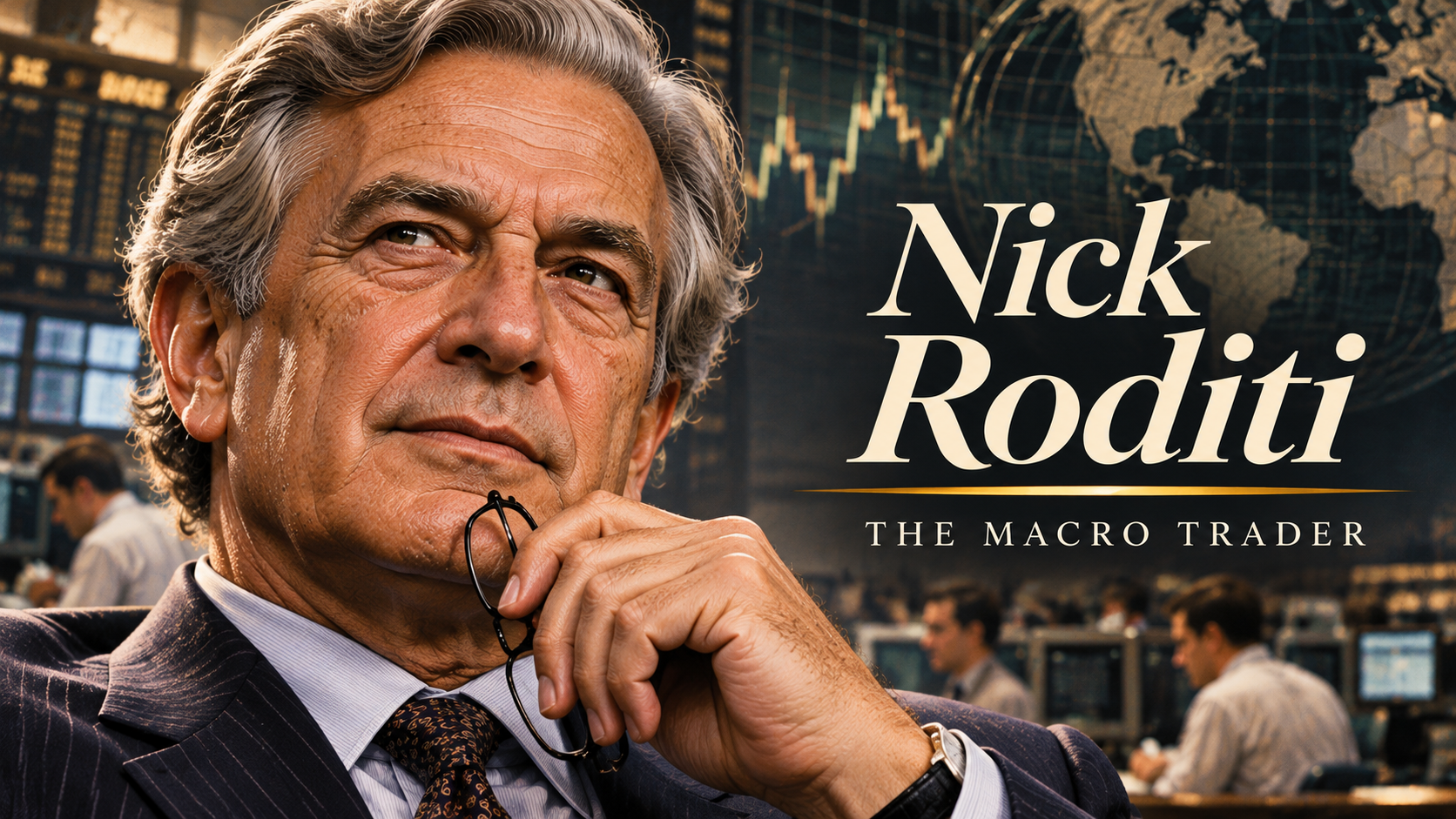
On 28 April 2000, George Soros announced that Nick Roditi would step down from the Quota Fund. The fund had lost about a third of its value in four months. The Nick Roditi trading strategy, built on a few huge leveraged bets, had just met its hardest test.
Three years earlier, the picture looked very different. Quota reportedly returned 159.4% in 1995 and 81.9% in 1996, net of fees. Press reports in the mid-1990s ranked Roditi among Britain’s best-paid fund managers.
Yet he never gave a long-form interview, and no audited record has surfaced. So the question is narrow. What can be proven about how Roditi made money, and why did it stop?
The Making of a Secretive Macro Investor
Roditi was born in August 1945 and grew up in Rhodesia. He attended Peterhouse Boys’ School near Marondera. Investor Swen Lorenz, who assembled Roditi’s public record in 2022, reports that he joined the merchant bank Schroders in 1969 and later worked for Lord Rothschild. Those details rest mainly on Lorenz.
By 1992 Roditi was managing money for Soros in London. The Quota Fund launched that year, reportedly with £160 million.
No defining loss or mentor story is documented. The nearest thing is advice attributed to Soros. Lorenz relays a 1997 Independent article saying Soros told Roditi to add to a losing position if he still believed his analysis.
That fits the style Roditi became known for. Conviction, not price, decided when to hold or add. Lorenz says conventional fund houses disliked the volatility, while Soros’s firm tolerated it.
How Nick Roditi Actually Made Money
Roditi tried to profit from a handful of very large macro bets, held for years while his thesis played out. This description comes from Barton Biggs’s 2006 book Hedgehogging and Steven Drobny’s Inside the House of Money, as excerpted by Lorenz.
Biggs described about ten positions, sometimes only three. Leverage was heavy. In one undated example, the portfolio was short the dollar at three times equity. It held more than 100% of equity in Japan and 200% in two-year Treasuries as insurance. Lorenz identifies the manager, called “Tim,” as Roditi. That identification comes from Lorenz alone.
The edge was research and patience. Biggs described constant travel to Japan, Russia and India, plus contacts inside Japanese banks. Drobny wrote that Roditi could pick two or three themes and sit through adverse moves for years.
His entry triggers, stop levels and exit rules are not publicly documented. His exact role is also unclear. One corporate history calls Quota a fund of funds run by outside managers, with Roditi as chief adviser. Contemporary press called him its manager.
Nick Roditi’s Core Trading Rules
Five principles emerge from the surviving accounts. None comes with a verified position-sizing formula.
| Principle | Market Logic | Modern Relevance |
|---|---|---|
| Concentrate | Real edge exists in few ideas. About ten positions, sometimes three. | Timeless, but only with a genuine edge. |
| Lever, but hedge | Amplify conviction. Treasuries served as insurance. | Adaptable. Retail leverage limits are tighter. |
| Hold themes for years | Big macro trends pay slowly. | Hard without patient capital. |
| Add when the thesis holds | Price alone does not invalidate a view. | Risky without a defined exit. |
| Decide alone | Avoids committee compromise. | Mixed. One mind is also one point of failure. |
The fourth rule is the most fragile. It rests on one reported instruction from Soros, and no limit on how far to add is documented.
When Conviction Became Dangerous
The style’s weakness showed in 1998. Lorenz says Roditi’s portfolio was up 32% in June and down 14% five months later. Another account puts Quota down 13.6% for the year by late October. The accounts differ, but both show a violent reversal.
The backdrop was the Russian default and emerging-market turmoil. Soros closed one fund and merged another that month. In late October, Soros said Roditi was taking a temporary medical leave. Bloomberg later reported that he returned a few months afterward.
The second blow came in 2000. Technology losses and the euro hurt Soros’s funds, and Quota fell about a third by late April. The Wall Street Journal said Roditi was also squeezed by fewer attractive macro bets. Soros said Roditi would stop macro investing. The fund passed to Roditi’s chosen successor, Michele Ragazzi, with a stock-picking tilt.
The episode shows the trade-off. Concentration and leverage produced huge gains in friendly regimes. In hostile ones, nothing diversified the damage.
What the Record Actually Shows
Partly, yes. Contemporary reporting supports large gains from 1992 to 1997 and a deep loss in 2000. The detail beneath those headlines is thin.
Soros announced Roditi’s departure in April 2000. Several outlets put Quota’s 2000 loss near one-third. Soros’s firm confirmed his 1998 leave, and Roditi returned. Quota’s assets were roughly $1.2–1.3bn in 2000, with one report citing $1.6bn for the wider Quota group.
The 39% average annual gain comes from a single Bloomberg report that does not say whether it is gross or net. The annual returns come from one newsletter. Peak assets, performance fees and the exact scope of Roditi’s authority are all unverified.
| Metric | Result | Context |
|---|---|---|
| Quota net return, 1995 | 159.4% | Newsletter figure, US dollars, net of fees |
| Quota net return, 1996 | 81.9% | Same source |
| Quota net return, 1997 | 49.3% | Same source |
| Average annual gain | About 39% | 1992 to April 2000; method not stated |
| 2000 year to date | About −33% | To late April; reports range from −32% to −33% |
Personal wealth is a separate matter. The Sunday Times Rich List put the Roditi family at about £2 billion in 2020, up from £1.67 billion in 2019. Those are estimates, and the fortune is tied largely to later stakes such as Ocado. They say little about his hedge fund record.
Where the Strategy Broke
The approach is most dangerous when leverage meets a regime change. Few positions leave little cushion when the market turns against all of them.
The history supports that. Biggs noted the immense volatility of Roditi’s results. The 1998 reversal came as emerging markets unraveled. By 2000, macro opportunities were reportedly shrinking, and Soros said a large, closely watched fund was no longer the best vehicle.
Today’s markets would probably be harder still. Faster information and cheaper data shrink the research advantage in liquid markets. Central-bank intervention can also interrupt multi-year macro trends. These are modern judgments, not documented failures of Roditi’s own method.
Can Nick Roditi’s Trading Strategy Still Work Today?
The principles survive, but the original edge is unlikely to. Concentration and hedged leverage still apply. Access, scale and patient capital do not transfer to most traders.
| Principle | Still Relevant? | Modern Difficulty |
|---|---|---|
| Concentrated conviction | Yes | Needs a provable edge, not just confidence. |
| Hedged leverage | Partly | Margin limits and drawdown rules restrict sizing. |
| Multi-year macro themes | Partly | Crowded trades and policy intervention. |
| Field research and contacts | Weaker | Information now travels almost instantly. |
| Soros-scale capital and network | No | Institutional advantage. Lorenz argues connections helped him; that is opinion. |
TraderVerified Verdict
Roditi’s real contribution was a demonstration, not a rulebook. A few large, researched, leveraged bets held for years can produce outsized returns. The same structure can also erase a year’s gains within months.
Contemporary reporting supports his strong run at Soros and the sharp decline that ended it. The precise returns, assets and pay remain thinly documented, and no audited record is available.
Modern traders can keep the discipline of concentrating on a real edge and hedging the book. They should not copy the leverage, the willingness to add to losers or the multi-year patience without his capital and access. The fall in 2000 answers the opening question. The strategy made money when conviction was right and nothing stood between the portfolio and a wrong call.