
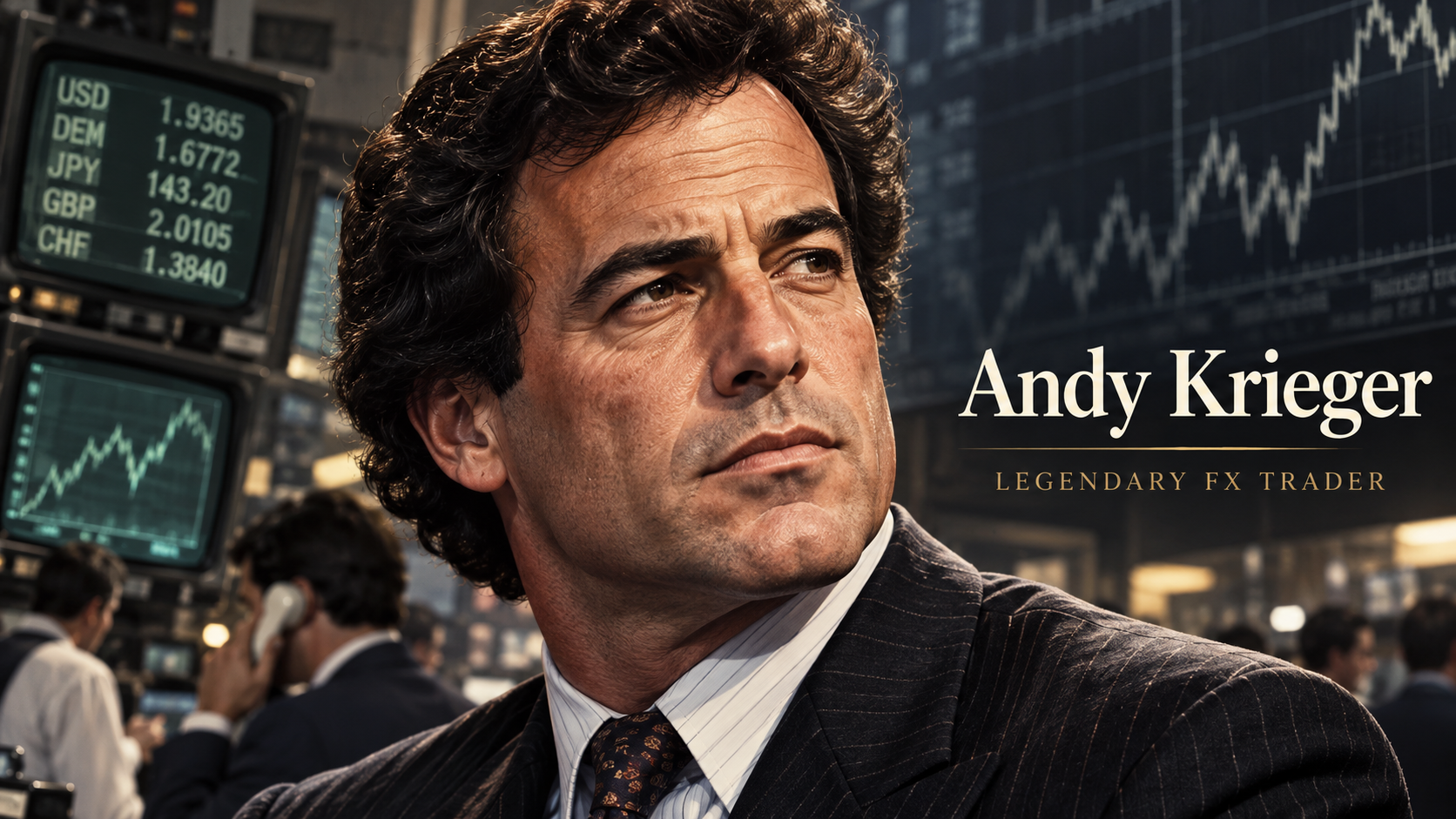
A currency trader credited with about $300 million in a single year, Andy Krieger became a Wall Street legend. His fame rests on a kiwi trade that the record only partly supports.
On 20 January 1988, Bankers Trust announced that its currency traders had earned $593 million in 1987. Later that day, the bank’s financial control team finished valuing the options portfolio of Andy Krieger, the trader credited with much of that profit. The team cut its value by $80 million.
That gap frames the Andy Krieger trading strategy. Krieger headed currency options trading at Bankers Trust in the 1980s. He built positions so large that they made him famous. They also made his profits hard to pin down.
So how much of the Krieger legend survives verification? A few facts are well documented. Several of the most repeated claims rest on far less.
A Desk With Unusual Freedom
Krieger’s path was unusual. A March 1988 Wall Street Journal report said he had been studying Sanskrit in graduate school only four years earlier. By 1986, according to The Times, he was global head of currency options trading at Bankers Trust.
The bank gave him room to take risk. A description of his 1992 NPR Fresh Air interview says he had a $700 million trading limit, against about $50 million for typical individual traders. The Times later reported that his desk’s profits grew from $56 million to $512 million in a year.
His best-known episode followed the October 1987 stock market crash. Krieger sold New Zealand dollars short in enormous size. The Economist later wrote that he sold more kiwis than New Zealand’s entire money supply. The magazine did not define the money measure, and the dates and structure of the trade are not documented.
Krieger received $3 million in salary and bonus for 1987, according to the Journal and Fortune. Fortune reported that he thought the sum was too small. He told the magazine he was also tired of 120-hour weeks
. He left in February 1988.
Soros Fund Management hired him as a senior portfolio manager that April. By June he had quit and announced his own firm. No verified account explains what Krieger learned from these events. The record shows a trader who took size, felt underpaid and moved on.
“What keeps me at the screen is the most challenging match I’ve ever played.” Andy Krieger, on his website
How Andy Krieger Actually Made Money
Krieger tried to profit from large currency mispricings by taking oversized positions, often through options. Fortune confirms his portfolio held both puts and calls. The strikes, expiry dates, hedges and stop-losses have never been publicly documented.
Later profiles describe the kiwi thesis this way: the New Zealand dollar had become overvalued as investors shifted money after the crash. Krieger’s own explanation does not appear in the sources reviewed. Based on the documented limit, his edge appears to have been scale combined with options expertise. Bankers Trust’s balance sheet let him hold positions most traders could not.
Options also made valuation a central risk. A large book of puts and calls has no single obvious price. As Bankers Trust learned, a trader’s marks and an independent review can differ by tens of millions of dollars.
Krieger’s own funds later moved toward systematic and arbitrage strategies. Those results appear below.
Krieger’s Risk Rules: What the Record Supports
Krieger never published a rulebook. The patterns below come from documented behavior. No stop-loss method, sizing formula or drawdown rule has been publicly verified.
| Principle | Market Logic | Modern Relevance |
|---|---|---|
| Concentrate on a few high-conviction currency views | Large positions pay most when a currency is badly mispriced. They also magnify mistakes. | Harder today. Deeper markets and tighter limits reduce the room for oversized bets. |
| Use options to shape the payoff | Options can limit the cost of being wrong. His book held both puts and calls, so its net risk is unknown. | FX options are widely quoted now. His actual structures remain unknown. |
| Work inside institutional limits | A $700 million limit, set by the bank, allowed far larger positions than typical traders held. | Retail and prop traders cannot replicate this capital. |
| Accept independent valuation | Bankers Trust checked desk marks with a separate control team, which found an $80 million difference. | Highly relevant. Verify prices from a second source. |
| Close strategies that stop working | Krieger shut three Northbridge funds in 2006 after losses. | Still relevant. Hanging on to a failed system is costly. |
Two nuances matter. The $700 million limit was the bank’s decision, not Krieger’s personal risk rule. And options do not guarantee safety. Owning them can cap what a position costs, but a book containing both puts and calls can still lose heavily.
The Day the Profits Were Marked Down
The bank’s January 1988 release put 1987 foreign exchange income at $593 million, including $338 million in the fourth quarter. That income helped Bankers Trust absorb a $700 million addition to loan reserves. The bank still reported a $1.2 million profit for the year.
Then the independent valuation arrived. It put Krieger’s options book $80 million lower, cutting foreign exchange income to $513 million. A public correction would have produced a loss for the year, Fortune reported, the bank’s first since the 1930s.
Management chose another route. It cut 1987 compensation expense by $80 million, from $862 million to $782 million, which left profit unchanged. The March 1988 annual report and 10-K still showed the original foreign exchange figure. The Federal Reserve then refused to accept the incorrect number in a regulatory filing. On 20 July 1988, the bank announced it would amend both documents.
Fortune stressed that Krieger had not been publicly accused of wrongdoing. The restatement was a decision by bank management and its auditors. The episode still exposes the risk beneath a large options book: reported profit depends on valuation. Reports do not make clear whether the $300 million credited to Krieger already reflects the $80 million markdown.
What the Record Actually Shows
Reliable evidence shows that Krieger ran a very large currency options book at Bankers Trust and was credited with about $300 million of 1987 profit. It does not support the most dramatic versions of the kiwi story.
- Bankers Trust first reported $593 million in 1987 foreign exchange income, then cut it by $80 million.
- The Wall Street Journal credited Krieger with about $300 million of that income and a $3 million pay package.
- He left Bankers Trust in February 1988, joined Soros in April and had quit by June.
- His trading limit was reported at $700 million.
- The profit from the kiwi trade alone. The popular version, $300 million in a few hours, has no identifiable source.
- The frequently cited 5% drop in the kiwi. No price data supports it in the sources reviewed.
- Reports that New Zealand’s central bank complained to Bankers Trust. The story is widely repeated, but no primary record appears to confirm it.
- Claims of 400-to-1 leverage, which come from a single unsourced profile.
- His long-term returns. No audited track record appears to be publicly available.
| Metric | Result | Context |
|---|---|---|
| Bankers Trust FX income, 1987 | $593 million first reported; $513 million after restatement | Bank-wide figure, not Krieger alone. Source: Fortune. |
| Profit credited to Krieger, 1987 | About $300 million | Wall Street Journal, March 1988. Unclear whether it reflects the markdown. |
| Krieger’s pay, 1987 | $3 million, salary and bonus | Reported consistently by the Journal, Fortune and Institutional Investor. |
| Northbridge peak assets, Dec. 2004 | About $300 million in Sigma and Sigma 3X | NorthStar held $53 million. The report’s wording leaves unclear whether that is included. |
| Northbridge returns, Jan.–Sept. 2005 | Sigma down over 10%; Sigma 3X down 32%; NorthStar down 7.2% | Barclay Group data via Alternative Investment News. Gross or net not stated. |
The rows measure different things. Bank profit, personal credit, pay and fund assets are not interchangeable.
Where Krieger’s Approach Broke
The documented weaknesses were valuation risk and, later, a fund business that did not repeat the Bankers Trust results.
Northbridge Capital Management, Krieger’s Edgewater, New Jersey, firm, ran Sigma, a three-times levered version called Sigma 3X, and NorthStar. NorthStar was a statistical arbitrage fund launched in May 2002. Assets peaked near $300 million in December 2004. By September 2005, the firm held only $13.1 million, according to the Barclay Group.
The levered fund lost the most, a reminder that leverage cuts both ways. In January 2006, Krieger told Alternative Investment News he was closing all three funds. He said Sigma and NorthStar had been attempts to computerize strategies directed by managing director Ron DiRusso. He put their 2005 losses at roughly 8% to 9%.
DiRusso disagreed. He said the system was profitable overall, with gains of about 3% in 2003 and 6% in 2004. Those figures are his own recollection. A replacement fund, Northbridge Partners, was to pursue relative-value and volatility arbitrage with $40 million of proprietary capital. Its results are not documented in the sources reviewed.
In today’s market structure, a kiwi-style trade would probably be harder to repeat. Currency markets are deeper and more electronic. Information travels faster, and banks enforce tighter limits. That is modern analysis, not a documented failure.
Can Andy Krieger’s Trading Strategy Still Work Today?
Parts of it can. The discipline around valuation transfers easily. The size and balance-sheet backing do not.
| Principle | Still Relevant? | Modern Difficulty |
|---|---|---|
| Independent valuation of positions | Yes — timeless | Low. Any trader can check marks against a second source. |
| Options for asymmetric exposure | Partly — adaptable | Moderate. His exact structures are unknown, so they cannot be copied. |
| Oversized bets after market shocks | Unlikely — institutional | High. It required a bank’s capital and a $700 million limit. |
| Short-term systematic FX and arbitrage | Doubtful — edge likely compressed | High. Krieger’s own Northbridge funds did not succeed. |
TraderVerified Verdict
Krieger showed what a bank-backed, options-driven currency desk could do. Bankers Trust credited him with about $300 million of 1987 profit, and the record supports a very large book.
The profit announced on 20 January 1988 did not survive that same day intact. That gap is the lesson. His headline number was large enough to make him famous, yet fragile enough that $80 million came off it within hours.
The exact kiwi profit, the price move and the central bank’s reaction remain unproven. No audited long-term record appears to be publicly available, and his later funds lost money. Modern traders should keep the habit of independent valuation. They should not copy the size, the leverage or the belief that one famous trade defines a method.