

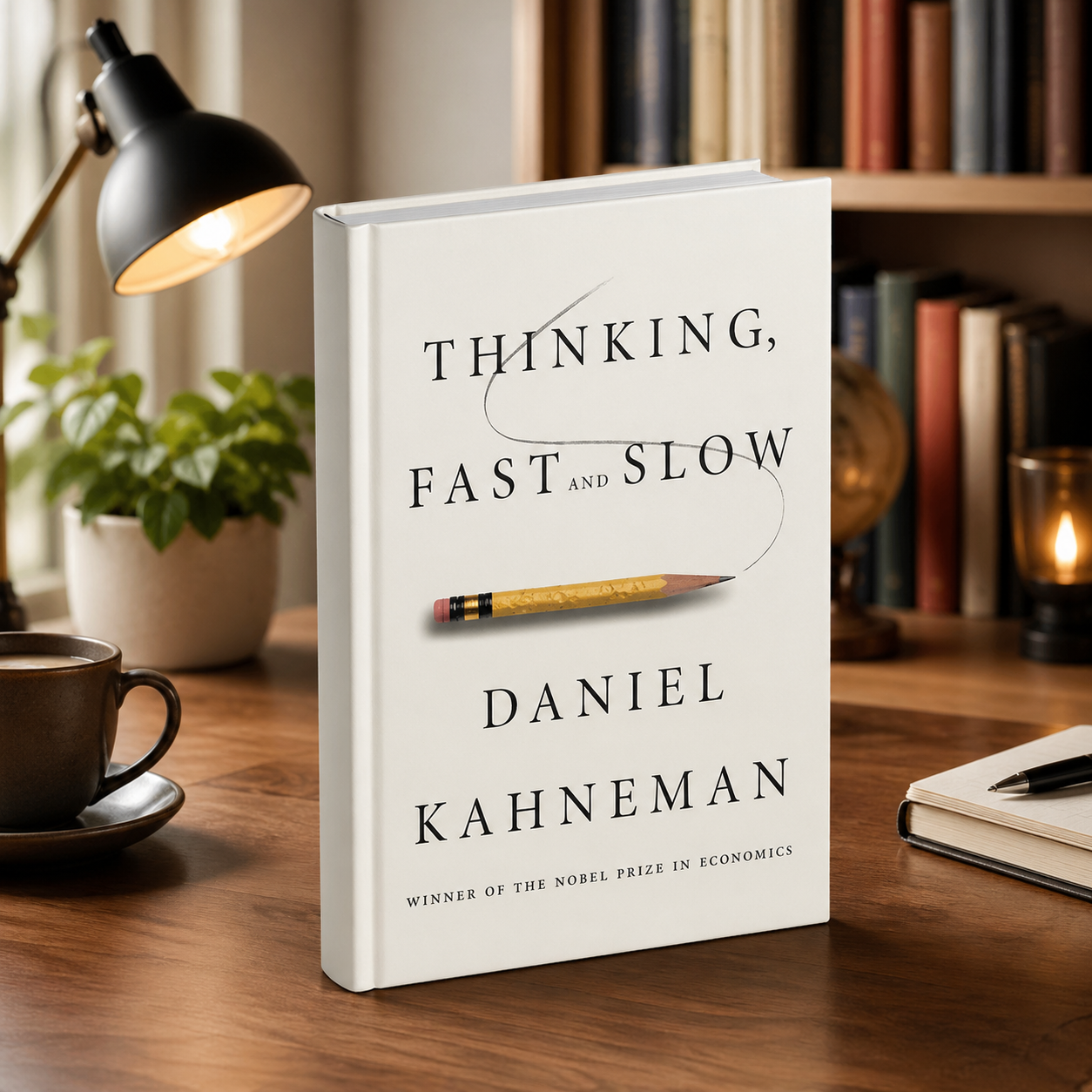
Thinking Fast and Slow investing reveals why your brain often leads to costly trading mistakes. Daniel Kahneman’s classic explains System 1 and System 2 thinking, loss aversion, and overconfidence in plain language. Gain clearer decision-making and avoid common emotional traps that hurt returns. See how this timeless book can improve your investing habits.
“Thinking, Fast and Slow” by Daniel Kahneman is one of those rare books that can quietly change how you see the world—especially if you put money into stocks, funds, or any kind of trading. Published in 2011, it distills decades of groundbreaking work by the Nobel Prize-winning psychologist (who passed away in 2024) and his longtime collaborator Amos Tversky. At its heart, the book explains why our minds often lead us astray when we make decisions under uncertainty. For investors and traders, that uncertainty is everyday life: market swings, hot tips, fear of missing out, or the temptation to hold a losing position “just a little longer.”
Kahneman shows that we are not the coolly rational calculators that traditional economics assumes. Instead, our thinking comes from two systems that often clash. This insight matters today more than ever. Social media, 24-hour news, and apps that let us trade with a tap have made impulsive decisions easier than ever. Understanding the hidden forces behind our choices can help ordinary people avoid costly mistakes and build steadier habits with their money.
Core Ideas
Kahneman builds his argument step by step, like laying out pieces of a puzzle until the full picture snaps into place.
First comes the central framework: System 1 and System 2. System 1 is the fast thinker—automatic, intuitive, and emotional. It jumps to conclusions, spots patterns (even fake ones), and runs on mental shortcuts called heuristics. Think of it as the part of your brain that instantly feels a stock is “due for a bounce” after a bad day or panics when the market drops 5%. It feels effortless and usually works well for simple, familiar tasks, like recognizing a friend’s face.
System 2 is the slow thinker—deliberate, logical, and effortful. It handles complex calculations, weighs evidence, and checks System 1’s quick guesses. The catch? System 2 is lazy. It tires easily and often lets System 1 take the wheel, especially when we’re stressed, distracted, or overconfident. Kahneman shows through clever experiments how this handover creates predictable errors.
From there, he explores the many ways these systems trip us up. One big idea is loss aversion: we feel the pain of losing money about twice as strongly as the pleasure of gaining the same amount. This explains why many investors sell winning stocks too soon (to lock in the good feeling) but cling to losers (hoping to avoid the sting of realizing a loss). Another is overconfidence. We tend to think our judgments are more accurate than they really are, especially after a few lucky wins in the market. Kahneman calls this the “illusion of skill”—the sense that picking stocks is like playing chess when it often resembles rolling dice over the long run.
He also covers anchoring (being overly influenced by the first number you see, like a stock’s recent high price), the availability bias (judging risk by how easily examples come to mind, such as remembering big market crashes), and the endowment effect (overvaluing what we already own simply because it’s ours). These aren’t random flaws. They are built-in features of how our minds evolved to handle everyday survival, not the complex probabilities of modern investing.
Kahneman ties it together with prospect theory, the work that earned him the Nobel in economics. It shows that people do not evaluate gains and losses in absolute terms but relative to a reference point—and they treat probabilities in curved, not straight, ways. The result? Decisions that look irrational on paper but feel perfectly natural in the moment.
Strengths
The book’s greatest strength is its clarity. Kahneman writes like a wise teacher guiding you through a garden of ideas, pointing out the interesting plants without overwhelming you. He uses simple experiments—many involving nothing more than imagining two people or choosing between bets—to reveal deep truths. No heavy math is required; the stories and examples do the heavy lifting.
The relevance to everyday life, and especially money, feels immediate. You finish a chapter and suddenly recognize your own behavior in past trades: that time you bought a “hot” stock because everyone was talking about it (availability bias at work), or refused to sell a declining position because you didn’t want to admit the mistake (loss aversion plus overconfidence).
The depth is impressive too. Kahneman doesn’t just list biases; he explains where they come from and why they persist. This builds trust. Readers walk away not with a list of rules but with a new mental model for spotting trouble before it strikes. For curious beginners, it’s like getting a user’s manual for your own brain.
Limitations
No book is perfect, and “Thinking, Fast and Slow” has honest limits worth noting.
Some of the specific studies Kahneman cites, especially on priming (where subtle cues unconsciously influence behavior), have faced a replication crisis in psychology. Not all findings have held up as strongly as hoped when other researchers tried to repeat them. Kahneman himself acknowledged issues with parts of the field over the years. The core ideas—System 1 versus System 2, loss aversion, overconfidence—remain robust and widely confirmed, but readers should treat the book as a strong starting point rather than gospel on every detail.
The book is long—nearly 500 pages—and some sections feel denser than others. Beginners might find the middle chapters heavy going if they try to read straight through without pauses. It also focuses more on describing problems than prescribing detailed fixes, though the awareness it creates is itself a powerful tool. Finally, while timeless in its psychology, the investing examples reflect the era before widespread retail trading apps and meme stocks; today’s faster, more emotional markets only make the lessons more urgent, not less.
Trader’s Takeaway
For a retail trader or beginner investor, the practical payoff is huge—if you let it sink in and change your habits.
When the market jumps on news, your System 1 wants to react instantly. Kahneman teaches you to pause and ask: Am I letting a quick gut feeling (or the crowd’s excitement) override careful thought? Slow down. Check the fundamentals or your pre-set rules instead of chasing the headline.
Loss aversion can push you to take too little risk overall or to avoid selling losers. A useful counter: set stop-loss rules or rebalancing schedules in advance, when your calm System 2 is in charge, so emotion doesn’t hijack the decision later. Many successful investors use “if-then” plans: “If this stock drops 10%, I will review it against my original thesis, not my hope.”
Overconfidence shows up when you think you’ve spotted a sure thing after a winning streak. Kahneman’s research on the illusion of skill suggests humility pays: diversify, avoid concentrated bets based on “edge” that might just be luck, and remember that even pros struggle to beat simple index funds over time.
Anchoring might make you fixate on the price you paid for a stock rather than its current value. Try this mental trick: pretend you don’t own it and ask whether you’d buy it today at this price. Availability bias warns against over-weighting recent events—yes, the last crash felt terrifying, but markets have recovered before.
In short, the book doesn’t promise you can eliminate mistakes. It helps you catch more of them in time and design systems (checklists, rules, automatic investments) that rely less on willpower and more on structure. For beginners, starting with low-cost index funds or systematic plans can act as a helpful “System 2 in a box,” reducing the room for impulsive errors.
Who Should Read
This book suits anyone curious about why they (or the market) behave the way they do. New traders and casual investors will gain the most immediate value—it explains the emotional landmines before they step on them. Finance students and young professionals will appreciate how it bridges psychology and economics. Even experienced investors can benefit from the reminder that no amount of charts or data fully protects against human nature, including their own.
You don’t need a background in psychology or finance. If you’ve ever wondered why a “sure bet” went wrong or why panic selling feels so natural, the book speaks directly to you. It’s especially helpful for those who want to invest more calmly rather than chase quick wins.
Verdict
“Thinking, Fast and Slow” remains a landmark work that has shaped how millions understand decision-making. Its blend of rigorous research, engaging stories, and real-world insight earns it a place on any thoughtful investor’s shelf. While some details have aged with the replication crisis, the big lessons about our two thinking systems and common biases hold strong and directly improve financial choices.
For ordinary readers who want credible, non-jargon-filled wisdom that actually sticks, this is essential reading. It won’t make you rich overnight, but it can help you avoid the self-inflicted wounds that derail so many portfolios.
Rating: 9/10
It loses a point only for length and the need for readers to approach certain studies with modern caution. Otherwise, it delivers what every good book on money should: not just knowledge, but a clearer, kinder understanding of ourselves. Pick it up, read a chapter at a time, and notice how your next investment decision feels a little less automatic—and a little more deliberate.