

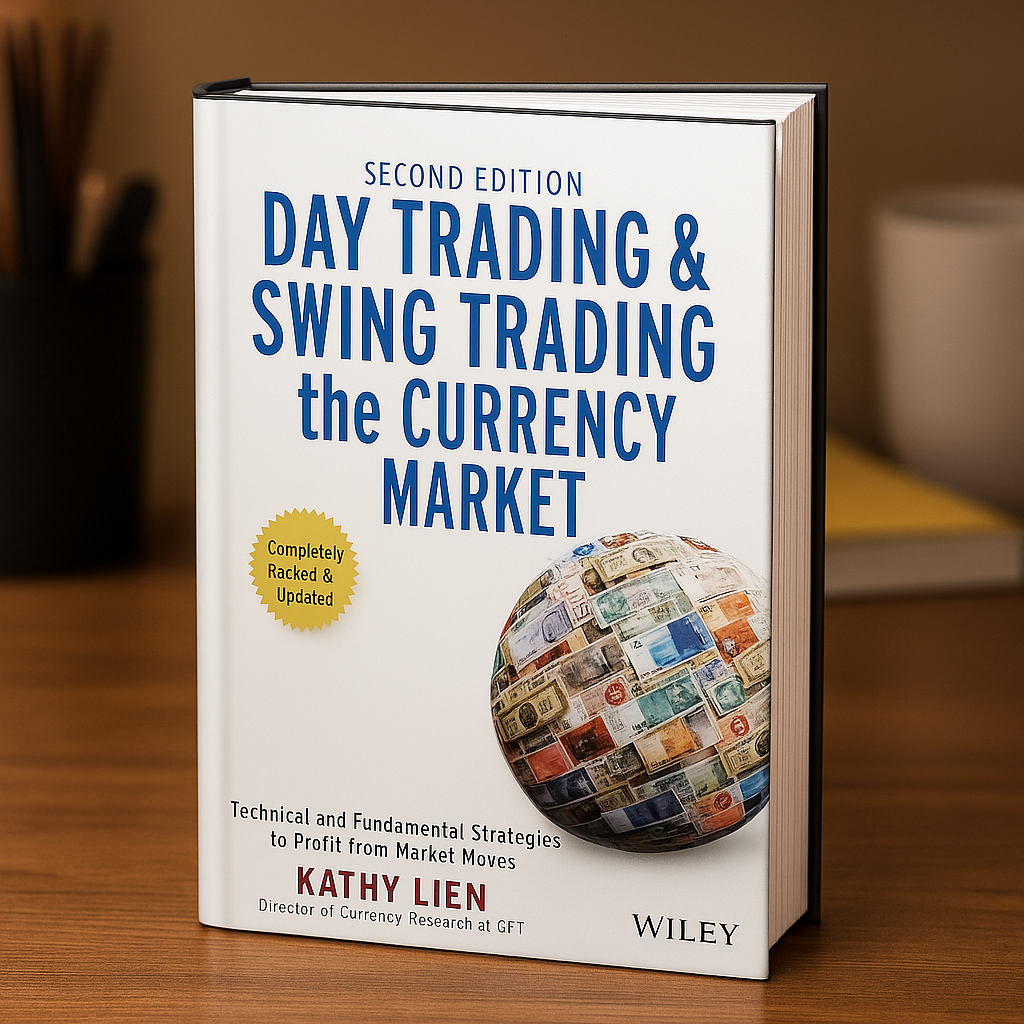
Day Trading and Swing Trading the Currency Market explains how forex really works, blending charts and economic news so retail traders can trade with rules, manage risk, and think like professionals; see how its disciplined, process-first framework can strengthen any active strategy.
Kathy Lien’s Day Trading and Swing Trading the Currency Market is a trading book with a simple promise: to show ordinary investors how the foreign exchange (forex) market really works, and how to trade it with rules rather than guesswork. It is not a hype-filled guide to “easy money.” Instead, it reads like a structured course. For people who see exchange rates moving on the news and wonder whether there is a disciplined way to trade those moves, this book matters. Currencies now affect almost every portfolio, whether through multinational stocks, global funds, or direct forex trading. Lien’s message is that you can approach this market like a professional if you are willing to think in systems, not in hunches.
Core Ideas
At the heart of the book is a clear idea: currencies move in patterns that reflect both human behavior and economic forces. Lien argues that you should not treat forex as a casino, even if many platforms make it look that way. Instead, she builds on two pillars. The first is technical analysis, which in plain terms means reading price charts. The second is fundamental analysis, which means understanding the economic stories behind those prices. She does not ask the reader to become an economist or a quant. She asks them to learn to recognize a few key patterns and key data points, and then link them together.
On the technical side, Lien treats charts as the market’s “body language.” She introduces tools like moving averages, Bollinger Bands, and candlestick patterns as ways to see whether a market is trending or pausing. For a beginner, this is often the most intimidating part of trading. Here, the tone is calm and practical. A moving average is shown as a way to smooth the noise and define direction. Bollinger Bands are described as a way to judge whether price is stretched, like a rubber band pulled too far. Candlestick patterns highlight where buyers or sellers briefly took control. The book then turns these tools into trading setups for two styles: day trading (holding positions for minutes to hours) and swing trading (holding them for days). The logic is always the same: define where you enter, where you cut your loss, and where you take profit.
On the fundamental side, Lien reminds readers that currencies are not just symbols on a screen; they are claims on economies. A strong jobs report, a surprise rate hike from a central bank, or a sudden inflation print are not random events. They are reasons why a currency might jump or slide. The book walks through key economic indicators, interest-rate expectations, and central-bank behavior in language that a non-specialist can follow. You learn, for instance, why a currency with higher interest rates may attract capital, or why a “safe haven” currency can rise even when its domestic economy looks weak. The point is not to predict every release, but to know when the macro backdrop supports or contradicts what you see on the chart.
Strengths
One of the book’s main strengths is how it combines these two worlds. Lien does not present technical and fundamental analysis as rival camps. Instead, she shows how to use them together. A simple example: you may have a bullish macro view on the U.S. dollar after a strong run of data, but you wait for a pullback to a key moving average before entering. Or you might see a breakout on the chart, but you only trade it if it aligns with the latest central-bank tone. For a beginner, this integrated approach is valuable. It moves you away from trading every pattern you see and toward trading patterns that fit a bigger story.
The book is also strong on process and discipline. Trade examples include entry levels, stop-losses, and targets. This is more than a list of past “wins.” It is a training ground in thinking in probabilities. You are encouraged to ask, before any trade, “How much am I willing to lose?” rather than “How much can I make?” Lien compares risk management to wearing a life jacket when sailing. You may never fall overboard, but you wear it because the sea can turn fast. In markets, the “life jacket” is your position size and your stop-loss. This idea, simple as it is, is one that many casual traders ignore, and the book keeps returning to it.
The writing itself is another plus. The tone is professional but never cold. Complex ideas are explained with clear metaphors: market waves, tides, cycles. You can read a chapter in one sitting and come away with both a concept and a concrete rule you could test on a demo account. The material is serious enough for a finance student, but the language is plain enough for someone who has only used a brokerage app and watched a few financial news clips.
Limitations
Still, there are limits that a careful reader should note. First, forex is a fast-changing market. Technology, regulation, and liquidity conditions evolve. Any specific trading rule described in a book is a snapshot in time. What worked in one period may need adjustment in another. Lien’s systems should be seen as frameworks for testing, not as plug-and-play recipes. Second, the book, by design, focuses on active trading. If your main interest is long-term investing in funds or blue-chip stocks, much of the detail may feel too tactical. The risk, for some readers, is that the structured nature of the book can make trading look cleaner and more predictable than it is in real life.
Another limitation is one of perspective. The book takes for granted that active forex trading can be a suitable activity for a serious retail trader. It does warn about risk and leverage, but it cannot fully solve the deeper question of whether most individuals should be trading currencies at all. The leverage available in forex can magnify both gains and losses. A newcomer who reads the book as a green light, without self-knowledge or strict rules, may still run into trouble. The text provides brakes; it cannot force you to use them.
Trader’s Takeaway
For a retail trader or curious investor, the practical takeaway is straightforward. First, process beats prediction. You do not need to “know” where the euro or yen will be in a month. You need a method for acting when certain conditions appear, and a rule for when to exit if you are wrong. Second, risk management is not an add-on; it is the core product. Whether you trade currencies, stocks, or commodities, sizing positions and setting stops with care is what keeps you in the game. Third, combining macro awareness with chart-reading can improve timing and cut down on random trades. Even if you never touch a forex platform, these habits can improve how you think about market moves across asset classes.
Who Should Read
Who will gain the most from this book? It is well suited to beginners and intermediate traders who already understand basic concepts like bid-ask spreads and order types, and now want a serious, non-sensational guide to forex. Finance students and junior analysts can use it as a bridge between textbooks and trading screens. Curious investors who are not sure if they want to trade actively, but want to understand how currency traders think, will also find value. In contrast, a set-and-forget index investor will likely see this as interesting background, but not essential reading.
Verdict
Taken as a whole, Day Trading and Swing Trading the Currency Market succeeds on its main promise. It offers a systematic framework that emphasizes logic, structure, and discipline over gut feeling and thrill-seeking. It frames forex not as a late-night, high-leverage game, but as a professional arena where rules and risk control decide who survives. The book does not remove the dangers of trading, and its specific tactics must be updated and tested. Yet its core lessons—respect for risk, integration of fundamentals and technicals, and commitment to process—are timeless. On that basis, it deserves a place on the shelf of any reader serious about understanding active trading.
Verdict: 8.5 out of 10.