

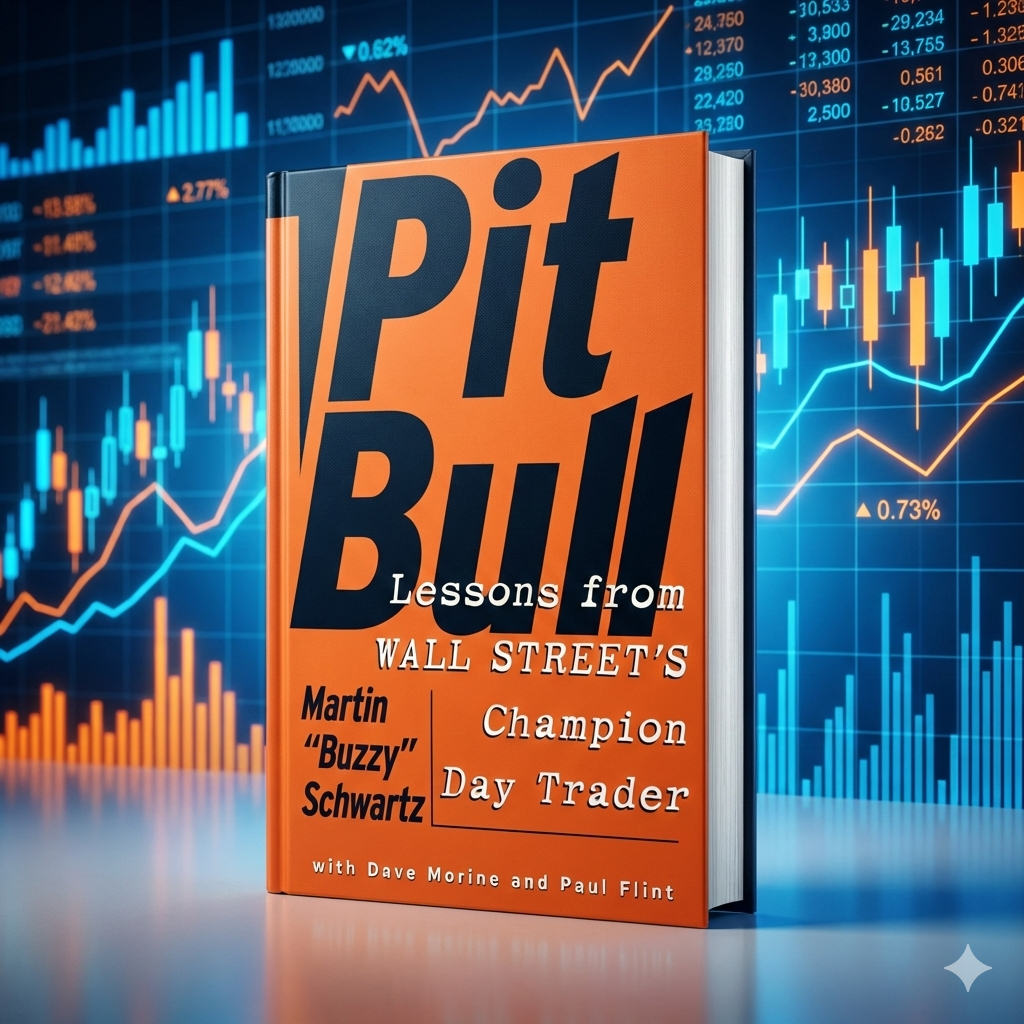
Pit Bull Marty Schwartz offers a gritty look at professional day trading. Learn to master market emotions and the ten-day moving average rule to protect your capital. See how here.
The world of investing often feels like a gated community. On one side, you have the “suits”—the analysts in mahogany offices using words like amortization and macroeconomic headwinds. On the other side, you have the “gamblers”—the people chasing the latest meme stock based on a gut feeling.
Rarely does a book come along that peels back the curtain and shows you how the game is actually won by those who do it for a living. Marty Schwartz’s Pit Bull: Lessons from Wall Street’s Champion Day Trader is that rare book. It is not a dry textbook or a get-rich-quick manual. Instead, it is a gritty, honest, and often funny account of how one man went from being a “loser” (his words) to one of the most successful traders in history.
Whether you are just starting your first brokerage account or you’ve been watching the markets for years, Pit Bull offers a masterclass in the one thing most investors lack: a professional mindset.
Core Ideas: The Strategy of a Champion
To understand Marty Schwartz, you first have to understand his transition. For years, Schwartz worked as a security analyst. He followed the traditional rules: he studied company balance sheets, listened to earnings calls, and tried to predict which companies were “good.” And for years, he barely broke even.
The central theme of Pit Bull is his “Great Pivot.” Schwartz realized that knowing a company’s value wasn’t the same as knowing where its stock price was going. He stopped trying to be right and started trying to make money. This led to several core insights that remain vital for any modern investor.
1. The Market is a Mirror of Human Emotion
Schwartz argues that stock prices don’t move based on math; they move based on people. People get greedy, and they get scared. If you can learn to read the charts that track these emotions—what pros call “technical analysis”—you can see the tracks the “big money” is leaving in the snow.
2. The “Red Light, Green Light” Rule
One of Schwartz’s most famous lessons is his use of the 10-day moving average. Think of this like the “speed limit” of a stock.
- Green Light: If the price is above the average of the last 10 days, the trend is up. It’s generally safe to buy.
- Red Light: If the price falls below that average, stop. The “weather” has changed, and you shouldn’t be outside without an umbrella.
3. Check Your Ego at the Door
Most investors lose money because they want to prove they are smart. They buy a stock, it goes down, and they hold onto it because they refuse to admit they were wrong. Schwartz’s rule is simple: the market is never wrong; only you are. If a trade isn’t working, kill it. It’s better to lose a little bit of money today than all of your money tomorrow.
Strengths: Why This Book Stands Out
What makes Pit Bull a classic isn’t just the trading advice; it’s the storytelling. Schwartz writes with a “war story” energy that makes the reader feel like they are sitting in the pits of the American Stock Exchange in the 1980s.
- Total Honesty: Schwartz doesn’t just talk about his wins. He talks about the times he lost millions, the times he cried in his office, and the physical toll the stress took on his health. This vulnerability is refreshing in a field often filled with “alpha” posturing.
- Actionable Tools: Unlike many memoirs that stay vague, Schwartz gives you his specific “checklist.” He explains exactly what he looked at before he placed a trade. This turns the book from a biography into a guidebook.
- Accessibility: You don’t need a finance degree to understand this book. Schwartz uses metaphors—comparing trading to a professional sport or a military campaign—that make complex ideas click instantly for a beginner.
Limitations: What to Watch For
While the wisdom in Pit Bull is timeless, the setting is not. Readers should keep a few things in mind while reading:
- The Technology Gap: This book was written in the late 1990s and covers the 1980s. There are references to “calling your broker” and “reading tape” that feel like ancient history in the age of iPhone apps and high-frequency trading bots.
- The Intensity Factor: Marty Schwartz is a “Pit Bull” for a reason. He worked 16-hour days and obsessed over the market to a degree that is unhealthy for most people. For a casual investor, his level of dedication is more of a warning than a roadmap.
- Survivorship Bias: It is important to remember that for every Marty Schwartz, there are thousands of people who tried his methods and failed. The book can sometimes make day trading look more like a “skill you can master” and less like the high-risk endeavor it truly is.
Trader’s Takeaway: Lessons for Your Portfolio
If you are a retail trader or a beginner, you don’t need to quit your job to benefit from this book. You can apply the “Pit Bull” philosophy to your own investing style right now.
First, prepare like a pro. Most people spend more time researching a new vacuum cleaner than they do a stock. Schwartz suggests that before you put a single dollar into the market, you should have a written plan. When will you buy? More importantly, at what price will you sell if you are wrong?
Second, use the 10-day rule. Even if you are a long-term investor, checking a stock’s moving average can prevent you from “catching a falling knife.” If a stock is in a freefall, don’t try to be a hero. Wait for the “weather” to clear.
Third, manage your “mental capital.” Schwartz explains that losing money is bad, but losing your confidence is worse. If you have a string of losses, walk away. Close the laptop. Go for a walk. The market will be there tomorrow, but your ability to make good decisions might not be if you’re frustrated.
Who Should Read This?
- The Curious Beginner: If you want to know what “the pros” actually do all day, this is the most entertaining way to find out.
- The Frustrated Investor: If you’ve been buying “good companies” only to see their prices drop, Schwartz will show you the “missing piece” of the puzzle.
- Students of Psychology: Anyone interested in how stress, ego, and discipline affect decision-making will find this a fascinating character study.
Verdict: The Final Word
Pit Bull is a masterpiece of financial literature. It manages to be both a high-octane thriller and a sober instructional manual. It strips away the jargon and replaces it with the raw reality of how money is made and lost.
Marty Schwartz doesn’t promise you a “system” that works every time. Instead, he offers something much more valuable: a mindset. He teaches you that to win in the market, you don’t have to be the smartest person in the room—you just have to be the most disciplined.
While the world of 1980s floor trading is gone, the human emotions of fear and greed that Schwartz mastered are exactly the same today. This book is a compass for anyone trying to navigate the stormy seas of the modern stock market.