

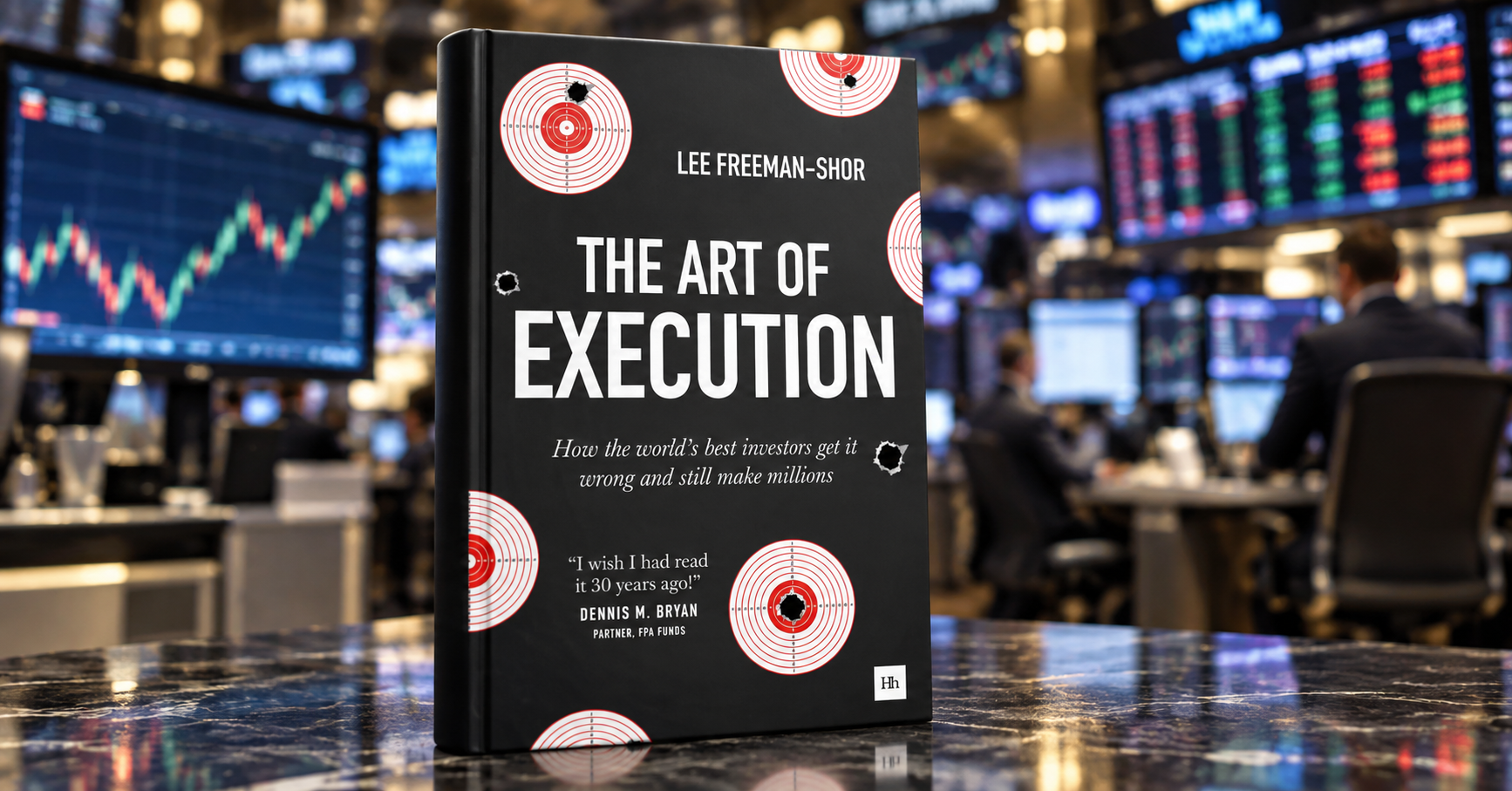
Essential reading on loss management: this is a book about what you do after you’re wrong, and it argues that exits, not entries, decide who keeps the money. Its most important finding is that the most successful tribe of professionals lost money on roughly six of every ten ideas and still won. Read it if you hold losers on hope; skip it if you expect a stock-picking system, because it doesn’t sell one.
Introduction
Freeman-Shor delivers the most useful finding in behavioral trading literature: how you exit decides who keeps the money, not how you pick. He didn’t backtest it. He watched 45 professional investors run real capital and recorded what they did when they were wrong.
The setup is clean. As a fund-of-funds manager at Old Mutual Global Investors, he gave each manager between $25 million and $150 million with one rule: hold only your ten best ideas. Most of those ideas lost money, and a coin toss would have out-picked the group.
The window ran from June 2006 to October 2013, which means the 2008 crash and the eurozone crisis sit inside the sample. That is a stress test no backtest can honestly replicate, and it is the book’s strongest credential.
The book is a 2015 product, which means no zero-commission apps, no meme-stock squeezes, and no fintech influencers screenshotting their P&L. The greed is identical. In a live trading environment, this is the book that names the thing you do at 2 a.m. when a position is down 22% and you open the chart “just to check.”
Key Takeaways
- Being wrong more often than right is survivable; having no rule for being wrong is not.
- The Assassins’ edge was mechanical: cut losers at a fixed 20-33% loss or after a fixed time, with no negotiation.
- The Hunters averaged down profitably, but only where the original thesis survived a fresh look, which is the opposite of doubling down on ego.
- The Raiders’ habit of banking gains early was the winning tribe’s mirror image, and it capped the upside that pays for every loser.
- The Connoisseurs had the worst hit rate and the best results: expectancy beats accuracy.
Overview
Part I covers losing positions and sorts investors into three tribes. The Rabbits froze and did nothing, holding losers through capital impairment. The Assassins sold, and the Hunters bought more.
Part II covers winning positions. The Raiders snatched profits, and the Connoisseurs let winners compound. Freeman-Shor’s data shows the Rabbits and Raiders as the unsuccessful tribes, and the other three as viable, depending on temperament.
The book also glances at the fund-house culture around these managers, meaning the pressure to justify positions to committees and clients. Case studies of specific trades carry the argument, and the tribe labels serve as memory hooks rather than a formal model.
Writing & Structure
Prose Style
The writing is plain, brisk, and short on ego, which is rare in a genre stuffed with memoirists in love with their own genius. Freeman-Shor writes like an allocator, not a hero.
The tribe names are hokey, and a Bloomberg editor would have cut the animal metaphors. They also work, because you will remember “Rabbit” at the exact moment you’re freezing.
Research Depth
Live-capital observation is worth ten backtests, and the seven-year window earns the book its authority. The weakness is that the tribes are classified from outcome data, so the categories carry hindsight. A manager who averaged down and was right becomes a Hunter; one who averaged down and died gets filed elsewhere.
Narrative Structure
The losing-then-winning structure is tidy and pedagogically sound. The case-study rhythm gets repetitive by the fourth or fifth tribe, but the book is short enough that repetition never becomes a tax.
The Trader’s Lens
Central Financial Concepts
- Stop-loss discipline: a predefined exit level or holding period that removes discretion at the point where discretion is most corrupted.
- Averaging down (Hunters): adding to a loser to lower cost basis. It is a form of position-sizing risk, not a recovery method.
- Hit rate versus payoff ratio: expectancy is win rate times average win minus loss rate times average loss. A 40% win rate breaks even only if average wins exceed average losses by 1.5 times.
- Disposition effect: the documented tendency to sell winners early and hold losers, which is the Raider-Rabbit combination.
Lessons for Traders
- Pre-commit your exit before you enter. The Assassins made the decision when they were calm, not when they were bleeding.
- Averaging down is only defensible after re-underwriting the thesis. Long-Term Capital Management (1998) is the historic warning: the trade was “right” until leverage made being early fatal.
- Protect the right tail. A winner sold at +15% funds nothing when your losers cost 30%.
- Size positions so a stop-out is survivable. Concentration is only tolerable with an exit rule.
Accuracy vs. Narrative Spin
The financial mechanics are correct, but the framing has three problems. First, the sample: concentrated, unleveraged equity portfolios of professionals, with no control group. Freeman-Shor also has a career riding this dataset, including a sequel, so his incentive to present the tribes as clean, actionable categories is not zero.
Second, gaps. A 20-33% stop assumes you can exit near your level, and in a 2008-style tape, single stocks gap straight through stops. In a live trading environment, I’ve watched “stops” fill at prices the trader would call theft, which is why a stop is a decision rule, not a guarantee.
Third, leverage. A 25% stop at 20:1 on an FX pair or CFD doesn’t exist; your margin call arrives at roughly 5%. The behavioral lesson survives translation, but every number in the book needs rescaling before it touches a leveraged account.
Psychology & Culture
The Rabbit is a portrait of identity-based decision-making. The position isn’t a bet anymore; it’s a claim about your judgment, and selling would mean retracting the claim in public. The rationalization chain is predictable: “the thesis is intact,” then “the market is wrong,” then “it’s a long-term hold.”
Freeman-Shor points to the narrative fallacy, the pull of the crowd, and self-attribution (“not my fault”) as the fuel. In a live trading environment, this rings true: nobody holds a loser because of the math, they hold it because the story is still flattering.
The fund-house culture makes it worse. When a firm rewards conviction and punishes reversals, the rational move, taking the small loss, becomes the career-risking move. Institutions manufacture Rabbits.
Trader Insight
Professionals with decades of experience and institutional resources behaved exactly like retail traders when their best idea went red. The book’s most unsettling finding is that skill at picking did nothing to protect them from the reflex to hold and explain.
Reader Fit
- Retail traders: Essential, but rescale the thresholds. If you trade FX or CFDs on leverage, the 20-33% stop is a fantasy, and the book won’t tell you that.
- Finance and economics students: A vivid, memorable companion to prospect theory and the disposition effect. It is not academically rigorous, so don’t cite it as evidence.
- Wall Street insiders: Useful as a mirror for your own process. You’ll know most of it, and you won’t like how much of it is about you.
- General readers: Skippable unless you own stocks. Without a portfolio at risk, the tribes are trivia.
Verdict
Final Score: 8/10
Composite Score
| Category | Score (/10) | Weight | Weighted | Bar |
|---|---|---|---|---|
| Financial Accuracy | 8 | 20% | 1.60 | |
| Writing & Clarity | 7 | 15% | 1.05 | |
| Trader Psychology | 9 | 25% | 2.25 | |
| Educational Value | 8 | 20% | 1.60 | |
| Lasting Relevance | 8 | 20% | 1.60 | |
| Total | 100% | 8.10 |